

Spray Paint Pressure | Water-Based vs. Solvent-Based Paint
Does Paint Type Affect Spray Paint Pressure?
Yes. The type of coating influences the equipment configuration and operating conditions required for effective spraying. Spray paint pressure must be selected according to the coating’s viscosity, formulation, spray technology, nozzle configuration, and manufacturer recommendations.
Water-based and solvent-based coatings can differ in flow behavior, surface tension, drying characteristics, and compatibility requirements. These differences may affect atomization, material delivery, and the final coating appearance.
However, water-based paint does not automatically require lower pressure, and solvent-based paint does not automatically require higher pressure. The appropriate settings depend on the specific formulation and spray equipment.
For industrial manufacturers, understanding these differences helps prevent equipment incompatibility, inconsistent application, and unnecessary material waste.
1. Understanding Water-Based Coating Requirements
Water-based coatings use water as a major liquid carrier, although their complete formulations may contain other ingredients. They are used in various industrial applications, depending on the coating’s performance requirements and substrate.
When selecting spray paint pressure settings for water-based materials, consider the following factors.
Viscosity and preparation: The coating must be prepared according to the manufacturer’s instructions. Changes in temperature, mixing, or permitted dilution can affect flow behavior.
Surface tension: Droplet formation and wetting behavior influence how the coating spreads across the target surface.
Drying conditions: Temperature, humidity, and airflow can affect water evaporation and film formation. Pressure alone cannot correct unsuitable drying conditions.
Equipment compatibility: Hoses, seals, pumps, tanks, and spray components must be suitable for the coating formulation.
Before changing pressure, confirm that the selected spray gun and fluid supply system are approved for the material.
2. Understanding Solvent-Based Coating Requirements
Solvent-based coatings use organic solvents as carriers or formulation components. Their properties vary considerably depending on the resin, solvent blend, pigments, and intended application.
Several considerations are important when setting up a solvent-based spray system.
Material flow: The coating’s viscosity and solvent composition influence how it moves through the delivery line and spray nozzle.
Evaporation behavior: Solvent evaporation affects film formation, leveling, and the time available for the coating to flow across the surface.
Chemical compatibility: Seals, hoses, tank linings, and wetted components must be compatible with the specific solvents used.
Workplace controls: Ventilation, ignition-source control, and suitable electrical equipment may be required depending on the coating’s hazards.
The correct spray pressure should be established using the coating manufacturer’s technical data and the spray equipment specifications, rather than assuming that all solvent-based products behave alike.
3. Comparing Spray Paint Pressure Requirements
Water-based and solvent-based coatings do not have one universal pressure requirement. The following comparison highlights the main factors that influence setup decisions.
| Factor | Water-Based Coatings | Solvent-Based Coatings |
|---|---|---|
| Material flow | Depends on formulation, viscosity, and temperature | Depends on formulation, viscosity, and solvent composition |
| Drying behavior | Influenced by water evaporation and environmental conditions | Influenced by solvent evaporation and formulation |
| Equipment compatibility | Verify compatibility with the complete coating system | Check solvent resistance of seals, hoses, and wetted components |
| Pressure selection | Follow coating and spray equipment specifications | Follow coating and spray equipment specifications |
| Maintenance | Remove residue before it dries, following approved procedures | Use cleaning materials approved for the coating and equipment |
| Workplace controls | Follow product safety and handling instructions | Assess ventilation, flammability, and exposure controls |
The key principle is to select pressure settings for the actual material and application method, not simply for the broad category of paint.
4. How to Establish Suitable Spray Paint Pressure Settings
A controlled setup process helps determine whether the selected coating, spray equipment, and pressure settings work together.
Step 1: Review the coating documentation. Check the recommended application method, viscosity range, preparation instructions, and environmental conditions.
Step 2: Confirm equipment compatibility. Verify that the spray gun, pressure tank or pump, hoses, seals, and fittings are suitable for the coating.
Step 3: Identify the relevant pressure settings. Separate atomizing air pressure from fluid delivery pressure where the equipment uses both.
Step 4: Begin within the specified operating range. Use the manufacturer’s recommended setup rather than selecting an arbitrary pressure.
Step 5: Conduct a test application. Evaluate spray pattern, coverage, wet-film behavior, and visible surface defects on a representative test panel.
Step 6: Adjust one parameter at a time. Change pressure, material preparation, or another relevant setting systematically and observe the result.
Step 7: Record the approved configuration. Document the coating product, equipment setup, pressure settings, and test conditions for repeatable production.
If the coating remains difficult to atomize or deliver, investigate whether the equipment is appropriate before increasing pressure.
5. Selecting a Paint Pressure Tank for Different Coatings
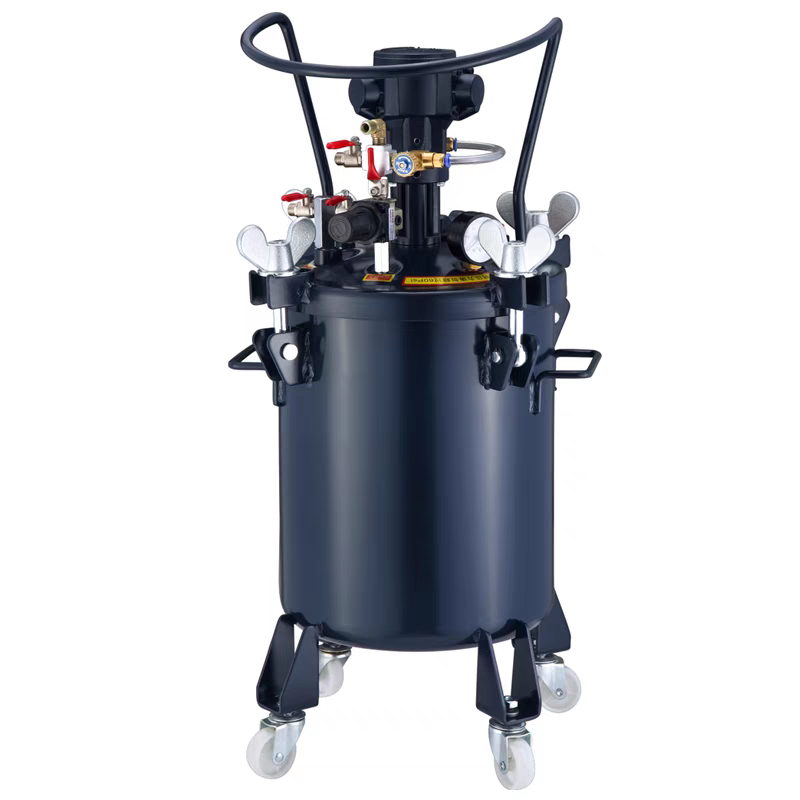
A paint pressure tank, also called a pressure pot, supplies compatible coating material under controlled pressure. It may be useful for industrial operations requiring a continuous material supply or fewer interruptions for refilling.
When evaluating a tank for water-based or solvent-based coatings, consider:
- Chemical compatibility: Verify the tank, seals, fittings, and fluid passages against the exact coating formulation.
- Operating pressure: Confirm that the tank and all connected components meet the required specifications.
- Material capacity: Match tank volume to expected consumption and production cycles.
- Fluid delivery: Check that the tank and outlet arrangement can supply the required material flow.
- Cleaning requirements: Consider how easily coating residue can be removed during changeovers.
- Safety features: Confirm that required pressure gauges, regulators, and pressure relief devices are suitable for the application.
A pressure tank controls material supply; it does not independently determine atomization quality. The tank, spray gun, and air supply must be configured as a compatible system.
Never exceed the rated pressure of the tank or its connected components.
6. Preventing Problems During Paint Changeovers
Switching between water-based and solvent-based coatings requires careful attention to material compatibility and cleaning procedures.
Do not assume that residual material from one coating can safely mix with another. Incompatible formulations may cause coagulation, contamination, poor coating performance, or blockages.
Before changing materials:
- Follow the equipment manufacturer’s approved shutdown and depressurization procedure.
- Use cleaning agents compatible with the coating and equipment.
- Remove residue from the relevant fluid passages and components.
- Inspect seals and connections for deterioration.
- Reconfigure the system according to the next coating’s specifications.
- Test the new setup before returning to production.
Never open a pressurized tank or disconnect a pressurized hose. Follow the manufacturer’s safety procedures throughout cleaning and maintenance.
Frequently Asked Questions
Does water-based paint require lower spray paint pressure?
Not necessarily. The appropriate pressure depends on the formulation, spray technology, nozzle, and equipment specifications.
Can the same pressure tank be used for both coating types?
Only when the tank, seals, fittings, and associated components are compatible with both materials and the intended operating conditions.
Why does the same pressure produce different spray results with different paints?
Different formulations can have different viscosity, surface tension, evaporation behavior, and atomization characteristics. Pressure is only one factor affecting spray performance.
What should I check before switching coating materials?
Review chemical compatibility, cleaning procedures, equipment condition, pressure settings, and the application instructions for the new coating.
How do I choose the right pressure tank for industrial paint spraying?
Consider material compatibility, rated pressure, required capacity, flow requirements, cleaning access, and compatibility with the spray gun and delivery system.
Find the Right Spray Paint Pressure Solution
Choosing suitable spray paint pressure for water-based and solvent-based coatings requires an understanding of the material, application method, and equipment limitations.
For industrial users, a properly matched spray gun, pressure tank, and fluid delivery system can support consistent material application and repeatable production results.
Contact an industrial paint pressure tank or spray equipment supplier to discuss your coating formulation, material flow requirements, equipment compatibility, and operating conditions.