

Pressure Pot vs Pressure Tank | What Buyers Need to Know
A pressure pot and a pressure tank are both enclosed vessels that hold fluid under gas pressure, but they usually serve different roles. A pressure pot is generally a working vessel that feeds a coating, adhesive, or other fluid to a spray gun, dispenser, or valve during production. A pressure tank is often a supply or buffer vessel within a fluid system, and the term is used loosely across industries. The correct choice depends on what the vessel must do in the process, not on the name used by the supplier.
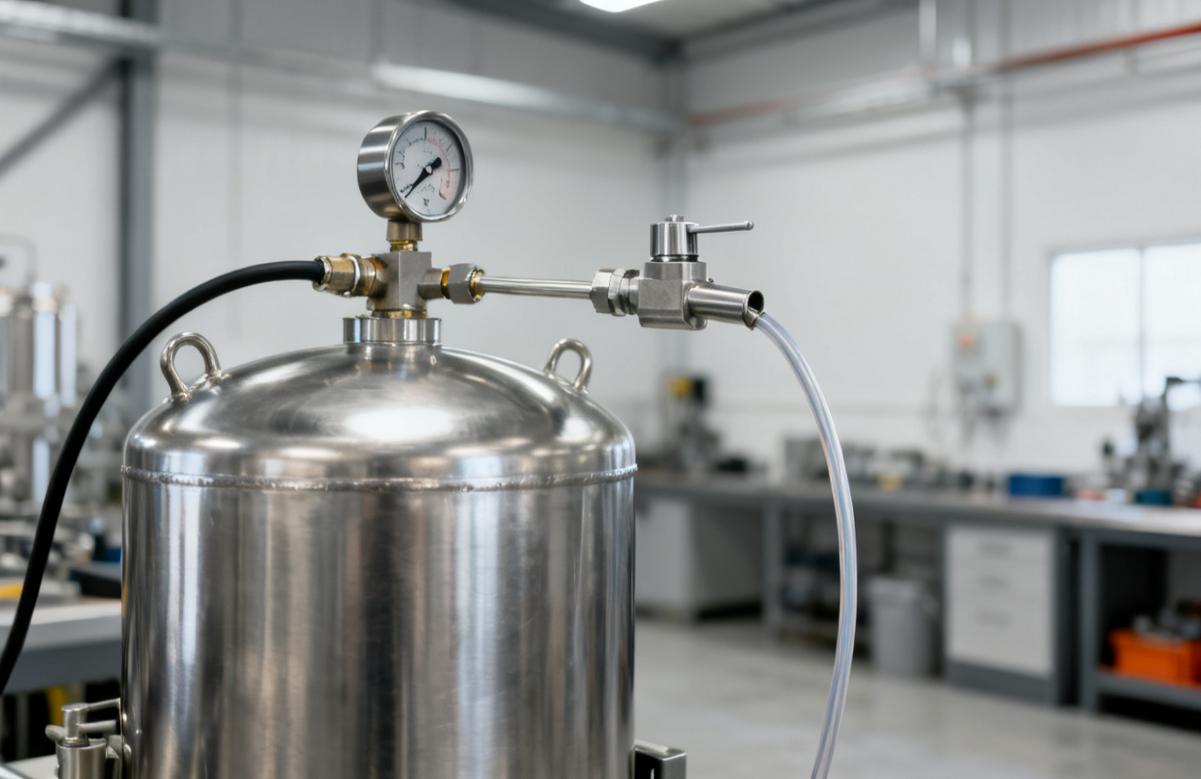
Why the terminology causes confusion
In coating and adhesive work, “pressure pot” commonly describes a vessel that holds material, receives regulated compressed air, and pushes the fluid toward the point of use. In other contexts, “pressure tank” may describe a reservoir in a pumping system, a buffer tank, or a vessel stored under pressure for other reasons. Because terminology varies by region and industry, buyers should describe the function they need rather than rely on the label alone.
Two vessels of similar shape can differ significantly in wetted materials, lid closure method, outlet arrangement, regulator configuration, and how they are intended to be operated. The nameplate and manufacturer documentation are the authority; the product name on a website or quotation is not.
How a pressure pot works in a dispensing line
A typical pressure pot is filled with fluid, sealed, and pressurized with regulated air. The air pressure acts on the fluid surface and forces material through an outlet line toward a spray gun, dispense valve, or applicator. The operator sets the air pressure to suit the fluid and the desired flow, and a dispenser or valve — where fitted — controls when material is released.
This arrangement is common where a steady supply of coating or adhesive is needed and where the fluid can be pushed from the vessel under pressure. The pot itself does not meter or shut off material; those functions belong to the downstream valve, gun, or pump. Buyers should keep that division of responsibility clear when comparing quotations.
Typical use cases
- Supplying paint or coating to spray equipment in a workshop
- Feeding adhesive or sealant to a manual or automated dispenser
- Holding a batch of material that must be delivered to one or more application points
Where a pressure tank fits instead
In a broader fluid supply system, a pressure tank may act as a reservoir, a buffer, or a supply vessel within a pumping or circulation arrangement. It may be selected for its connection to pumps, its role in maintaining supply, or its placement in a system rather than for direct hand-held dispensing. The important question is whether the vessel is intended to hold fluid under pressure and deliver it to a dispensing device, or whether it performs a different system function.
If the aim is to push adhesive or paint to a valve or gun, a pressure pot configuration is usually the more direct comparison. If the vessel is part of a pumped circulation or supply system, the pump, piping, and control arrangement need to be assessed as a whole.
Comparison at a glance
| Factor | Pressure pot | Pressure tank (general supply role) |
|---|---|---|
| Primary role | Hold and push fluid to a dispensing point | Supply, buffer, or store fluid within a system |
| Typical downstream equipment | Spray gun, dispense valve, applicator | Pump, piping, or another system component |
| Key selection inputs | Fluid, pressure, capacity, outlet, controls | Fluid, system pressure, connections, duty |
| Main verification | Nameplate, regulator and safety documentation | Nameplate and system engineering documentation |
The table is a starting point only. Actual capabilities vary by model and application and must be confirmed in the datasheet.
Selection criteria that matter more than the label
Buyers should define the job before comparing models. Useful criteria include:
- Fluid characteristics: whether the material is a coating, adhesive, solvent, water-based product, or something else, and how it interacts with wetted parts
- Supply requirement: whether the vessel feeds a hand-held gun, an automated valve, or a system with several points of use
- Pressure and capacity: values are not universal; they vary by model and must be checked against the specific datasheet
- Closure and access: how the vessel is filled, cleaned, and inspected
- Downstream control: whether a valve, gun, or pump controls flow, since the vessel itself may not
- Installation conditions: available space, utilities, and work practice
What may make either option unsuitable
A pressure pot is not the right answer if the fluid cannot be reliably pushed by regulated air, if the process needs precise metering rather than supply pressure, or if the material must remain under agitation or temperature control that the vessel does not provide. A general pressure tank is not automatically suitable as a dispensing supply source unless the manufacturer’s documentation confirms that role.
Pressure-containing equipment must always be selected and operated according to the actual nameplate, manufacturer documentation, applicable local requirements, and qualified engineering review. No generic vessel should be assumed to be certified for a particular pressure or application without evidence.
Installation and maintenance considerations
Installation details differ by model. In general, buyers should plan how the vessel will be filled, how air pressure will be regulated, how lines will be routed to the dispenser, and how the vessel will be depressurized before servicing. Maintenance planning should include inspection of closures and fittings according to the manufacturer’s instructions, and checking that the regulator and any safety devices are working as intended.
Operators should be trained on the specific equipment rather than on generic habits, because closure methods and pressure controls differ between designs.
Buyer checklist before requesting a quotation
- Describe the fluid and its compatibility concerns.
- State where material goes next: gun, valve, pump, or multi-point system.
- Explain the required supply arrangement, without assuming a pressure value.
- Give capacity needs in practical terms, such as batch size or run duration.
- Ask for the datasheet and confirm rated pressure, wetted materials, and connections.
- Clarify which accessories are included and which are supplied separately.
Quotation, MOQ, and lead time depend on configuration, accessories, and order details; they cannot be assumed and should be confirmed directly with the supplier.
Evaluating suppliers
Ask verifiable questions: can the supplier provide documentation for the vessel’s stated pressure rating, describe the wetted materials, explain the closure and safety arrangements, and support the downstream connection? A supplier who answers clearly and refers to documentation is easier to evaluate than one who offers only general claims.
Frequently Asked Questions
Is a pressure pot the same as a pressure tank?
Not necessarily. The terms overlap, but a pressure pot usually feeds fluid to a gun or dispenser, while a pressure tank may serve a different supply or system role. Confirm the intended function in the documentation.
Can a pressure pot replace a pump in a dispensing system?
It can push fluid using regulated air, but it does not necessarily meter, circulate, or control flow. Those functions usually require a valve, gun, or pump, depending on the process.
What information should I give a supplier?
Describe the fluid, where it goes next, the supply arrangement, batch or run requirements, and installation conditions. Ask for the datasheet to confirm pressure rating, materials, and connections.
Which vessel is suitable for adhesive?
Either may be considered if its documentation confirms suitability for the fluid and the way it will be used. Wetted material compatibility, pressure arrangements, and downstream control must be verified for the specific model.
How do I confirm the pressure rating?
Use the actual nameplate and manufacturer documentation for the specific unit. A generic description or a claim in a catalogue is not a substitute for the equipment's stated rating.
Company Information and Technical Inquiries
Company: Hejikang (Guangdong) Metal Surface Treatment Co., Ltd.
Address: No. 3, Liuhua Industrial Road, Dongcheng Subdistrict, Dongguan, Guangdong, China
Phone: +8613253611781
Email: 847317465@qq.com
