

Spray Paint Pressure for Robotic Painting | Achieving Consistent Coverage on Complex Parts
How Does Spray Paint Pressure Affect Robotic Painting?
Spray paint pressure affects atomization and material delivery in robotic painting, but consistent coverage also depends on robot speed, gun orientation, spray distance, path overlap, and workpiece geometry. These variables must be coordinated to achieve a repeatable coating result across complex industrial parts.
Unlike manual spraying, a robotic coating process follows programmed movements. If pressure settings and robot motion are poorly matched, the system may deposit too much material in one area and too little in another, even when the robot follows the programmed path accurately.
The objective is to establish a validated combination of pressure, material flow, and motion parameters that meets the coating specification throughout the complete workpiece.
1. Why Robot Movement Changes Coating Results
A robot controls the spray gun’s position, direction, and travel speed. These movements determine how long each surface area remains within the spray pattern.
When the gun moves too slowly, excessive material may accumulate, particularly around edges and overlapping passes. When it moves too quickly, the coating may not reach the required coverage or film thickness.
Spray paint pressure influences the spray pattern and material behavior, so a pressure setting that works with one robot speed may not produce the same result at another speed.
For repeatable production, validate pressure and motion together rather than treating them as independent settings.
2. Adjusting Spray Parameters for Complex Geometry
Industrial components often include corners, recesses, narrow channels, curved surfaces, and changes in surface orientation. These features can make uniform coating more difficult.
Flat surfaces
Large flat panels generally allow relatively straightforward spray-path programming. Consistent gun distance, parallel passes, and controlled overlap help maintain uniform coverage.
Edges and corners
Edges can receive different coating deposits from flat surfaces because the spray pattern intersects the geometry differently. Robot orientation and path transitions should be evaluated to prevent excessive buildup or insufficient coverage.
Recessed areas
Deep recesses and narrow channels may be difficult to coat because of restricted gun access and changing spray angles. Adjusting pressure alone may not solve the problem; gun orientation, path design, and suitable equipment access must also be considered.
Curved components
Curved surfaces require the spray gun to maintain an appropriate orientation and distance as the robot follows the contour. Changes in distance can affect the effective spray pattern and coating distribution.
Each geometry should be validated using representative workpieces rather than relying exclusively on a flat test panel.
3. Coordinate Pressure with Robot Speed and Path Overlap
Three parameters deserve particular attention when optimizing robotic spray painting.
Robot travel speed: Determines the time spent spraying each section of the surface. Changes in speed can affect deposited material per unit area.
Path overlap: Determines how adjacent spray passes combine. Insufficient overlap may create gaps, while excessive overlap can produce uneven buildup.
Spray pressure and material delivery: Influence atomization and the amount of coating available during each pass, depending on the spray technology.
A practical commissioning process should establish a suitable baseline using the coating manufacturer’s guidance and the equipment specifications. Engineers can then test controlled changes to robot speed, path overlap, and the relevant pressure settings.
Avoid changing multiple variables simultaneously. This makes it difficult to identify which adjustment caused an improvement or introduced a defect.
4. Managing Multi-Layer Coating Operations
Some industrial coatings require multiple passes or separate layers to meet the specified film thickness and performance requirements.
In these applications, consistent pressure and repeatable robot motion help maintain similar application conditions between passes. However, coating quality also depends on flash-off time, curing conditions, surface preparation, and the requirements of the coating system.
A robotic program should account for:
- The required coating thickness and approved application procedure.
- The number and direction of spray passes.
- The overlap between adjacent paths.
- The required drying or flash-off interval.
- The inspection method used to verify the finished coating.
Do not increase pressure simply to accelerate layer formation. Excessive material deposition can lead to runs, sags, or other defects, depending on the coating and application conditions.
5. How to Validate a Robotic Spray Painting Program
A structured validation process helps confirm that the programmed spray parameters produce acceptable results.
Step 1: Define the acceptance criteria. Establish the required film thickness, coverage, surface appearance, and any other relevant coating specifications.
Step 2: Prepare a representative workpiece. Use a part with the actual geometry, surface condition, and masking arrangement.
Step 3: Establish the baseline settings. Record the spray technology, pressure settings, material flow conditions, gun distance, robot speed, and path overlap.
Step 4: Run a controlled trial. Apply the coating using the programmed path and inspect flat areas, corners, edges, and recessed sections.
Step 5: Measure the result. Use appropriate inspection methods to assess coating thickness and coverage against the specified requirements.
Step 6: Refine the program. Make controlled adjustments to pressure, motion, orientation, or overlap as indicated by the inspection results.
Step 7: Confirm repeatability. Repeat the process across representative production cycles before releasing the program for routine operation.
Document the validated settings so that future maintenance or program changes can be evaluated against an established baseline.
6. The Role of Pressure Supply Equipment in Robotic Coating
A robotic spray system needs a material supply arrangement that can support the required flow throughout the programmed cycle.
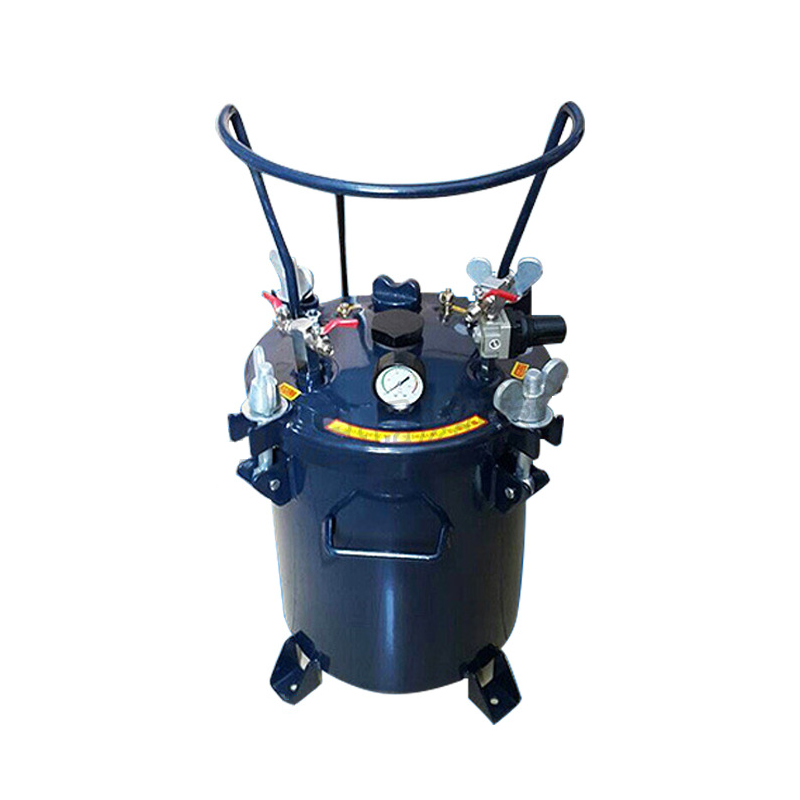
Depending on the application, this may involve a pressure paint tank, pump, regulator, fluid hoses, and a compatible spray gun. The correct configuration depends on the coating material, spray technology, required output, and equipment specifications.
When evaluating the supply system, consider whether it can maintain suitable delivery conditions during acceleration, deceleration, path changes, and continuous operation.
For systems using a paint pressure tank, confirm that its capacity, material compatibility, and rated pressure meet the process requirements. The tank supplies coating material; the spray gun and associated atomization system determine how that material is applied.
Frequently Asked Questions
Does higher spray paint pressure improve robotic coating uniformity?
Not necessarily. Uniformity depends on the spray technology, coating properties, material delivery, robot speed, gun orientation, and path overlap. Pressure must be validated as part of the complete process.
Why does coating thickness vary along a robot’s spray path?
Possible causes include changes in travel speed, gun distance, spray angle, path overlap, material delivery, or workpiece geometry. Inspection should identify where the variation occurs before adjustments are made.
Should spray pressure change when robot speed increases?
Not automatically. First evaluate whether the existing material delivery and spray pattern can meet the coating specification at the new speed. Any pressure adjustment must remain within the equipment manufacturer’s limits.
How can robotic painting improve coating repeatability?
Consistent programming, stable material delivery, validated pressure settings, routine equipment maintenance, and repeatable inspection procedures help maintain similar results across production cycles.
Is a pressure paint tank suitable for automated spray systems?
It can be suitable when its capacity, pressure rating, material compatibility, and delivery characteristics match the spray gun and production requirements.
Improve Coverage in Automated Industrial Painting
Robotic painting requires coordination between spray paint pressure, material delivery, robot motion, and workpiece geometry. A validated process helps manufacturers achieve more consistent coverage while reducing avoidable coating variation.
For automated coating projects, equipment selection should be based on the actual material, required finish, production speed, and workpiece design.
Contact an industrial spray equipment or paint pressure tank supplier to discuss your robotic coating application, material supply requirements, and production targets.
