

What Is an Industrial Pressure Tank for Fluid Dispensing?
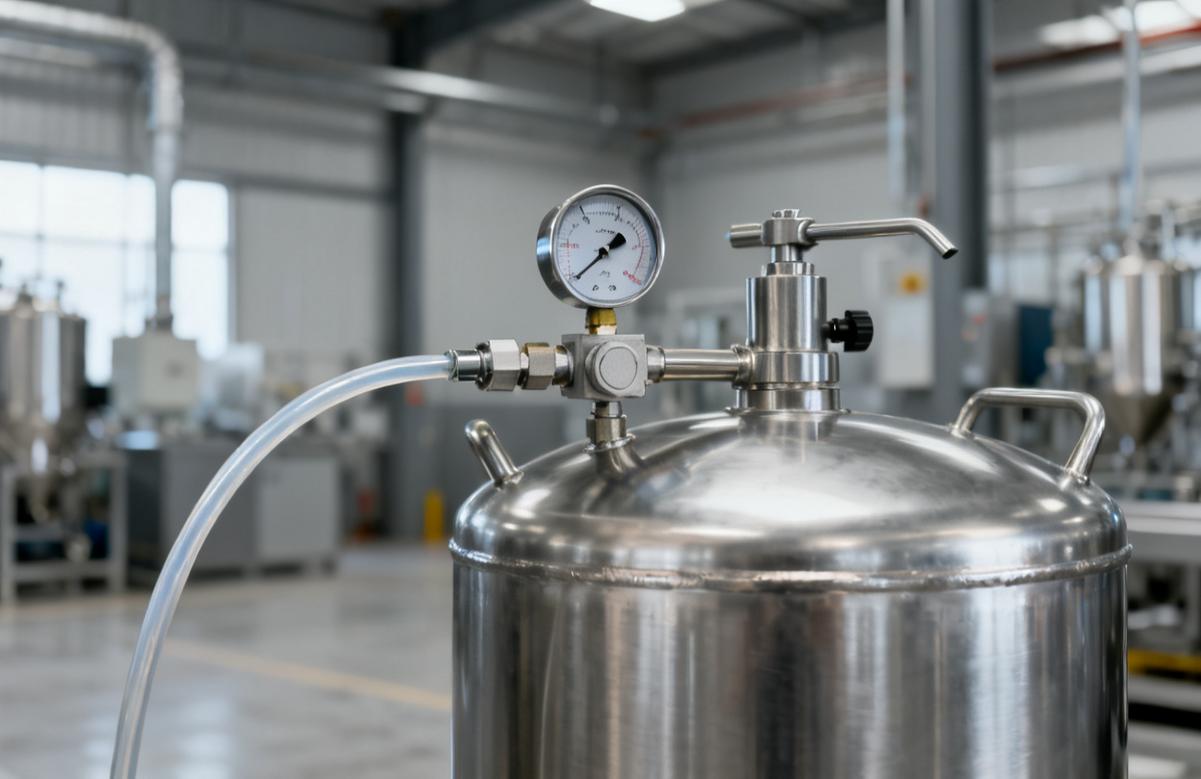
An industrial pressure tank is a sealed vessel that holds a fluid—such as adhesive, coating, solvent, or lubricant—under regulated gas pressure and delivers it to a dispensing valve, nozzle, or applicator. Its primary role is to provide a stable, pressurized supply of material, enabling consistent flow and reducing manual handling in production processes.
How It Works
The tank is partially filled with fluid and sealed. Compressed air or inert gas is introduced into the headspace above the fluid, pressurizing it. The fluid is then forced out through a dip tube or bottom outlet to the dispensing point. A pressure regulator controls the gas pressure, which in turn determines the fluid output pressure. The dispensing valve or gun controls the flow rate and timing of material delivery.
This method is distinct from pump-based systems: the pressure tank stores and pressurizes the fluid, while the valve or pump meters and dispenses it. Pressure tanks are often chosen for low-to-medium viscosity fluids, or where a simple, pulse-free supply is desired.
Key Design Choices
Tank Construction and Materials
Tanks are typically made of carbon steel, stainless steel, or other materials compatible with the fluid. Material choice depends on corrosion resistance, cleanliness requirements, and fluid chemistry. Common internal finishes include painted or coated carbon steel and polished stainless steel. The wetted materials—tank body, dip tube, seals, and outlet fittings—must be compatible with the fluid to prevent contamination or degradation.
Capacity and Pressure Rating
Capacity ranges from small tanks of a few liters to large vessels of hundreds of liters. The choice depends on production rate, refill frequency, and space constraints. Pressure rating is a critical safety parameter: the tank must be rated for the maximum gas pressure it will see in service. This rating varies by model and must be confirmed on the nameplate and in the manufacturer’s documentation. Never exceed the rated pressure, and always follow local pressure vessel regulations where applicable.
Agitation and Heating
Some fluids settle or change viscosity. Optional agitators (manual or motor-driven) keep solids in suspension, while heating jackets or internal coils maintain temperature for fluids like hot-melt adhesives or certain coatings. These features add complexity and cost; specify them only when the fluid requires it.
Regulators and Accessories
A pressure regulator, gauge, safety relief valve, and shut-off valves are typical accessories. The safety relief valve is essential to protect against overpressure. Quick-disconnect fittings and drain ports simplify cleaning and maintenance. The choice of regulator and fittings should match the required pressure range and fluid compatibility.
Selection Criteria for Buyers
To select a suitable pressure tank, gather the following information:
- Fluid properties: type, viscosity, density, corrosiveness, solids content, and operating temperature range.
- Required output: flow rate and pressure needed at the dispensing point.
- Duty cycle: continuous or intermittent use, and refill frequency.
- Environment: indoor/outdoor, ambient temperature, and hazardous area classification (if any).
- Regulatory requirements: local pressure vessel codes, material certifications, and documentation needs.
Provide these details to the manufacturer to confirm the correct model and options. For pressure-containing equipment, always verify the rated pressure, temperature limits, and materials against the actual datasheet and nameplate.
Use Cases and Limitations
Pressure tanks are commonly used in adhesive dispensing, paint and coating supply, sealant application, and lubricant delivery. They are well-suited for:
- Low-to-medium viscosity fluids that can be pressurized without degradation.
- Processes requiring a steady, pulse-free flow.
- Applications where a simple, cost-effective supply system is preferred over a pump.
They may be less suitable for:
- High-viscosity fluids that do not flow readily under pressure.
- Fluids with large particles or fillers that can settle and clog dip tubes.
- Processes requiring precise, high-pressure delivery beyond the tank’s rating.
- Applications where fluid agitation or heating is essential, unless the tank is equipped accordingly.
Installation and Maintenance
Proper installation is critical for safety and performance. Follow these steps:
- Locate the tank on a stable, level surface, secured against movement.
- Connect the gas supply through a filter, regulator, and safety relief valve as specified.
- Connect the fluid outlet to the dispensing system using compatible fittings.
- Fill the tank with the correct fluid, leaving sufficient headspace for gas.
- Pressurize slowly, checking for leaks at all connections.
- Adjust the regulator to the required dispensing pressure, monitoring the gauge.
Maintenance includes regular inspection of seals, hoses, and fittings; cleaning or replacing the dip tube; checking the relief valve operation; and verifying the pressure gauge accuracy. Depressurize and drain the tank before any service. Establish a maintenance schedule based on the manufacturer’s recommendations and the fluid’s characteristics.
Supplier Evaluation Checklist
When evaluating a supplier, consider:
- Does the supplier provide clear documentation, including pressure ratings, material certificates, and operating manuals?
- Are the wetted materials and seals compatible with your fluid?
- Is the tank rated for the required pressure and temperature, with evidence?
- Does the supplier offer options for agitation, heating, or custom fittings?
- Are safety accessories like relief valves and regulators included or available?
- Can the supplier support local regulatory requirements and provide necessary certifications?
Avoid suppliers who cannot provide verifiable documentation or who make unsubstantiated performance claims. The final selection should be based on the actual nameplate data, manufacturer documentation, and a qualified engineering review.
Frequently Asked Questions
What is the difference between a pressure tank and a pressure pot?
The terms are often used interchangeably. A pressure pot is typically a type of pressure tank used for dispensing fluids, while 'pressure tank' can also refer to vessels in water systems. In the context of fluid dispensing, both serve to hold fluid under pressure for delivery to a dispensing valve.
Can I use a pressure tank for high-viscosity adhesives?
Pressure tanks are generally suitable for low-to-medium viscosity fluids. High-viscosity adhesives may require a pump-based system or a tank with special features like heated platens or follow plates. Consult the manufacturer with the adhesive's viscosity and flow characteristics.
What safety features should a pressure tank have?
A pressure tank should have a pressure relief valve, a pressure gauge, and a regulator. It must be rated for the maximum operating pressure and used according to the manufacturer's instructions and local regulations. Never modify or disable safety devices.
How do I choose the right tank capacity?
Capacity depends on your production rate, fluid consumption, and refill logistics. A larger tank reduces refill frequency but takes more space and may be harder to clean. Provide your daily fluid usage and available space to the supplier for a recommendation.
What information should I provide to get a quotation?
Provide the fluid type and properties, required output pressure and flow rate, duty cycle, available utilities (air pressure), space constraints, and any regulatory requirements. This helps the supplier propose a suitable configuration and quote accurately.
Company Information and Technical Inquiries
Company: Hejikang (Guangdong) Metal Surface Treatment Co., Ltd.
Address: No. 3, Liuhua Industrial Road, Dongcheng Subdistrict, Dongguan, Guangdong, China
Phone: +8613253611781
Email: 847317465@qq.com
