

Automated Fluid Dispensing Tank | Selection Guide for Industrial Production Lines
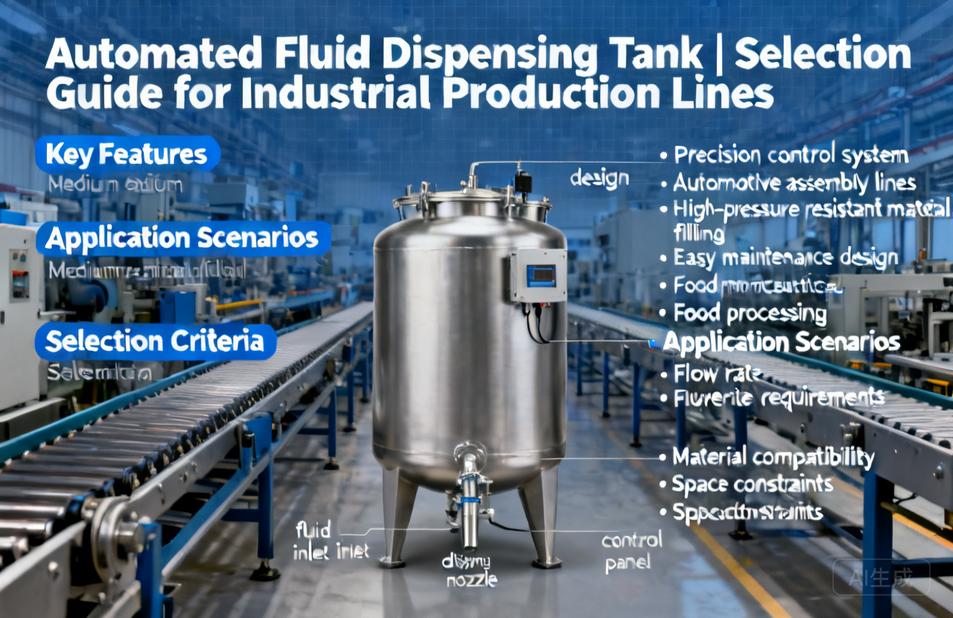
An automated fluid dispensing tank is a pressure-rated vessel designed to store, condition, and supply adhesives, sealants, lubricants, or other process fluids to dispensing valves or applicators in a controlled manner. In industrial manufacturing, this equipment is a core component of precision fluid application systems, often integrated with robot arms or semi-automatic workstations for bonding, potting, gasketing, or lubricating operations. Unlike simple gravity-fed containers, an automated fluid dispensing tank maintains consistent material flow, minimizes air entrapment, and supports repeatable output, which is essential for quality-critical applications in electronics, automotive, aerospace, and white goods assembly. This guide explains the key functions, design variants, selection criteria, and procurement considerations for production engineers and purchasing teams looking for a reliable tank solution.
What Is an Automated Fluid Dispensing Tank and How Does It Work?
An automated fluid dispensing tank is essentially a sealed or vented reservoir that delivers fluid to a dispensing gun or jet valve under controlled pressure or pump-based flow. The tank often includes a quick-release lid, a fluid level sensor, and an inlet for compressed air or an integrated pump. When used with a separate controller, it enables the operator to set output pressure, dispensing time, and cycle intervals. For materials with high viscosity or those that change viscosity over time, the tank may be equipped with a heating jacket, agitation mechanism, or vacuum degassing function. The common operating principle follows a straightforward sequence: the tank is filled with material, pressurized or pumped, and then fluid is forced through the outlet line to the dispensing tip; the control system activates the valve to start and stop the flow. This mechanism is widely adopted because it offers a stable supply and reduces operator intervention in repetitive production processes.
Key Features of a Well-Designed Dispensing Tank
When evaluating an automated fluid dispensing tank, production engineers typically focus on several structural and functional characteristics that directly affect output quality and equipment uptime.
Consistent Material Outlet Pressure
For applications where adhesive bead width or sealant volume must remain uniform, the tank should maintain steady outlet pressure. Some models use a regulator integrated into the lid assembly, while others rely on a digital pressure controller linked to the production line. If the fluid viscosity varies with room temperature, a pressure-feedback system is preferable.
Material Compatibility and Cleanability
The tank interior must be compatible with the chemical characteristics of the fluid, whether it is a solvent-based adhesive, moisture-curing polyurethane, or an oil-based lubricant. Stainless steel is the most common choice for industrial tanks, but carbon steel with corrosion-resistant coating can be acceptable for certain non-corrosive materials. The ease of disassembly and cleaning is another critical factor, especially when switching colors or material types during the day.
Level Control and Low-Level Alerts
Automated lines often need a low-level sensor to alert the operator or the PLC system before the tank runs dry. For continuous operation, some tanks can be supplied with an automatic refill option, either from a drum pump or a central material feed line. Level control prevents air from entering the fluid path, which can cause voids or inconsistent seals.
Integration with Dispensing Controllers
Most automated tanks work with a separate dispensing controller that manages valve actuation time, air pressure, and string prevention. Some advanced tanks include a manual bypass valve for small volume hand dispensing, but for fully automatic operation, the tank’s pressure input must be compatible with the controller’s output signal.
Materials and Construction Overview
The construction materials of a dispensing tank determine its service life, safety, and allowable operating pressure. A typical industrial tank body is made of stainless steel 304 or 316, with 316 preferred for high chloride environments or those involving acidic substances. The lid assembly often contains a pressure gauge, a safety valve, and an inlet port. The welds should be smooth and fully penetrated to avoid dead zones where material can accumulate. Seals are commonly made of PTFE, Viton, or EPDM, depending on the solvent resistance required. For heated dispensing, a stainless steel jacket can be welded around the vessel, using hot water, steam, or electrical heaters. If the material must be degassed, the tank can include a vacuum port and a suitable vacuum gauge.
Industrial Applications of Automated Fluid Dispensing Tanks
Automated fluid dispensing tanks are used across a wide range of assembly and production processes where precise fluid placement is necessary. In electronics manufacturing, they supply solder paste, conformal coating, or thermal adhesive for component protection. In automotive assembly, they are used for applying PVC sealants, sound-deadening materials, and adhesive bonding for body parts. In white goods production, such as refrigerators and washing machines, they handle gasketing and seam sealing. Medical device manufacturing may require small volume tanks for biocompatible adhesives. Packaging, solar panel production, and LED lighting also rely on these tanks for potting and encapsulation. Beyond these, they are common in general industrial maintenance for automatic lubrication of mechanical guides and bearings.
How to Choose an Automated Fluid Dispensing Tank for Your Production Line
Selecting the most suitable tank requires a review of your existing equipment, material characteristics, and production volume. There is no one-size-fits-all option, and an informed decision involves asking the right questions.
1. Determine the Fluid Viscosity and Flow Rate
The tank must have a capacity and pressure range that can deliver the target flow rate without causing material shear or overflow. A higher viscosity material often requires a ram or a follower plate to assist material movement, especially at the bottom of the tank when it is nearly empty. For low viscosity fluids, a simple pressurized tank may be enough.
2. Assess the Duty Cycle and Continuous Operation
If your line runs 24/7, you need a tank with a larger reservoir or automatic refill capability. For intermittent operation, a smaller tank may reduce material waste due to curing or settling during idle periods. Consider whether the tank can be easily opened for cleaning or whether it requires a flush cycle.
3. Check the Required Precision and Repeatability
For applications where dot size or bead height must remain within a narrow tolerance, the tank’s pressure regulation must be precise and stable. Some tanks offer closed-loop pressure control, while others rely on a simple precision regulator. It is best to discuss the target tolerance with your dispensing system supplier to match the tank performance.
4. Evaluate the Physical Installation Space
Your factory layout may limit the tank’s dimensions and mounting style. Some tanks are designed for bench-top operation, while larger ones are floor-standing. Consider the distance from the tank to the dispensing valve, since excessive line length can cause pressure drop or material separation. A fluid supply line with suitable diameter and material compatibility is necessary.
5. Consider the Compatibility with Existing Equipment
If you already have a dispensing controller, verify that the tank’s input signal and pressure range match the controller’s output. For retrofit projects, some suppliers offer custom coupling options for specific valve brands. Communication via I/O or fieldbus can be implemented if needed, but this is not always a standard feature.
Customization and OEM Options
Many manufacturing companies require a tank that fits a unique production condition, such as a special mounting bracket, a particular inlet thread, or a customized output fitting. A reputable dispensing tank factory usually offers a range of customization services, including altering the tank volume, adding an agitator, installing a special seal material, or integrating a level sensor with a specific electrical connector. For OEM projects, the tank can be supplied without a brand label or with your private label, and the manufacturer can adapt the design to your drawings. It is important to request a detailed specification sheet and a material compatibility certificate for the sealing materials if you are handling aggressive chemicals.
Buying Considerations: Pricing, Lead Time, and After-Sales Support
When sourcing an automated fluid dispensing tank, price is not the only criterion that matters. You should evaluate the total cost of ownership, including installation, maintenance, and downtime risks. A cheaper tank with thin walls or low-quality seals may cause frequent leaks and production stoppages. Inquire about the manufacturer’s lead time, which may vary from a few days for standard models to several weeks for custom units. Also, clarify the warranty terms and the availability of spare parts. A foreign trade supplier should be able to provide clear delivery terms, packaging details, and documentation required for customs clearance. If you are buying from a manufacturer rather than a trader, you can often get better technical support and a more cooperative attitude toward modifications.
Supplier Selection: What to Look for in a Dispensing Tank Manufacturer
Finding a reliable supplier of automated fluid dispensing tanks involves checking several aspects. First, verify the factory’s production capacity and equipment, such as welding machines, pressure testing benches, and surface finishing lines. Ask whether they have a quality control process for each tank before shipment. Next, request a technical drawing and a sample if possible, especially for custom designs. A supplier that can provide clear communication and respond quickly to questions is valuable, since installation issues or process adjustments often arise later. Check whether the supplier has experience with your specific industry, such as electronics or automotive, because they may already understand common material handling pitfalls. Also, consider their ability to ship internationally, including their experience with export packing and environmental protection standards. A supplier with a dedicated export department is often more efficient in handling paperwork.
Frequently Asked Questions
What capacity tank do I need for a small production line?
For a bench-top operation with intermittent dispensing, a 5-liter or 10-liter tank may be sufficient. For continuous assembly lines with multiple nozzles, you might need a 20-liter to 40-liter tank with a low-level sensor. It is best to estimate your hourly consumption and compare it with the tank’s refill frequency to avoid unscheduled downtime.
Can a dispensing tank handle two-component adhesives?
Some automated dispensing systems use two separate tanks and a static mixer to combine the materials. In such a case, each tank is dedicated to one component. The tank must be compatible with the resin and hardener separately. You may also need a metering pump for accurate ratio control, but the pressure tank itself can serve as a reservoir for each side.
How often do I need to clean the tank?
The cleaning frequency depends on the material’s curing or drying properties. Solvent-based adhesives may require cleaning at the end of each shift, while moisture-cure materials need regular cleaning of the lid and wetted parts to prevent clogging. Using a drop-in liner or a disposable cup can reduce the time and effort required. Always refer to the material supplier’s recommendations for safe solvents and procedures.
Can I use a pressure tank for high-viscosity grease?
Yes, but you may need a tank with a follower plate or a ram to force the grease toward the outlet. A standard pressure tank may experience cavitation or uneven output with very thick materials. For such applications, a tank with a mechanical agitator or a piston-type follower is often necessary.
Conclusion
Choosing an automated fluid dispensing tank is a step that directly influences the consistency and efficiency of your dispensing process. The key is to match the tank’s construction, pressure control, and material handling features with your actual production requirements. Always prioritize material compatibility, cleanability, and reliable pressure stability over minor price differences. If you are uncertain about the specifications, it is wise to consult with a knowledgeable manufacturer or supplier who can provide guidance based on your fluid type and application. To discuss your specific requirements, request a technical datasheet, or inquire about OEM and custom options, we encourage you to contact our engineering team. We can help you select or design a dispensing tank that fits your production line and budget.