

Spray Paint Pressure and Transfer Efficiency | Reduce Coating Waste in Industrial Painting
How Does Spray Paint Pressure Affect Coating Efficiency?
Spray paint pressure affects how coating material is atomized, delivered, and deposited on a workpiece. When pressure and equipment settings are properly matched to the paint and application method, manufacturers can improve coating consistency and manage material consumption more effectively.
Excessive atomizing pressure in some spray systems can increase overspray and cause more paint to miss the target surface. Insufficient or unsuitable pressure can also produce poor atomization, uneven coverage, or additional rework. Neither extreme guarantees an efficient coating process.
For industrial manufacturers, the goal is to find an operating range that delivers the required finish while balancing material usage, production speed, and coating quality.
1. Understanding Paint Transfer Efficiency
Paint transfer efficiency describes the proportion of coating material supplied to the application process that reaches the intended surface.
For example, if a process uses 10 kilograms of coating material and 6 kilograms are deposited on the intended workpieces, the simplified material-based transfer efficiency is 60%. Actual measurement methods must account for the coating process, material losses, and measurement boundaries.
Several factors influence transfer efficiency:
- Spray technology and equipment design.
- Atomizing air pressure or fluid pressure, as applicable.
- Gun-to-workpiece distance and spray angle.
- Workpiece geometry and surface area.
- Coating viscosity and application characteristics.
- Operator technique or automated gun movement.
- Booth airflow and overspray collection arrangements.
Pressure is only one variable. Raising or lowering it without considering the complete application process may not improve overall efficiency.
2. Why Excessive Pressure Can Increase Coating Costs
In conventional air spray systems, excessive atomizing air can contribute to overspray, depending on the gun, coating, and application conditions. More material may be carried away from the workpiece instead of forming the required coating film.
This can increase several operating costs:
Higher paint consumption: More coating may be required to achieve the target coverage.
Additional cleanup: Overspray can increase the cleaning workload for booths, fixtures, and surrounding equipment.
Greater filter loading: Where applicable, increased airborne coating material can place additional demand on extraction and filtration systems.
More process variation: An unsuitable spray pattern can create inconsistent coverage and increase inspection or rework requirements.
These effects are not identical across all technologies. Airless, HVLP, conventional air spray, and other systems operate differently, so pressure adjustments must follow the relevant equipment specifications.
3. A Practical Strategy for Reducing Paint Waste
Reducing coating waste requires a controlled process rather than simply choosing the lowest possible pressure.
Step 1: Establish a Quality Baseline
Record the current spray settings, paint consumption, workpiece output, and finish quality. Use a representative production run so the baseline reflects actual operating conditions.
Step 2: Review the Spray Technology
Determine whether the process uses conventional air spray, HVLP, airless, or air-assisted airless equipment. Each technology has different pressure requirements and transfer characteristics.
Step 3: Optimize the Application Setup
Review the manufacturer’s recommended pressure range, nozzle or air cap selection, spray distance, gun angle, and overlap between passes.
Step 4: Evaluate Material Delivery
Confirm that the fluid supply system provides a suitable and consistent flow rate. An incorrectly configured pressure tank or pump can deliver more material than the spray process can use effectively.
Step 5: Conduct a Controlled Trial
Change one relevant setting at a time and compare paint consumption, finish quality, coverage, and cycle time. Keep all other practical conditions as consistent as possible.
Step 6: Validate the Results
Repeat the trial under representative production conditions. A setting that performs well on a single test panel may not deliver the same results across different part geometries or longer production runs.
Step 7: Document the Approved Process
Record the validated settings and operating procedures so that operators can reproduce the results and identify deviations more easily.
4. The Role of Paint Pressure Tanks in Material Efficiency
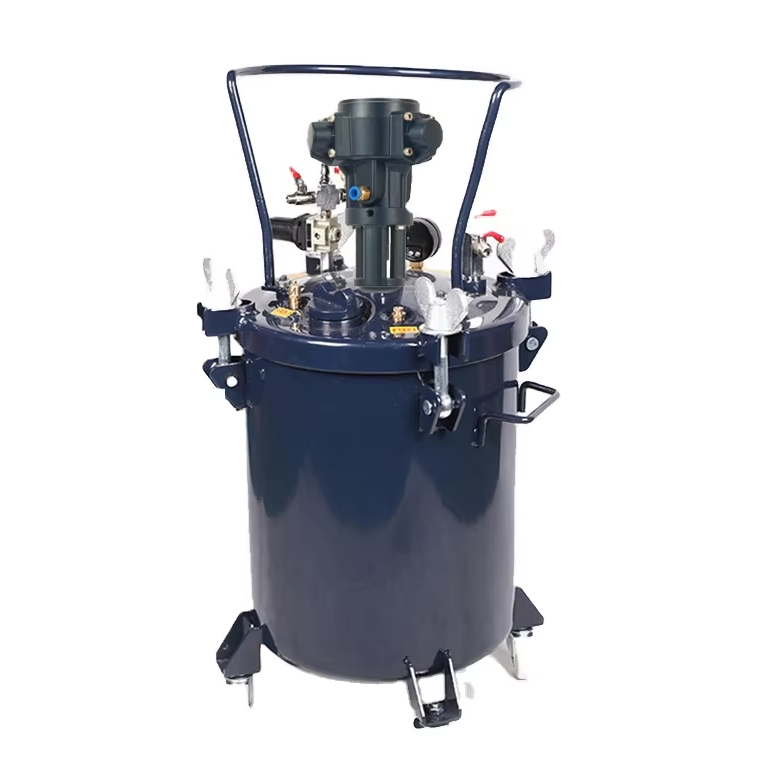
A paint pressure tank, also called a pressure pot, supplies compatible coating material under controlled pressure. It can be useful in industrial applications that require a continuous supply of paint or reduced interruption for manual refilling.
A suitable pressure tank system can support material efficiency by providing controlled fluid delivery and integrating with the selected spray gun. However, the tank alone does not determine transfer efficiency.
When evaluating a pressure tank, consider:
- Required coating volume and consumption rate.
- Material compatibility of the tank, seals, and fittings.
- Fluid pressure and flow requirements of the spray gun.
- Regulator performance and pressure monitoring.
- Cleaning procedures and coating changeover requirements.
- Compatibility with the existing production system.
The tank’s fluid pressure should not be confused with the atomizing air pressure of a conventional spray gun. Both must be configured appropriately for the selected equipment.
Always operate the tank within its rated pressure limits and use the required pressure relief devices.
5. Measuring the Business Value of Pressure Optimization
A successful pressure optimization project should demonstrate measurable improvements without compromising coating quality.
Useful performance indicators include:
| Metric | What it helps evaluate |
|---|---|
| Paint consumed per finished part | Material usage relative to production output |
| Rework rate | The frequency of parts requiring corrective work |
| Coating defect rate | Consistency of the finished surface |
| Production cycle time | Time required to complete the coating operation |
| Cleaning frequency | Maintenance effort associated with overspray and material residue |
| Material cost per production batch | Overall coating expenditure |
Compare these indicators before and after changing the process. Consider differences in part geometry, coating specifications, and production volume when interpreting the results.
A reduction in paint consumption is not a genuine improvement if it results in insufficient film thickness, poor coverage, or increased rejection rates.
6. Common Mistakes When Optimizing Spray Paint Pressure
Choosing pressure based only on appearance: A visually smooth finish does not automatically confirm correct film thickness or coating performance.
Reducing pressure without testing: Lower pressure may reduce some losses in certain systems but can also create poor atomization or an unsuitable spray pattern.
Ignoring fluid supply conditions: Stable atomization requires the material delivery system to match the gun’s requirements.
Changing several settings simultaneously: This makes it difficult to identify which adjustment produced the result.
Overlooking maintenance: Worn nozzles, restricted passages, and deteriorated seals can undermine an otherwise suitable pressure setup.
A disciplined testing procedure helps distinguish pressure-related problems from issues involving equipment condition, material preparation, or application technique.
Frequently Asked Questions
Does higher spray paint pressure always increase paint consumption?
Not always. The effect depends on the spray technology, coating, and application conditions. Excessive atomizing pressure can increase overspray in some systems, but pressure must remain within the equipment’s recommended operating range.
How can I reduce overspray in industrial painting?
Review spray technology, pressure settings, nozzle selection, gun distance, spray angle, and application overlap. Test changes under consistent conditions and confirm that coating quality remains acceptable.
Can a paint pressure tank improve transfer efficiency?
A pressure tank can provide controlled material delivery, but it does not independently determine transfer efficiency. The spray gun, coating properties, application method, and operating settings also matter.
What is the best way to compare paint consumption?
Measure coating usage against a consistent production output, such as kilograms of paint per accepted part or per defined production batch. Account for changes in part geometry and coating requirements.
Is the lowest possible spray pressure the most efficient setting?
No. The most efficient setting is the one that meets the required coating quality and production requirements while managing material consumption and staying within the equipment’s operating limits.
Improve Your Industrial Coating Process
Optimizing spray paint pressure can contribute to better material utilization, reduced overspray, and more predictable coating costs when supported by appropriate equipment selection and process testing.
For industrial manufacturers, the best results come from treating pressure as one part of a complete coating system rather than an isolated setting.
Contact an industrial spray equipment or paint pressure tank supplier to discuss your coating material, required production output, fluid delivery needs, and equipment configuration. A properly matched system can help you pursue consistent finishes and more efficient material use.
