

Industrial Dispensing Valve Selection | A Buyer’s and Engineer’s Guide
An industrial dispensing valve is a controlled shut-off device that releases a measured amount of fluid, adhesive, sealant, or coating from a pressurized supply line into or onto a workpiece. It is the component that decides when flow starts, when it stops, and how cleanly it cuts off. In a material supply system, the pressure tank or pump creates the supply pressure; the dispensing valve governs the actual deposit. Choosing a valve therefore starts with the fluid and the deposit, not with the tank behind it.
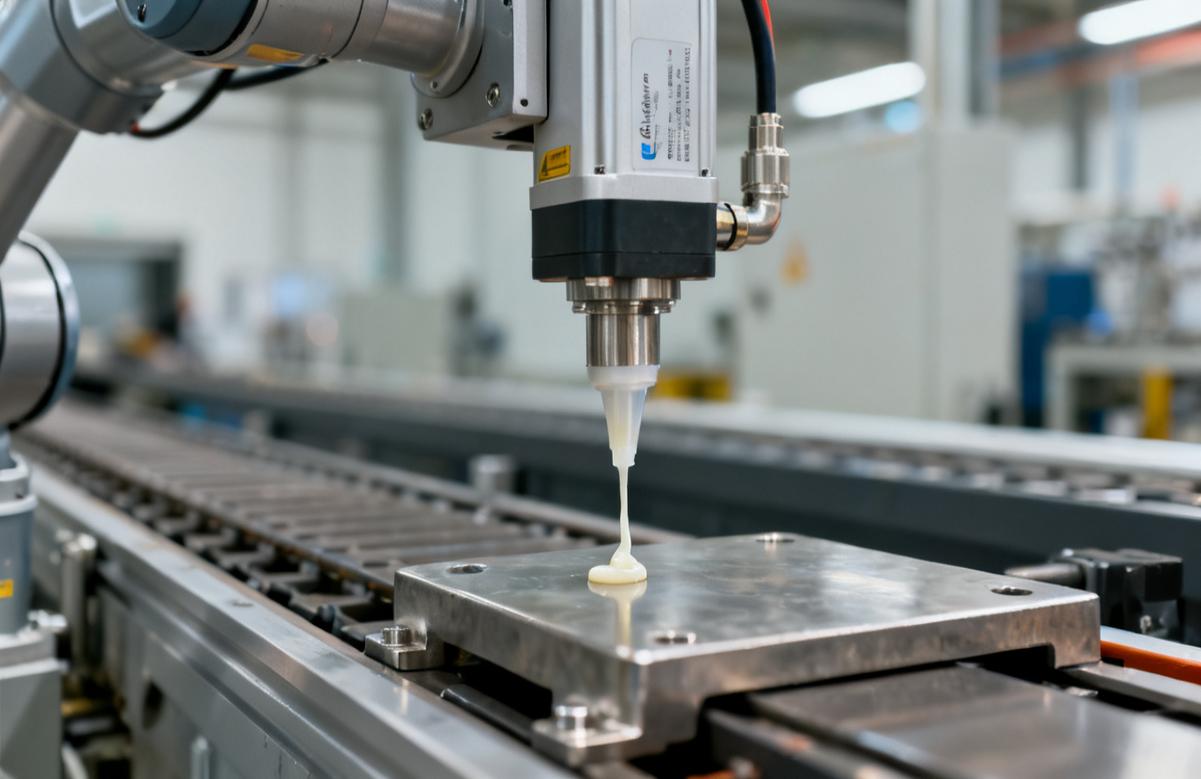
What a Dispensing Valve Does and Does Not Do
The valve controls flow. It does not usually create pressure, meter ratio, or compensate for an unstable supply. If supply pressure fluctuates, the deposit will vary even with a good valve. For two-component materials, the mixing and ratio function belongs to the metering system upstream. Keep these boundaries clear during selection, because most dispensing problems are traced to the supply side, the fluid, or the sequence, not to the valve alone.
Start With the Fluid, Not the Valve
Fluid behavior determines which valve family can work at all. Before comparing models, describe the material precisely:
- Viscosity range at the actual process temperature, not at room temperature in the container.
- Filled or abrasive content such as pigments, fillers, or metallic particles, which affects seat and nozzle wear.
- Pot life and curing behavior for reactive adhesives; a valve that traps material in dead zones can cure shut.
- Solvent or chemical aggressiveness, which drives wetted-body and seal material choice.
- Shear sensitivity, relevant for materials that change structure when forced through narrow passages.
Wetted materials, seal compounds, and internal geometry must be confirmed against the fluid’s safety data sheet and the valve manufacturer’s compatibility guidance. Generic statements such as ‘stainless steel body’ are not enough, because seal and seat materials often set the real limit.
Match Valve Type to the Deposit
| Requirement | Typical valve approach | Trade-off to check |
|---|---|---|
| Small, repeatable dots or beads | Needle or pin-type shut-off with fine nozzle | Narrow passages suit low-viscosity or well-filtered fluids; may clog with filled materials |
| Larger volumes or faster fills | Spool, diaphragm, or larger seat designs | Faster flow often means less precise cut-off and more drip risk |
| Abrasive or filled fluids | Wear-resistant seat and nozzle materials | Shorter service intervals; verify wear-part availability |
| Reactive adhesives | Designs with minimal dead volume and clean flush paths | Purge and cleaning procedure becomes part of cycle design |
This table shows decision logic, not product specifications. Actual orifice sizes, stroke, and response times vary by model and must come from the datasheet.
Dose Size, Cycle Rate, and Cut-Off Quality
Three process numbers shape the choice. The deposit size sets the flow area and opening time needed. The cycle rate sets how fast the valve must open and close without overheating or wearing prematurely. Cut-off quality decides whether the bead ends cleanly or leaves a string, drip, or tail that contaminates the next part.
Cut-off is influenced by fluid viscosity, nozzle geometry, supply pressure, and whether the valve has a snuff-back or suck-back feature. Ask the supplier how the valve is expected to behave with your fluid, and plan a trial rather than accepting a general claim of ‘drip-free’ operation.
Actuation and Integration
Dispensing valves are driven pneumatically, electrically, or mechanically. The choice depends on available utilities, required response speed, and how the valve will be triggered by a robot, conveyor, or PLC. Integration questions to settle early:
- What signal triggers the valve, and what timing accuracy does the process need?
- How is the valve mounted relative to the workpiece, and does the mount allow adjustment?
- Is there a purge, flush, or cleaning station, and how does the cycle sequence use it?
- Are supply lines sized and routed to avoid pressure loss and trapped air?
- Who adjusts dosing parameters, and how are settings locked or recorded?
When a Dispensing Valve Is the Wrong Tool
A dispensing valve may be unsuitable when the deposit tolerance is extremely tight and the supply pressure cannot be stabilized, when the fluid cures so fast that cleaning between cycles is impractical, or when the required volume is large enough that a pump or transfer system should do the main work. In those cases, review the whole supply and metering arrangement rather than forcing a valve to compensate.
Information to Provide to a Supplier
- Fluid name, viscosity range, filler content, and process temperature.
- Target deposit size, tolerance, and acceptable cycle time.
- Supply method and expected supply pressure range.
- Available actuation utilities and control signal type.
- Mounting constraints, nozzle orientation, and cleaning method.
- Any applicable local requirements for the finished equipment.
Pressure-containing parts and the complete dispensing system must be selected and operated according to the nameplate, manufacturer documentation, local requirements, and qualified engineering review. Ratings shown in a catalogue do not transfer automatically to your fluid, temperature, or duty cycle.
Supplier Evaluation Checklist
- Can the supplier explain wetted materials and seal options for your specific fluid?
- Are wear parts and nozzles listed as separate, orderable items?
- Is documentation available for installation, maintenance, and troubleshooting?
- Does the supplier ask about your supply system, or only quote a valve?
- Can they support a trial with your material before a volume order?
Price and lead time depend on valve type, wetted materials, actuation, nozzle configuration, and order quantity; these factors should be quoted against a defined specification rather than a generic model name.
Frequently Asked Questions
What is the difference between a dispensing valve and a pressure tank?
A pressure tank or supply vessel holds and pressurizes the material; the dispensing valve controls when and how much material leaves the line. They are selected together but perform different functions.
How do I choose between a needle valve and a larger seat valve?
Needle and pin designs generally suit small, precise deposits of low-viscosity or filtered fluids. Larger seat designs suit bigger volumes or faster fills, but cut-off precision and drip behavior must be checked for your fluid.
Can one dispensing valve handle several different adhesives?
Sometimes, but compatibility of seals, seats, and internal passages must be confirmed for each fluid. Reactive or filled materials may require different valves or dedicated cleaning procedures.
What causes dripping or stringing after the valve closes?
Common causes include fluid viscosity, nozzle geometry, supply pressure, and lack of snuff-back. The fix is usually a combination of valve design, nozzle choice, and cycle tuning rather than the valve alone.
What information should I send with a valve inquiry?
Provide the fluid and its viscosity range, filler content, process temperature, target deposit size and tolerance, cycle time, supply pressure range, actuation utilities, and mounting constraints.
Are published pressure ratings valid for my application?
Only within the conditions stated in the manufacturer documentation and applicable local requirements. Confirm suitability for your fluid, temperature, and duty cycle with the manufacturer and a qualified engineering review.
Company Information and Technical Inquiries
Company: Hejikang (Guangdong) Metal Surface Treatment Co., Ltd.
Address: No. 3, Liuhua Industrial Road, Dongcheng Subdistrict, Dongguan, Guangdong, China
Phone: +8613253611781
Email: 847317465@qq.com