

Fluid Supply Tank Selection Guide for Industrial Systems
A fluid supply tank is a storage and delivery component used to hold liquids, chemicals, or process fluids and feed them into pumps, mixers, dispensing equipment, or production lines at a controlled rate. In industrial settings, it serves as a buffer between bulk supply and point-of-use demand, helping maintain consistent flow, reduce downtime, and protect downstream equipment. Whether you are specifying a tank for a chemical dosing system, a coolant loop, a food processing line, or an OEM machine package, understanding how these tanks are built and selected is essential for reliable operation.
What a Fluid Supply Tank Does in a System
The primary function of a supply tank is to store fluid and make it available to a pump or process at the required rate and condition. Depending on the application, it may also allow solids to settle, permit air to escape, provide a mounting point for level sensors and heaters, or serve as a mixing chamber. In many industrial systems, the tank acts as the interface between bulk deliveries and precision delivery points, which means its design directly affects dosing accuracy, pump life, and overall process stability.
Unlike a simple container, an engineered supply tank is usually integrated with fittings, baffles, level controls, and access ports. The goal is not only to hold liquid but to deliver it cleanly and predictably.
Common Types and Configurations
Open Top and Closed Top Tanks
Open top tanks are common where operators need frequent access for cleaning, mixing, or visual inspection. Closed top tanks are preferred when the fluid must be protected from contamination, evaporation, or exposure to air. Closed designs can also support slight pressure or vacuum conditions when required by the process.
Single Wall and Jacketed Tanks
Single wall tanks are suitable for ambient temperature fluids. Jacketed tanks include an outer shell that allows heating or cooling media to circulate around the inner vessel, which is useful for temperature-sensitive chemicals, adhesives, and food ingredients.
Portable and Stationary Units
Portable supply tanks are often mounted on carts or skids and used for mobile dispensing, cleaning, or maintenance tasks. Stationary tanks are permanently installed and may be connected to fixed piping, recirculation loops, or central fluid delivery systems.
Materials and Construction Considerations
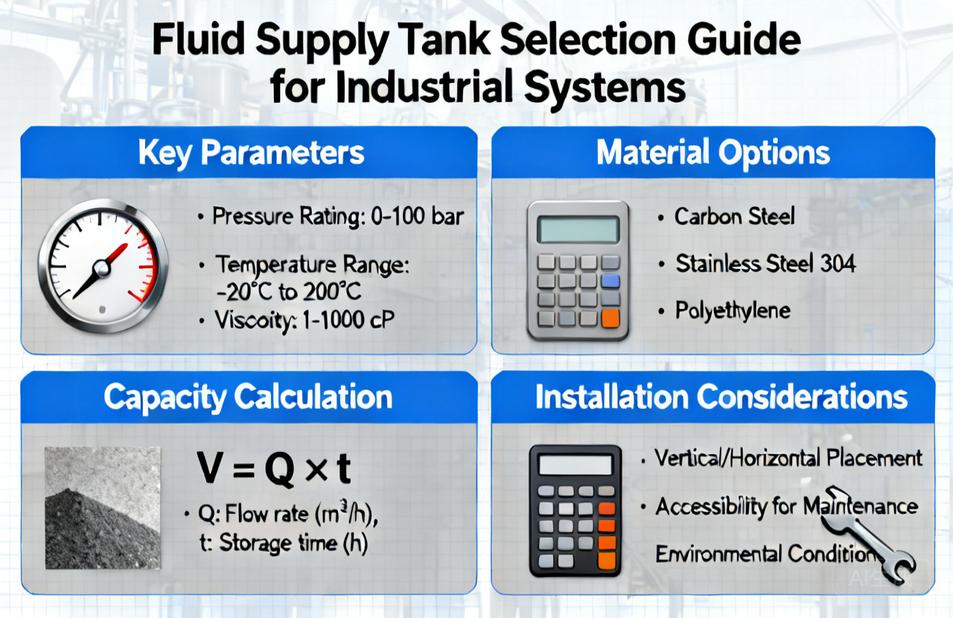
Material selection depends on the chemical compatibility, operating temperature, cleanliness requirements, and mechanical loads of the application. Stainless steel is widely used in food, pharmaceutical, and corrosive chemical environments because it resists rust and is easy to clean. Polyethylene and polypropylene tanks are common for water treatment, plating, and laboratory use where chemical resistance and cost are important. Carbon steel may be acceptable for non-corrosive fluids such as certain oils and coolants, often with a protective coating.
Construction details matter as much as the base material. Weld quality, surface finish, wall thickness, and fitting placement all influence service life and cleanability. For sanitary applications, internal surfaces should be smooth and free of crevices that could trap residue. For outdoor installations, UV resistance and structural reinforcement may be necessary.
Typical Industrial Applications
Fluid supply tanks support a broad range of industrial processes. In metalworking, they hold coolant or cutting fluid that is recirculated to machining centers. In chemical processing, they feed reagents into reactors or treatment lines. In food and beverage production, they store ingredients such as oils, syrups, and cleaning solutions before they are pumped to filling or mixing stations. Water treatment plants use supply tanks for coagulants, disinfectants, and pH adjustment chemicals. Printing, packaging, and adhesive dispensing systems often rely on pressure tanks to deliver inks, glues, and coatings at a steady rate.
Because each of these environments has different demands, a tank that works well in one application may not be suitable in another. This is why buyers should define the fluid, temperature, flow rate, and cleaning method before selecting a model.
How to Choose the Right Tank for Your System
Start by identifying the fluid properties: viscosity, corrosiveness, solids content, and operating temperature. These factors determine the compatible materials and whether agitation or heating is needed. Next, calculate the required capacity based on consumption rate, refill frequency, and the need for a buffer volume. A tank that is too small may cause frequent refills or pump cavitation, while an oversized tank can increase cost and floor space requirements.
Consider the pump or dispenser that will draw from the tank. The tank outlet size, fitting type, and bottom shape should match the pump inlet to avoid air entrapment or restricted flow. If the system requires level monitoring, choose a tank with ports for float switches, ultrasonic sensors, or sight glasses. For applications involving fumes or volatile liquids, a closed tank with proper venting is usually preferred.
Finally, review maintenance access. Large access covers, removable lids, and drain ports make cleaning and inspection easier. In hygienic industries, this can reduce downtime and help meet sanitation standards.
Customization and OEM Options
Many industrial buyers need tanks that fit specific equipment footprints or process requirements. A capable manufacturer or supplier can provide custom dimensions, fitting layouts, material grades, and surface finishes. OEM production is common for machine builders that need a branded or private-label tank integrated into their equipment. Custom options may include additional baffles, level sensor mounting, insulation, heating elements, or specialized coatings.
When requesting a custom fluid supply tank, provide detailed drawings or specifications, including connection sizes, orientation, and any standards the tank must meet. Clear communication at this stage helps avoid costly modifications later.
Supplier Selection and Buying Considerations
Choosing a reliable supplier is as important as choosing the right tank. Look for a factory with experience in your industry and the ability to document material certificates, welding procedures, and dimensional inspections. Ask about their quality control process and whether they can support small batch or prototype orders. A supplier that understands industrial applications can often suggest design improvements that reduce cost or improve performance.
Evaluate lead times, packaging, and after-sales support. For imported tanks, confirm that the design complies with local regulations and that replacement parts are available. If the tank will be part of an OEM machine, discuss labeling, documentation, and long-term supply agreements early.
Frequently Asked Questions
How do I determine the correct tank capacity?
Capacity depends on your fluid consumption rate, refill schedule, and the buffer volume needed to prevent pump starvation. Estimate peak demand and add a reasonable margin, but avoid oversizing unless future expansion is planned.
Can a fluid supply tank be used with corrosive chemicals?
Yes, but the material must be compatible with the specific chemical and concentration. Stainless steel, polyethylene, and polypropylene are common choices, and the supplier should confirm suitability based on the fluid data.
What information should I provide for a custom tank quote?
Provide the fluid type, operating temperature, required capacity, inlet and outlet sizes, mounting requirements, and any cleaning or sanitary standards. Drawings or sketches help the manufacturer respond accurately.
How do I know if a supplier can handle OEM production?
Ask about their experience with custom projects, their engineering support, and their ability to maintain consistent quality across production runs. A factory that regularly serves OEM customers will have established processes for documentation and change control.
Conclusion
Selecting a fluid supply tank involves matching material, capacity, configuration, and fittings to your specific process. Focus on fluid compatibility, flow requirements, maintenance access, and the supplier’s ability to support customization or OEM needs. If you are unsure which design fits your application, contact a qualified manufacturer or supplier with your specifications and let their engineering team help you evaluate the options.
