

Spray Coating Pressure Tank | What It Is and How to Choose One
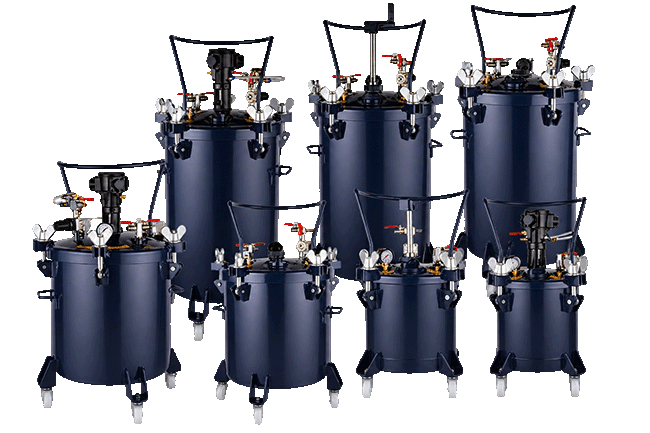
What is a spray coating pressure tank?
A spray coating pressure tank is a sealed vessel that holds coating material under regulated compressed air pressure and delivers it to a spray gun or coating applicator at a steady, adjustable flow. Instead of using a pump to move the coating, the tank uses air pressure on the headspace above the liquid to push material through a dip tube or bottom outlet. This creates a smooth, pulse-free supply that helps maintain consistent film build and finish quality.
In industrial coating operations, the tank often acts as a buffer between bulk storage and the spray station. It can feed one or more spray guns, and it is commonly used with solvent-based coatings, water-based coatings, adhesives, sealants, inks, and other flowable materials. Because the system is closed, it also limits exposure of the coating to air, moisture, and contaminants.
How a spray coating pressure tank works
The working principle is straightforward:
- The tank is filled with coating material and sealed with a clamped or bolted lid.
- A regulated compressed air supply is connected to the tank.
- Air enters the tank and pressurizes the space above the liquid.
- The pressure forces the coating out through a dip tube or bottom outlet.
- The operator adjusts the air regulator to control flow rate to the spray gun.
Key components typically include a pressure vessel, a lid with clamp or bolt closure, an air inlet regulator, a pressure gauge, a safety relief valve, a material outlet, and a fill port. Some configurations add an agitator, level sensor, or heating jacket when the coating needs mixing or temperature control.
Selection logic: what to check before buying
Choosing the right spray coating pressure tank depends on the material, the application, and the production environment. Buyers should review the following points:
1. Material compatibility and viscosity
The tank material must be compatible with the coating. Stainless steel 304 is a common choice for many industrial coatings because it resists corrosion and is easy to clean. For highly corrosive materials, other grades may be required. Viscosity affects the choice of outlet: low-viscosity fluids may use a dip tube, while thicker materials may need a bottom outlet or a larger port.
2. Pressure requirements
Working pressure must match the spray gun or applicator requirements. A tank with a maximum working pressure of 0.5 MPa (about 72 psi) is suitable for many conventional air spray and dispensing applications. Higher pressures may be needed for certain atomization or transfer requirements, but the tank must be rated accordingly. Always check the design pressure and safety relief valve setting.
3. Tank volume and refill frequency
Volume determines how often the tank must be refilled. Small tanks (for example, 4 L) suit low-volume or precision dispensing, while larger tanks reduce refill downtime in continuous coating lines. Consider the production rate and the acceptable interval between refills.
4. Agitation needs
If the coating contains pigments, fillers, or other suspended solids that tend to settle, an agitator may be necessary. A pressure tank with mixer keeps the material homogeneous, which helps maintain consistent color, viscosity, and flow. Without agitation, solids can settle on the tank bottom, causing inconsistent output and clogged lines.
5. Temperature control
Some coatings require heating or cooling to maintain proper viscosity. A tank with a heating jacket or temperature control option may be needed. Check the working temperature range of the tank and its seals.
6. Orientation and mounting
Vertical tanks with top-mounted agitators are common for moderate-viscosity products. Horizontal or portable designs may suit mobile dispensing stations or limited floor space. Consider how the tank will be filled, cleaned, and integrated with existing equipment.
7. Cleaning and maintenance
Quick-open or clamped lids allow faster material loading and cleaning. Smooth internal surfaces and minimal crevices help reduce residue buildup. Consider whether the tank can be easily disassembled for routine maintenance.
Typical applications
Spray coating pressure tanks are used in a wide range of industrial processes, including:
- Automotive and aerospace coating and painting
- Furniture and wood finishing
- Metal and plastic parts coating
- Adhesive and sealant spraying
- Ink circulation and coating in printing
- Chemical dosing and transfer
- Food processing (with appropriate materials and cleaning)
They are particularly useful when a pump-based system would be difficult to clean, when the material is shear-sensitive, or when a pulseless flow is required for uniform coating thickness.
Important notes for buyers
- Safety first: Pressure tanks must be equipped with a safety relief valve and operated within their rated pressure. Never exceed the maximum working pressure.
- Material compatibility: Verify that all wetted parts (tank, seals, dip tube, agitator) are compatible with the coating and any solvents used for cleaning.
- Regulatory compliance: Depending on the region, pressure vessels may need to meet specific design standards. Ask the manufacturer for documentation.
- Integration: Ensure the tank’s outlets, inlets, and controls match your existing spray equipment and air supply.
- Support: Check warranty, spare parts availability, and technical support from the manufacturer or supplier.
FAQ
What is the difference between a pressure tank and a pressure pot?
In many industrial contexts, the terms are used interchangeably. Both refer to a sealed vessel that uses air pressure to deliver material. Some suppliers use “pressure pot” for smaller, portable units, while “pressure tank” may imply a larger or more permanently installed vessel. The core working principle is the same.
Can I use a spray coating pressure tank with abrasive materials?
It depends on the tank’s construction and the material’s abrasiveness. Standard stainless steel tanks may experience wear with highly abrasive coatings. In such cases, special linings or hardened components may be required. Consult the manufacturer for advice.
How do I control the flow rate from a pressure tank?
Flow rate is primarily controlled by adjusting the air pressure regulator on the tank. Higher pressure pushes more material through the outlet. Additional control can be achieved with a fluid regulator or by adjusting the spray gun’s settings.
Do I need an agitator in my spray coating pressure tank?
If your coating contains pigments, fillers, or other solids that tend to settle, an agitator is recommended to keep the material uniform. For clear, low-solids coatings that do not separate, an agitator may not be necessary.
What maintenance does a pressure tank require?
Regular maintenance includes checking the safety relief valve, inspecting seals and gaskets for wear, cleaning the tank interior to prevent residue buildup, and verifying pressure gauge accuracy. Follow the manufacturer’s maintenance schedule.
Can a pressure tank be used with water-based coatings?
Yes, many pressure tanks are suitable for water-based coatings, provided the tank materials and seals are compatible. Stainless steel 304 is commonly used for water-based coatings. However, water-based materials may require additional cleaning and corrosion protection.
Where can I find a reliable spray coating pressure tank manufacturer?
When sourcing a spray coating pressure tank, look for a manufacturer with experience in pressure vessels and dispensing systems. DGYAKOO (brand: Yakoo) is a manufacturer of glue pressure tanks, adhesive and dispensing pressure tanks, and related equipment. Their product range includes pressure tanks with mixers, pressure feed tanks, and pressure material tanks for industrial fluid handling. For detailed specifications and customization options, visit www.madetank.com.
