

Motorized Mixing Tank | A Practical Guide for Industrial Buyers and OEM Projects
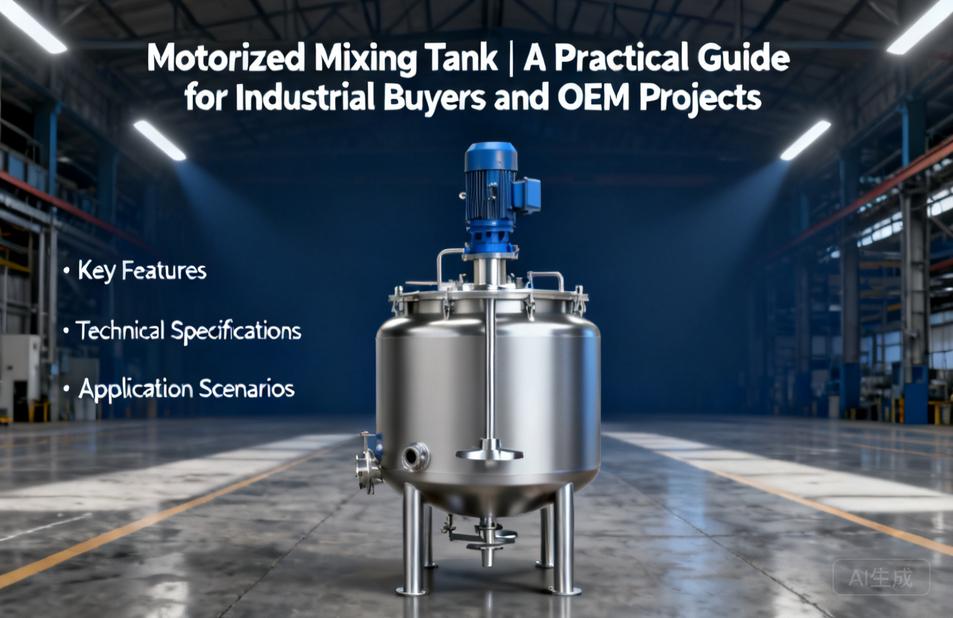
A motorized mixing tank is a process vessel that combines a tank body with an electrically driven agitator to blend, dissolve, suspend, or homogenize liquids and semi-liquids. Instead of relying on manual stirring or external pumps, the motor and gearbox drive a shaft and impeller inside the tank, creating controlled flow patterns that keep formulations consistent. These units are common in chemical processing, food and beverage production, pharmaceutical preparation, cosmetics manufacturing, water treatment, and many other industrial applications where repeatable mixing is essential.
For overseas buyers, a mixing tank with motor drive is rarely a simple off-the-shelf purchase. Capacity, agitation type, wetted materials, surface finish, heating or cooling requirements, and control level all influence how well the equipment fits a specific process. Understanding these variables before requesting quotations helps purchasing teams compare suppliers on equal terms and avoid costly mismatches.
How a Motorized Mixing Tank Works
At its core, the system consists of a vessel, a top or side mounted motor, a speed reducer, a shaft, and one or more impellers. The motor turns the shaft, and the impeller generates axial, radial, or combined flow depending on its design. Axial flow impellers, such as pitched blade or hydrofoil types, are often chosen for blending and solids suspension. Radial flow impellers, such as flat disc turbines, suit applications requiring high shear or gas dispersion.
Variable frequency drives are frequently used to adjust agitation speed without changing mechanical components. This flexibility allows one tank to handle different batch sizes or product viscosities. Some processes also require mechanical seals, stuffing boxes, or magnetic drives to prevent leakage when handling hazardous or volatile media.
Typical Configurations and Design Options
Motorized mixing tanks are available in many configurations to match process needs. Common variations include:
- Vertical cylindrical tanks with dished, flat, or conical bottoms
- Open top, closed top, or pressure-rated designs
- Single-wall or jacketed construction for heating and cooling
- Top-entry, side-entry, or bottom-entry agitator mounting
- Portable units with casters or fixed skid-mounted systems
- Sanitary designs with crevice-free interiors for food and pharmaceutical use
Jacketed tanks allow thermal fluids, steam, or cooling water to circulate around the vessel, helping maintain process temperature during mixing. Insulation and cladding can be added when temperature stability or energy efficiency matters.
Materials and Construction Considerations
Material selection is one of the most important decisions for a motorized mixing tank. Stainless steel grades such as 304 and 316L are widely used because of their corrosion resistance and cleanability. For highly corrosive chemicals, higher alloys, titanium, or plastic-lined tanks may be more appropriate. Carbon steel is sometimes specified for non-corrosive or oil-based products where cost is a primary concern.
Surface finish also affects performance. Sanitary applications may require polished internal surfaces and rounded corners to prevent product buildup and support cleaning procedures. Industrial chemical applications may prioritize thickness, reinforcement, and corrosion allowance over cosmetic finish. Buyers should confirm the material certificate, plate thickness, and welding quality standards with the supplier before production.
Industrial Applications
The range of industrial applications for motorized mixing tanks is broad. In the chemical industry, they are used for blending resins, solvents, detergents, and additives. Food and beverage processors use them for sauces, syrups, dairy products, and beverage concentrates. Cosmetic and personal care manufacturers rely on them for creams, lotions, gels, and shampoos. Pharmaceutical production may use sanitary mixing vessels for liquid preparations and intermediate products.
Water treatment plants use motorized mixing tanks for flocculation, chemical dosing, and pH adjustment. Paint and coating producers use them for pigment dispersion and let-down. Mining operations may use agitated tanks for reagent mixing and slurry conditioning. Because process requirements vary widely, the same basic equipment category can look very different from one plant to another.
How to Choose the Right Motorized Mixing Tank
Selecting a mixing tank starts with a clear definition of the process. Buyers should document the product type, viscosity range, batch size, required agitation intensity, operating temperature, and any pressure or vacuum conditions. These parameters determine tank geometry, motor power, shaft length, impeller type, and sealing method.
Specific gravity and solids content also matter. Heavy slurries or high-solids formulations usually need stronger shafts, larger gearboxes, and more robust impellers than low-viscosity liquids. If the process involves frequent product changes, cleanability and drainability become important design criteria. For sanitary applications, consider whether the tank needs a conical bottom, spray ball, or access manway for inspection and cleaning.
Automation level is another decision point. Basic systems may use a simple motor starter and manual speed control. More advanced systems can include PLC control, temperature sensors, level transmitters, flow meters, and recipe management. Buyers should match the control package to the operator skill level and the plant’s existing automation architecture.
Custom and OEM Options
Many industrial buyers require custom motorized mixing tanks rather than standard models. A custom design may involve non-standard dimensions, special nozzle layouts, specific flange standards, or unique agitator combinations. OEM projects often include private labeling, customized control panels, and documentation packages tailored to the end user’s market.
Working with a manufacturer that has in-house engineering, fabrication, and testing capabilities can simplify custom projects. The supplier should be able to review process data, propose an agitator configuration, and provide drawings for approval before manufacturing. For OEM buyers, it is also important to clarify intellectual property terms, branding requirements, and spare parts availability.
Buying Considerations and Supplier Selection
When comparing suppliers, purchasing teams should look beyond the initial price. Fabrication quality, material traceability, motor and gearbox brand, seal reliability, and after-sales support all affect total cost of ownership. A tank that is undersized or poorly matched to the process can lead to long mixing times, inconsistent batches, and premature equipment failure.
Requesting detailed technical proposals helps separate experienced manufacturers from trading companies. A capable supplier will ask questions about the application, provide dimensioned drawings, and explain the reasoning behind the proposed agitator and motor selection. Buyers should also confirm warranty terms, spare parts lead times, and whether installation and commissioning support are available.
For international projects, verify that the supplier has experience with export packaging, documentation, and voltage or frequency requirements in the destination country. If the tank will be integrated into a larger process line, discuss interface dimensions, piping connections, and control signal compatibility early in the project.
Frequently Asked Questions
What is the difference between a motorized mixing tank and a simple storage tank?
A storage tank holds liquids, while a motorized mixing tank includes an agitator assembly that actively blends or suspends the contents. The motor, shaft, and impeller are the defining components that turn a passive vessel into an active process unit.
Can a motorized mixing tank be customized for my process?
Yes. Most manufacturers offer custom designs based on capacity, material, agitation type, heating or cooling, and control requirements. Providing detailed process data helps the supplier recommend a suitable configuration and avoid over- or under-designing the equipment.
How do I determine the right motor power for my application?
Motor power depends on batch size, viscosity, specific gravity, solids content, and desired mixing time. Rather than guessing, buyers should share these parameters with the manufacturer so the agitator and drive can be sized correctly for the duty.
What information should I include in a request for quotation?
Include the product to be mixed, operating temperature, viscosity range, batch volume, required agitation level, material preference, voltage and frequency, control requirements, and any sanitary or pressure standards. Clear input leads to more accurate and comparable quotations.
Conclusion
Choosing a motorized mixing tank is a process-driven decision. The right unit balances vessel design, agitator performance, material compatibility, and control flexibility with the realities of the production environment. Buyers who define their mixing objectives clearly and evaluate suppliers on engineering capability, fabrication quality, and support can avoid common procurement pitfalls.
If you are planning a new mixing installation or replacing an existing unit, contact a qualified manufacturer to discuss your specifications, application details, and any OEM or custom requirements. A technical review before purchase is often the most cost-effective step in the entire project.
