

Electric Agitated Tank | A Practical Guide for Industrial Buyers
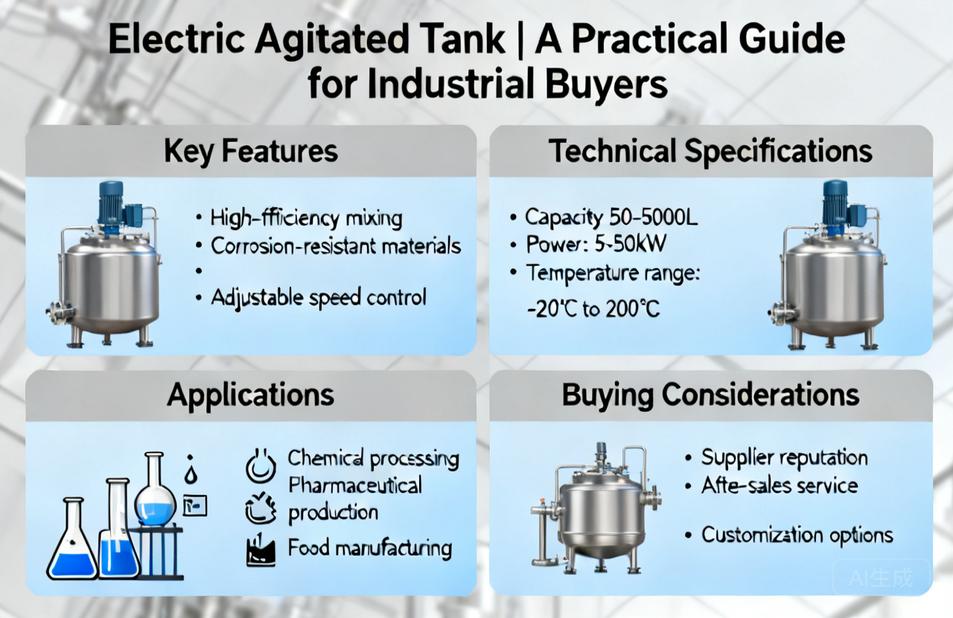
An electric agitated tank is a process vessel equipped with a motor-driven mixing assembly, used to blend, dissolve, disperse, suspend, or maintain the homogeneity of liquids and slurries in industrial production. It is commonly found in chemical processing, food and beverage preparation, pharmaceutical intermediate handling, water treatment, and coatings manufacturing. For overseas buyers sourcing this equipment, the real question is rarely just about capacity or price. It is about matching the agitator type, vessel construction, and control method to a specific process, then finding a manufacturer or supplier who can deliver a reliable unit, whether standard or custom, from a properly equipped factory.
Product Overview and Working Principle
An electric agitated tank consists of a vessel, a shaft, an impeller or agitator, a motor and gear reducer, a shaft seal, and often a control panel. The electric motor drives the shaft, which rotates the impeller inside the tank. The impeller generates flow patterns that create bulk movement and localized shear, allowing materials to mix efficiently. Depending on the process, the agitator may be top-mounted, side-entering, or bottom-mounted. Top-mounted units are the most common for open or closed tanks, while side-entry designs suit large storage vessels where full-top access is impractical.
The mixing action can be adjusted through impeller geometry, rotational speed, and tank geometry, including the use of baffles to prevent vortex formation. Buyers should understand that an electric agitated tank is not a single fixed product. It is a configuration, and the correct configuration depends on fluid viscosity, density, solids content, and the desired mixing result.
Key Features Buyers Should Evaluate
When reviewing an electric agitated tank, purchasing teams typically focus on several functional features. The agitator type is the first consideration: axial-flow impellers suit low-viscosity blending and solids suspension, while radial-flow turbines handle dispersion and gas-liquid mixing. High-shear or high-viscosity agitators may be needed for emulsions, gels, or pastes. The drive system, including motor power, gearbox ratio, and variable frequency control, determines flexibility and energy use.
Sealing is another critical point. Mechanical seals reduce leakage risk in closed tanks, while packing glands may be acceptable for less demanding duties. Tank closure, whether open-top, dished, or conical, affects cleaning, pressure tolerance, and hygiene levels. For sanitary applications, interior surface finish and cleanability become important. For corrosive media, wetted materials such as stainless steel grades or lined surfaces must be verified against the chemical compatibility of the process fluid.
Materials and Construction
Most industrial electric agitated tanks are built from stainless steel, carbon steel, or plastic-lined steel. Stainless steel grades are often selected for corrosion resistance, hygiene, and clean appearance in food, beverage, and pharmaceutical applications. Carbon steel with internal coating may be suitable for certain chemical or water treatment duties where stainless is not required. Construction details such as plate thickness, weld quality, reinforcement, and support legs or skirts should be reviewed against the tank size and operating conditions.
Because pressure, temperature, and chemical resistance requirements vary widely, buyers should not assume a standard material list applies to every project. A responsible manufacturer will ask for the process medium, operating temperature, and any cleaning or sanitation requirements before confirming construction. The same applies to surface treatment, insulation, and jacket design when heating or cooling is part of the process.
Industrial Applications
Electric agitated tanks appear across a wide range of industrial applications. In chemical production, they are used for reactions, dilution, neutralization, and blending of additives. In water and wastewater treatment, they support chemical preparation, flocculant mixing, and pH adjustment. In food and beverage processing, they handle syrup preparation, ingredient blending, and suspension of powders. In pharmaceutical and cosmetic manufacturing, they are used for intermediate preparation and emulsion mixing, often with sanitary design requirements. Coatings, inks, and adhesives producers rely on agitated tanks for pigment dispersion and batch consistency.
Because the application defines the mixing challenge, the same tank size can require very different agitator designs. A unit suitable for low-viscosity liquid blending may perform poorly with dense slurries, and a high-shear design may be unnecessary or damaging for shear-sensitive products. This is why application information is central to selecting a suitable electric agitated tank.
How to Choose the Right Configuration
The selection process should begin with the process objective rather than the equipment itself. Buyers should define what the tank must achieve: simple blending, solids suspension, dissolution, dispersion, heat transfer, or gas dispersion. Next, document fluid properties, including viscosity, density, solids concentration, particle size, and whether the material is shear-sensitive or prone to foaming. Operating conditions such as batch size, temperature range, cleaning method, and available utilities should also be recorded.
From there, the agitator type, motor power, shaft length, impeller diameter, and rotational speed can be matched through engineering calculation. The tank geometry, including diameter-to-height ratio, baffles, and discharge configuration, should be considered together with the agitator selection. Buying an electric agitated tank without this technical alignment often leads to poor mixing, excessive energy use, or mechanical problems later.
Customization and OEM Options
Many projects require custom engineering rather than a catalog unit. Custom electric agitated tanks may involve special vessel dimensions, alternative agitator styles, sanitary finishes, heating or cooling jackets, insulation, load cells, automated controls, or integration with existing production lines. OEM supply is common in this category, allowing equipment brands, engineering companies, and distributors to source tanks built to their specifications and private-label requirements.
When discussing customization, buyers should provide drawings, process descriptions, utility data, and any site constraints. A capable factory will confirm which features are standard options and which require engineering review. Clear communication about the interface points, such as inlet and outlet positions, instrument connections, and control signals, helps avoid later modifications.
Supplier Selection and Buying Considerations
Choosing a supplier is as important as choosing the equipment. Buyers should look for a manufacturer with experience in mixing and vessel fabrication, not simply a trading company. Ask how the supplier handles agitator sizing, material verification, and quality control during fabrication. Review whether the factory can provide drawings for approval, inspection records, and documentation for the wetted materials used.
Communication is another useful indicator. A supplier who asks detailed process questions, offers practical suggestions, and clarifies assumptions is generally better positioned to deliver a suitable unit than one who quotes immediately without technical review. Buyers should also confirm scope boundaries, including motor brand, control panel responsibilities, packaging, and shipping terms, so that expectations are aligned before the order.
Frequently Asked Questions
How do I determine the right agitator type for my electric agitated tank?
Start with the process objective and fluid properties. Low-viscosity blending usually calls for an axial-flow impeller, while dispersion or high-shear mixing may need a different design. Provide viscosity, density, solids content, and batch size to the manufacturer so the agitator can be sized correctly.
Can electric agitated tanks be supplied as custom or OEM units?
Yes. Many manufacturers offer custom fabrication and OEM supply for tank dimensions, agitator configuration, materials, connections, and controls. Buyers should provide process data and drawings so the factory can confirm feasibility and interface requirements.
What information should I prepare before requesting a quotation?
Prepare the process medium, viscosity, density, operating temperature, batch volume, required mixing result, cleaning method, and available utilities. Also clarify whether the tank is open or closed, whether heating or cooling is needed, and any site or control integration requirements.
How can I verify the quality of an electric agitated tank before delivery?
Ask the supplier for fabrication drawings, material documentation, and inspection records. For critical projects, discuss hold points, dimensional checks, and agitator assembly verification. A transparent factory should be able to explain its quality control process clearly.
Conclusion
Selecting an electric agitated tank comes down to matching the mixing duty, vessel construction, and control requirements to the actual process. Buyers get better results when they share complete application data, confirm custom or OEM scope early, and work with a manufacturer who can explain the engineering logic behind the configuration. If you are evaluating options for a new installation or replacement unit, contact a qualified supplier to discuss your specifications, application details, and customization requirements.
