

Adhesive Pressure Tank Selection Guide for Industrial Dispensing and OEM Supply
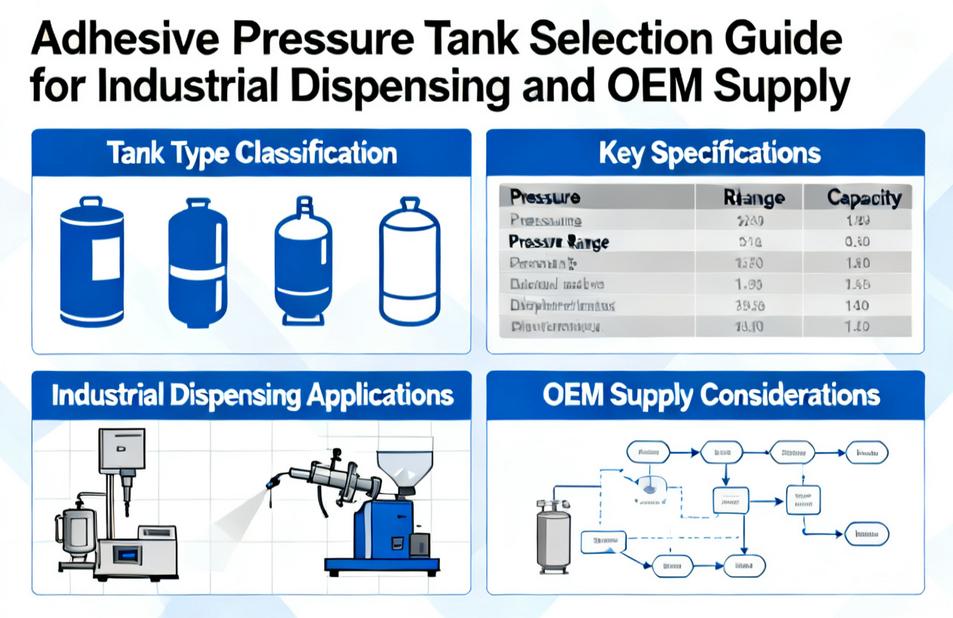
An adhesive pressure tank is a specialized pressure vessel designed to store and dispense adhesive materials, sealants, and similar high-viscosity fluids under controlled air pressure. It is widely used in industrial production lines where consistent adhesive flow is critical for bonding, sealing, coating, and assembly processes. The tank works by applying compressed air to the material surface, pushing the adhesive through a hose to a dispensing gun or nozzle, ensuring a steady and repeatable output. For manufacturers and assemblers, an adhesive pressure tank is an essential component in automated or semi-automated gluing systems, contributing to improved efficiency, reduced waste, and better product quality.
Product Overview: What Is an Adhesive Pressure Tank?
An adhesive pressure tank, often referred to as a pressure pot or glue tank, is a closed vessel that holds bulk adhesive and uses air pressure to force the material out. Unlike pumps that mechanically transfer fluids, a pressure tank relies on pneumatic pressure, which is simpler, more reliable, and easier to control. The tank typically includes a lid, a pressure regulator, a safety valve, an inlet for shop air, and an outlet connected to a fluid hose. The outlet may be configured with a filter, shut-off valve, or agitation system depending on the application. These tanks are commonly used with polyurethane, epoxy, silicone, hot melt adhesives, and other single-component or two-component materials that require consistent flow rate.
How Does an Adhesive Pressure Tank Work?
The operating principle of an adhesive pressure tank is straightforward. The tank is filled with adhesive through the top opening or a removable lid. A compressed air supply is connected to the tank’s air inlet, and the regulator sets the desired pressure level. The pressure pushes down on the surface of the adhesive, forcing it up through an internal suction tube and out of the tank through a hose. The dispensing gun or valve controls the start and stop of adhesive flow. By maintaining constant pressure, the tank provides a uniform flow rate, which is crucial for achieving consistent bond lines and preventing dripping or air pockets. Flow rate can be adjusted by varying the air pressure or by using a needle valve. This method is especially effective for low-to-medium viscosity adhesives, while higher viscosity materials may require a ram or follower plate to assist flow.
Key Features and Benefits of a Pressure Tank for Adhesives
When evaluating an adhesive pressure tank, several features contribute to performance, safety, and longevity. A robust construction, typically using carbon steel or stainless steel, ensures durability and corrosion resistance when handling reactive or moisture-curing adhesives. Stainless steel tanks are preferred for water-based or acidic adhesives, while carbon steel with a protective coating may be sufficient for less corrosive materials. The tank’s capacity ranges from a few liters to over 50 liters, allowing flexibility for small-scale production or large-volume assembly lines. Other essential features include a quick-opening lid for easy refilling, a precision pressure regulator with a gauge for accurate control, a safety relief valve to prevent over-pressurization, and a bottom outlet with a ball valve for easy cleaning. For certain high-viscosity or fast-curing adhesives, a pneumatic agitator or stirrer can keep components mixed and prevent sedimentation.
Materials and Construction Standards
The choice of material affects not only the tank’s lifespan but also the compatibility with different adhesive chemistries. Carbon steel tanks are economical and suitable for many non-corrosive adhesives, such as hot melts or solvent-based products. However, they require proper internal coating to avoid contamination. Stainless steel, especially grades 304 or 316, offers excellent resistance to acidic substances, and is mandatory for food-grade or medical adhesive applications. The tank’s internal surfaces should be smooth, without crevices, to facilitate cleaning and prevent residual adhesive build-up. Welds and joints must be leak-proof and meet or exceed applicable pressure vessel regulations. While specific certifications may vary by region, a reputable manufacturer should comply with CE, ASME, or other relevant international standards for pressure equipment. It is always advisable to confirm compliance with the supplier based on your target market and regulations.
Industrial Applications of Adhesive Pressure Tanks
Adhesive pressure tanks are versatile and find use across a wide range of industrial sectors. In the automotive industry, they are used for applying structural adhesives, sound-deadening materials, and sealants on body panels and interior components. In electronics manufacturing, precision-dispensing pressure tanks deliver controlled amounts of adhesives for conformal coatings, potting compounds, or component bonding. Woodworking facilities use them for edge-banding glue, laminating adhesives, or finger-jointing applications. Packaging lines employ pressure tanks to apply case-sealing adhesives or hot melt glue, while the construction and appliance industries rely on them for gasketing, sealing, and insulation bonding. Additionally, pressure tanks are common in the production of filters, motors, transformers, and other assemblies requiring precise glue placement. The simplicity of pneumatic pressure makes these systems easy to integrate into existing automated machinery or manual workstations.
How to Choose the Right Adhesive Pressure Tank
Selecting the correct adhesive pressure tank requires careful consideration of your adhesive type, production volume, and dispensing method. First, determine the viscosity of your adhesive. Low-viscosity fluids like cyanoacrylates or thin solvents may only need a simple tank, while high-viscosity pastes or sealants may require a tank with a larger outlet and possibly a ram plate. Second, consider the required flow rate; higher output demands a larger tank, larger diameter fluid lines, and adequate air pressure. Third, evaluate the chemical compatibility between the tank materials and the adhesive. For reactive materials, moisture-sensitive or acidic, stainless steel is safer. Fourth, think about the cleaning process. If switching between different adhesive types frequently, a tank with a removable lid, smooth interior, and easy-to-access valves will simplify maintenance. Finally, consider the working pressure range. Most industrial shop air is between 80 and 120 psi, and the tank should have a working pressure rating that exceeds the maximum operating pressure you plan to use, usually around 60 to 100 psi for adhesive dispensing. Always include a safety margin to protect operators and equipment.
Customization and OEM Options
Many adhesive pressure tank manufacturers offer customization and OEM services to meet specific application requirements. Custom options may include special tank sizes, custom outlet ports, multiple outlets for simultaneous dispensing stations, sight gauges to monitor fluid level, quick-disconnect couplings, and specialized seals for aggressive solvents. For automated production lines, manufacturers can integrate level sensors, pressure transducers, or controllers to provide feedback and maintain consistent dispensing. OEM suppliers can produce tanks with your own branding, custom coatings, or modified dimensions to fit into your machinery. If you have a unique application that requires unusual port configuration or a non-standard capacity, it is worth discussing with a qualified supplier early in the process. A reliable manufacturer should be able to provide technical drawings, material certifications, and pre-shipment testing to validate the design.
Buying Considerations and Supplier Selection
When purchasing an adhesive pressure tank, look beyond the initial price. Consider the total cost of ownership, including maintenance, spare parts availability, and service support. A quality tank should have a long service life and be easy to repair. Check the supplier’s manufacturing capabilities, quality control procedures, and whether they have experience with your type of adhesive. A factory with in-house machining and welding capabilities can often provide better custom solutions and shorter lead times. Ask about their minimum order quantity, delivery schedules, and after-sales support. It is also wise to request documentation of pressure testing, material certificates, and compliance with relevant regulations. If you are sourcing internationally, factor in shipping costs, import duties, and potential communication barriers. Many overseas buyers prefer to work directly with a dedicated manufacturer or supplier that offers responsive support. Before placing a bulk order, consider requesting a sample or a small trial unit to test with your specific adhesive. This reduces risk and helps confirm that the tank meets your operational expectations.
Maintenance and Safety Tips
Proper maintenance of an adhesive pressure tank ensures safe operation and extends equipment life. After each shift, release air pressure completely before opening the lid. Clean the interior and the outlet line to prevent adhesive curing and clogging. Use only compatible cleaning solvents and ensure all residues are removed. Periodically inspect the pressure gauge, regulator, and safety valve for correct operation. Check the gasket and lid seal for wear, replacing them if necessary to avoid leaks. Regularly drain any moisture from the air supply using a filter-regulator- lubricator unit to prevent water contamination in the adhesive. Also, verify that the relief valve opens at the specified set pressure. For tanks used with reactive adhesives, follow the material manufacturer’s safety data sheet regarding temperature limits and contamination. By following a simple preventive maintenance schedule, you can maximize uptime and avoid costly repairs.
Frequently Asked Questions
What is the difference between a pressure tank and a pump for adhesive dispensing?
A pressure tank uses compressed air to push adhesive out, which is simpler and cost-effective for low to medium viscosity materials and moderate flow rates. A pump, such as a piston or gear pump, provides a more consistent and high-pressure flow, suitable for high-viscosity adhesives or very high-volume applications. Pressure tanks are easier to clean and maintain, while pumps may deliver faster and more precise control in automated systems.
Can I use any type of adhesive in a standard pressure tank?
No, the compatibility depends on the adhesive’s chemistry and viscosity. Water-based, solvent-based, and hot melt adhesives are generally suitable if the tank materials are compatible. However, very viscous pastes may require a special tank with a follower plate or a larger outlet. Reactive adhesives like moisture-curing polyurethanes need tanks that prevent exposure to air, and two-component adhesives may require separate tanks or a static mixer after the outlet.
How do I prevent adhesive from clogging in the tank and hoses?
Clogging often occurs due to cured adhesive or air bubbles. Use a tank with a smooth interior and clean it regularly. Ensure that the adhesive is not left in the tank for long periods without pressure. Install a filter at the outlet to remove any particles. Also, purge the hose and gun after use with a suitable solvent. For fast-curing adhesives, minimize the time between filling and dispensing and keep the tank pressurized to prevent moisture ingress.
What is the typical lead time for a custom adhesive pressure tank?
Lead times vary depending on the complexity and the manufacturer’s workload. Standard tanks are often in stock or available within 1 to 2 weeks. Custom tanks with modified dimensions, multiple outlets, or special coatings may require 3 to 6 weeks from order confirmation, as the manufacturer needs to procure materials and complete fabrication and testing. It is recommended to discuss lead times with the supplier early and plan your inventory accordingly.
Conclusion
An adhesive pressure tank is a reliable and efficient solution for controlling adhesive dispensing in a variety of industrial applications. Its simplicity, affordability, and ease of operation make it a popular choice among manufacturers that need consistent glue application or sealing. When selecting a tank, focus on adhesive compatibility, working pressure, capacity, and material quality. Consider all factors such as maintenance, safety, and potential customization to fit your specific process. Working with an experienced manufacturer or supplier that offers OEM support and after-sales service is essential for long-term satisfaction. If you have questions about choosing the right adhesive pressure tank for your operation or would like to discuss custom specifications, we welcome you to contact our team for further assistance. We are ready to provide expert guidance and a solution tailored to your production needs.