

Custom Adhesive Pressure Tank | A Practical Guide for Industrial Buyers
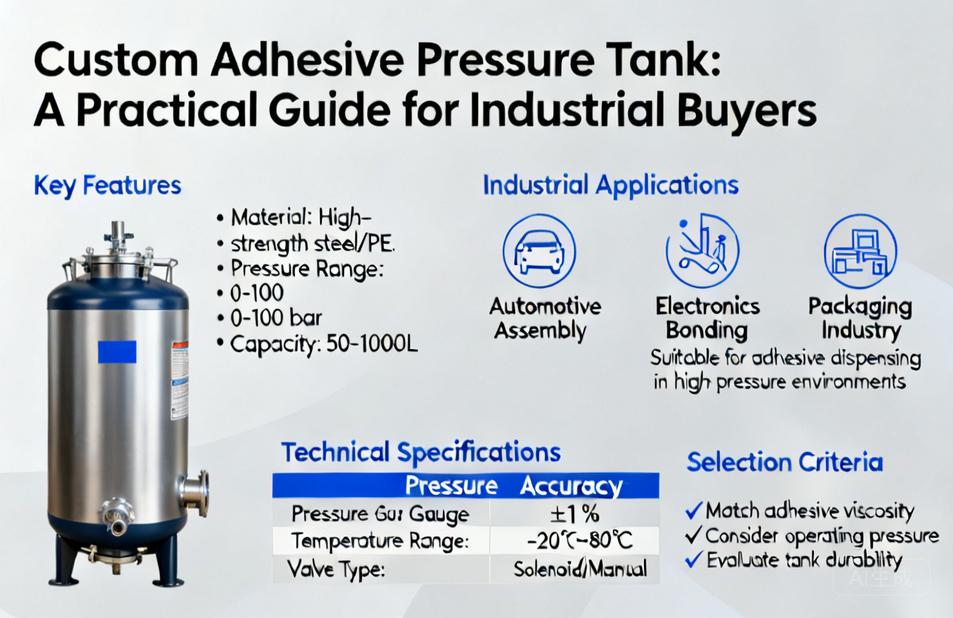
A custom adhesive pressure tank is a specialized pressure vessel designed to store, pressurize, and dispense adhesives, sealants, and other high-viscosity fluids in industrial production environments. Unlike standard tanks, a custom adhesive pressure tank is engineered to match specific application needs, whether for automated dispensing lines, manual glue stations, or robotic sealing systems. This guide helps procurement managers, maintenance engineers, and plant supervisors understand what makes a custom adhesive pressure tank different, how to evaluate its construction, and what to consider when working with a manufacturer or supplier for bespoke requirements.
Product Overview: What Is a Custom Adhesive Pressure Tank?
A custom adhesive pressure tank is essentially a sealed vessel that uses compressed air or an inert gas to push adhesive or sealant from the tank to a dispensing valve or gun. The tank is typically made from stainless steel or carbon steel, with internal coatings or liners to prevent chemical reactions with the adhesive. The term ‘custom’ indicates that the tank’s capacity, inlet and outlet connections, pressure rating, mounting style, and accessories can be tailored to fit a specific production process. For example, a tank used for hot melt adhesives may require heating jackets, while one for two-component adhesives may need separate chambers. Because adhesives vary widely in viscosity, chemical composition, and curing behavior, off-the-shelf tanks are often insufficient for demanding production schedules.
How Does a Custom Adhesive Pressure Tank Work?
The operating principle is straightforward. The tank is filled with adhesive, sealed, and then pressurized via a regulator that connects to a plant air supply or a nitrogen cylinder. The pressure forces the adhesive through a fluid line to a dispensing gun, nozzle, or automated applicator. A custom design ensures that the pressure range, discharge rate, and material compatibility align with the specific adhesive being used. For low-viscosity adhesives, a lower pressure setting is sufficient; for thicker, non-flowing pastes, a higher pressure and a larger outlet diameter may be necessary. The tank’s internal design also affects how completely it can be emptied, reducing waste and downtime. Some custom tanks include a follower plate or diaphragm to help evacuate high-viscosity materials more effectively.
Key Features to Consider in a Customized Pressure Tank
When specifying a custom adhesive pressure tank, several engineering features determine performance and longevity. First, the wetted material must be compatible with the adhesive’s solvents and additives. Stainless steel tanks are common, but some adhesives require a PTFE or glass lining. Second, the pressure rating should match your dispensing equipment and safety requirements. Over-specifying can increase cost, while under-specifying creates safety risks. Third, the agitator option matters for adhesives that separate or contain fillers. A slow-speed stirrer, driven by an air motor, keeps the material homogeneous. Fourth, the lid design influences cleaning ease. Quick-open clamps or hinged lids save time during batch changes. Fifth, level sensing and low-level alarms help prevent air entrainment, which can ruin adhesive application. Finally, the connection sizes, threads, and quick-couplings must fit your existing fluid lines. A custom tank is not simply a larger standard tank; it is a tailored component of your dispensing system.
Materials and Construction Standards
The construction of a custom adhesive pressure tank follows recognized pressure vessel standards, such as ASME, PED, or GB150, depending on the target market. A reputable manufacturer will build and test the tank to these codes, but certification is optional and cost-driven. For industrial use, 304 or 316 stainless steel is preferred for its corrosion resistance and cleanability. The internal surface finish should be smooth to minimize adhesive buildup and ease cleaning. Welds must be continuous and polished to avoid crevices where adhesives can cure and create contamination. The tank’s bottom often has a conical or dished profile to promote complete drainage. The lid seal is critical; a failed seal leads to pressure loss and adhesive leakage. Common seal materials include Viton, EPDM, or PTFE, chosen based on the adhesive’s chemistry. As a buyer, ask about the maximum allowable working pressure, test pressure, and the weld inspection procedure. Do not assume that a standard tank is inherently safe for all adhesives; the interaction between the pressure medium and the adhesive can cause unexpected polymerization or decomposition, so materials must be verified.
Industrial Applications for Custom Adhesive Pressure Tanks
These tanks are used in a wide range of industries, from automotive assembly to electronics manufacturing. In automotive plants, they dispense body sealants, sound deadeners, and structural adhesives. In electronics, they apply thermally conductive pastes or UV-curable adhesives for component encapsulation. In packaging, they handle hot melt glues for carton sealing. In woodworking, they supply polyurethane adhesives for edge banding. In construction, they dispense heavy-duty sealants for glazing and joints. A custom design becomes valuable when the adhesive is abrasive, corrosive, or requires a specific discharge pattern. For example, a tank with a heated jacket is common for hot melt adhesives that solidify at room temperature. A tank with a built-in filter is useful for adhesives containing fillers that may clump. For two-component adhesives, a custom tank may include separate pressure vessels that feed a static mixer at a controlled ratio. Thus, the application determines the necessary customization, and a reliable supplier should ask about your adhesive type, viscosity, flow rate, and duty cycle before recommending a configuration.
How to Choose the Right Custom Adhesive Pressure Tank
Choosing the right tank involves more than picking a volume and pressure rating. Begin by analyzing the adhesive’s technical data sheet, paying attention to viscosity, specific gravity, and chemical resistance. Then, calculate the required flow rate to ensure the tank outlet and regulator can deliver that volume without excessive pressure drop. Consider the production environment: is the tank stationary or mobile? Does it need a cart or a floor stand? Will it be refilled manually or via a pump? The batch size and frequency determine whether a larger tank with a follower plate is worth the investment. Also, evaluate cleaning procedures. Some adhesives cure on contact with moisture, so a tank with a dry nitrogen purge port may be necessary. The operating temperature range is another factor; if the adhesive must be kept warm, the tank requires a heating element and insulation. Finally, think about future maintenance. A tank with easily replaceable seals and a straightforward design is cheaper to service over time. A custom manufacturer can advise on all these aspects, but you must provide accurate process data. Do not rely on generic ‘one-size-fits-all’ advice.
Customization Options: From OEM to Specialized Configurations
Working with an OEM or a factory that offers custom adhesive pressure tanks opens up a wide range of possibilities. Standard customization includes capacity, ranging from a few liters to hundreds of liters; pressure rating, up to system limits; and connection types, such as NPT, BSP, or flanged. More advanced options include a heating or cooling jacket, a variable-speed agitator, a vacuum port for degassing, a pressure gauge with a sender for PLC integration, and a sight glass for level monitoring. For automated production, the tank can be fitted with a pressure transducer and a proportional valve to maintain a constant dispense pressure. A custom tank may also be designed with a lower chamber for the adhesive and an upper chamber for the pressurizing gas, separated by a diaphragm to prevent gas absorption. This is particularly useful for moisture-curing adhesives that cannot come into contact with humid air. If you are an equipment manufacturer seeking a private-label product, many suppliers offer OEM service, meaning the tank carries your brand name and is built to your specifications. In that case, you need to discuss minimum order quantities, lead times, and drawing approval processes.
Buying Considerations for Industrial Procurement
When purchasing a custom adhesive pressure tank, the total cost of ownership includes the initial price, installation, maintenance, and downtime. A cheap tank may fail prematurely, causing adhesive waste and production stops. Therefore, request a detailed quotation that specifies the material grade, wall thickness, pressure rating, and included accessories. Ask about the supplier’s testing procedures, such as hydrostatic testing and air pressure testing. Inquire about the availability of spare parts, especially seals and regulators. If you need a custom tank to match existing equipment, provide dimensional drawings or ask for a pre-shipment inspection. Also, consider lead time for a custom unit; it is usually longer than for a stock tank. A reliable supplier should be able to provide a clear drawing and a technical datasheet upon request. It is wise to choose a manufacturer that has experience with your industry’s specific adhesives, as they can proactively suggest features that reduce waste and improve consistency. However, beware of suppliers that make exaggerated claims about performance or safety. Always rely on verifiable data and references.
Supplier Selection: How to Identify a Reliable Manufacturer
Finding a trustworthy custom adhesive pressure tank manufacturer requires due diligence. Look for an established factory with a track record in pressure vessel fabrication. Ask for their compliance with international standards, but also request evidence, such as certificates or inspection reports. A good supplier will be transparent about their manufacturing process, from material sourcing to final testing. Evaluate their engineering support: can they help you optimize the tank design for your adhesive? Do they respond promptly with technical clarifications? Request samples or a prototype if the order size is small, or visit the factory if the order is substantial. Check their communication clarity and willingness to provide after-sales support. A long-term partnership is often more valuable than a one-time low price. Also, consider the supplier’s capacity to scale production if your business grows. You may want to start with a single custom tank, but later need dozens. Therefore, a supplier with a stable supply chain and flexible production is advantageous. Online reviews and industry referrals are helpful, but nothing replaces direct communication about your specific requirements.
Frequently Asked Questions
How do I determine the required pressure for an adhesive pressure tank?
Pressure is determined by the adhesive viscosity, the hose length and diameter, and the flow rate needed at the nozzle. As a general rule, higher viscosity and longer hoses require higher pressure. Start with the adhesive manufacturer’s recommended dispensing pressure, then adjust based on your system layout. A pressure regulator with a gauge allows fine-tuning. It is advisable to choose a tank with a maximum pressure rating at least 25% above your expected operating pressure for safety margin.
Can a custom adhesive pressure tank be used for multiple types of adhesives?
Yes, but it depends on material compatibility and cleaning ease. Stainless steel tanks with PTFE seals can handle many adhesives if cleaned thoroughly between product changes. However, if you switch between adhesives with very different chemistries, such as cyanoacrylates and epoxy, you may need separate tanks or extensive cleaning procedures. A custom tank can be designed with smooth surfaces and a removable lid to simplify cleaning, reducing cross-contamination risk.
What certifications are required for an industrial pressure tank?
This depends on your location and the tank’s operating pressure. In North America, an ASME-certified tank is common for pressures above 15 psi. In the EU, PED certification is required for certain pressure and volume combinations. For non-certified tanks, the manufacturer should still conduct pressure testing. Always check your local regulations and insurance requirements before installation. A reputable supplier will advise you on the applicable codes for your region.
What is the typical lead time for a custom adhesive pressure tank?
Lead time varies based on design complexity, material availability, and the manufacturer’s workload. For a standard customized tank with minor adjustments, expect 2-4 weeks. For a fully bespoke design with special coatings or instrumentation, lead time may extend to 6-10 weeks. Confirm the production schedule with the supplier and request regular status updates, especially if you have a project deadline.
Conclusion
A custom adhesive pressure tank is a practical investment for manufacturers that rely on consistent, efficient adhesive application. By understanding the product’s principle, key features, and customization possibilities, you can specify a tank that matches your process and reduces waste. When selecting a supplier, focus on engineering competence, material quality, and clear communication. Do not hesitate to discuss your application in detail with manufacturers, as the right design will improve your production efficiency and product quality. If you are considering a custom tank for your facility, contact a reputable custom adhesive pressure tank supplier with your process parameters to receive a tailored recommendation.