

OEM Stainless Steel Pressure Tank | A Practical Guide for Industrial Buyers
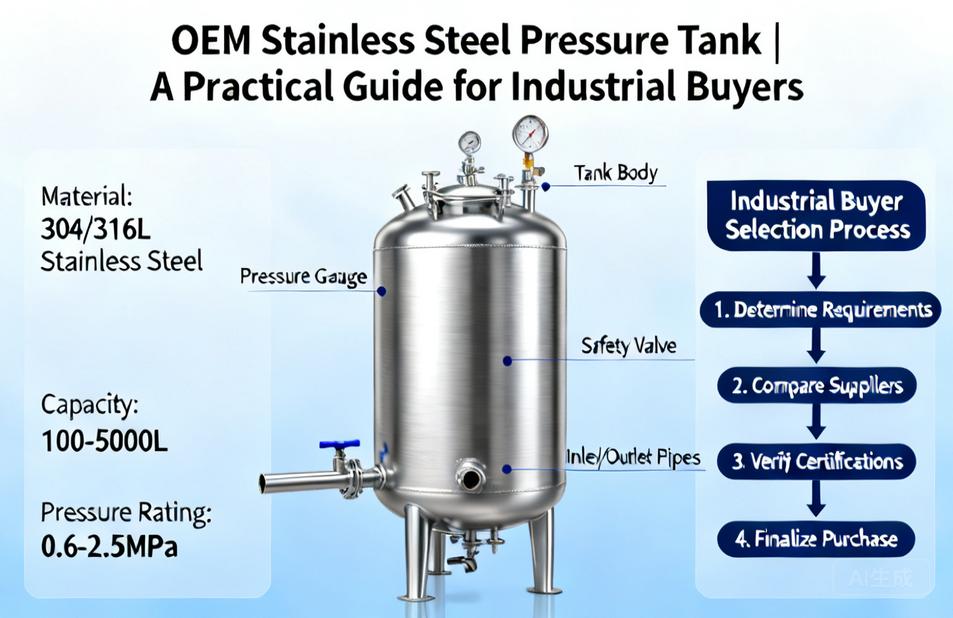
An OEM stainless steel pressure tank is a vessel designed to hold and pressurize liquids or semi-solids for controlled dispensing, filtration, or transfer in industrial settings. These tanks are commonly used in processes such as adhesive application, lubrication, liquid filling, and water treatment, where consistent pressure helps maintain flow and product quality. Unlike standard off-the-shelf tanks, an OEM stainless steel pressure tank is often built to a buyer’s specific requirements regarding dimensions, connections, accessories, and surface finish. For procurement professionals, engineers, and maintenance teams, understanding the role of a pressure tank in their workflow, and the options available from a stainless steel pressure tank manufacturer or supplier, is key to making a sound investment. This guide focuses on the practical aspects of these tanks, from construction and materials to selection criteria and supplier communication, helping you approach an OEM partner with the right questions.
What Is a Stainless Steel Pressure Tank and How Does It Work?
A pressure tank, in its simplest form, is a sealed container that stores a fluid and uses compressed air or gas to push that fluid out through a discharge line. In industrial applications, the tank is connected to an air compressor or plant air supply. The air pressure inside the tank acts evenly on the surface of the liquid, forcing it upward through a dip tube and into a hose, valve, or spray gun. The key advantage of a pneumatic pressure system is that it delivers a steady, pulsation-free flow, which is essential for precise coating, gluing, or metering tasks. The use of stainless steel as the primary construction material is common because it resists corrosion, handles a wide range of chemicals, and is easier to clean and sanitize than carbon steel or aluminum. For OEM applications, the tank becomes a component within a larger piece of equipment, such as a glue dispenser, a dosing unit, or a lubrication system.
Key Features of an OEM Stainless Steel Pressure Tank
Material and Surface Finish
The most common materials are Type 304 and Type 316 stainless steel. Type 304 offers good corrosion resistance for general industrial fluids, while Type 316 provides enhanced resistance to chlorides and more aggressive chemicals, making it suitable for food and pharmaceutical environments. The interior surface finish can be critical for hygiene and cleanability. A smooth, often polished finish (e.g., 180-grit or finer) reduces the chance of product buildup and bacterial growth, which is a typical requirement in food, dairy, and cosmetics industries. When discussing a custom tank with a factory, always specify the wetted material and the required surface finish.
Construction and Certification
An OEM pressure tank is normally a welded or constructed vessel, designed to withstand internal pressure. The thickness of the wall, the shape of the head (usually dished or elliptical), and the quality of the welds determine the maximum working pressure. While this article does not state specific pressure values, it is critical to know the maximum allowable working pressure (MAWP) for your intended application. A reputable pressure tank supplier should be able to provide documentation regarding design code, such as ASME in the United States or PED in Europe, if required. However, not all small pressure tanks are certified to these codes, so you must clarify what standards apply in your region and industry. For any custom pressure vessel, insist on hydrostatic testing records and material test certificates.
Connections and Mounting
Standard tanks come with a top inlet, a discharge valve, and a pressure gauge. An OEM tank can be modified with extra ports, different thread types (NPT, BSP, etc.), or special flanges to fit your equipment. Mounting style is also OEM-specific: some tanks have legs, some are designed for wall mounting, and others are built to be mounted directly on a frame. Consider the space available in your machinery and the ease of access for refilling and maintenance.
Common Industrial Applications for Stainless Steel Pressure Tanks
The fundamental purpose of a pressure tank is to move fluid, but the range of applications is wide. In the adhesive industry, tanks feed glue to nozzles for carton sealing or woodworking applications. In lubrication systems, they distribute oil to bearings or chains. The food and beverage sector uses stainless steel pressure tanks for transferring juices, syrups, or flavorings without introducing oxygen. Water treatment plants use large versions for filter backwashing or pressure boosting. In the chemical industry, they are used for dosing acids or bases in a controlled manner. For an OEM looking to integrate a pressure tank into a new machine, the fluid type, viscosity, temperature, and required feed rate will dictate the tank size, material, and internal configuration. For example, a high-viscosity silicone sealant requires a different ram or piston mechanism than a low-viscosity solvent. You will need to work with a pressure tank manufacturer who understands fluid dynamics and can recommend the appropriate discharge valve or follow-up pump.
How to Choose the Right OEM Stainless Steel Pressure Tank
Define Your Fluid and Operating Environment
Start by listing the properties of your media: is it acidic, alkaline, abrasive, or food-safe? What is its temperature at the point of use? What is the desired flow rate? These factors narrow down the material grade (e.g., 316 for caustic solutions) and the type of seal materials (Viton, EPDM, PTFE). Also, consider the environment where the tank will sit. If it is exposed to saltwater or chemical vapors, 316 stainless steel with a heavy-gauge wall is a safer choice. If the tank is indoors in a clean workshop, 304 is often sufficient.
Determine Capacity and Working Pressure
The volume of the tank affects how often you need to refill it and how much fluid is available under pressure. A larger tank might be more convenient, but it also requires more floor space and can be harder to clean. The working pressure must match your application’s needs. Too low a pressure results in slow flow, while too high a pressure may over-spray or damage upstream equipment. Always specify the required pressure range, not just a single value, because a system usually needs a minimum and a maximum. For OEM projects, you might also need to define the regulating valve’s accuracy, as some operations require very stable pressure.
Consider Cleanability and Maintenance
For food, pharmaceutical, or high-purity applications, the tank must be easy to disassemble and clean. A fully welded design without dead legs is preferred. Ask about the tank’s ability to be cleaned in place (CIP) or sterilized in place (SIP). In many processes, the tank is connected to a cleaning system, so the inlet and outlet positions are important. Also, consider how the tank is emptied: does the dip tube extend to the bottom? Are there any drains for residual liquid? An OEM tank can be designed with a bottom sloped to a central drain, which is a valuable feature for productivity.
Customization Options and OEM Considerations
The core of an OEM relationship is customization. A reliable stainless steel pressure tank factory will offer several modification points. You can customize the volume (from 1 gallon to 200 gallons or more), the pressure rating, the type of pressure gauge (analog vs. digital), the style of safety valve, and the inlet fitting. More advanced options include a quick-opening lid for faster refilling, a sight glass or level indicator, and a pressure relief valve that resets automatically. You might also need special interior coatings, though for most fluids that are compatible with stainless steel, a bare polished interior is best. When ordering a custom piece, you should ask for a draft or CAD drawing of the proposed assembly. This is not only to verify dimensions but also to confirm that the internal design, such as the dip tube length or the location of baffles, is correct. The lead time for a custom pressure tank is longer than a standard tank, so plan your project accordingly. A competent supplier will clearly state the lead time and the minimum order quantity (MOQ). Some factories are flexible with low MOQs for prototype work, while others focus on volume, so align your expectations early.
Selecting a Reliable Manufacturer, Supplier, or Factory
Choosing a partner for your stainless steel pressure tank is as important as choosing the tank itself. A supplier can be a local distributor, an importer, or a direct manufacturer. Each has its advantages. A direct manufacturer often offers better pricing and easier customization, but communication and shipping can be more complex if they are overseas. A local supplier may keep stock, but they might not be able to modify the tank to your exact specifications. Begin by checking if the company has experience in your industry. Ask for references from similar OEM projects, but do not expect to see their client list unless you sign an NDA. Instead, focus on their engineering capabilities: Can they provide a custom pressure tank drawing? Can they recommend the correct seal material for your chemical? Do they have a quality control process that includes pressure testing before shipment? A reliable supplier will be transparent about their manufacturing process, including the source of the stainless steel and the certifications of their welders. If you are contacting a factory in another country, be clear about your required standards. For instance, if your end product must meet CE or UL, the tank must often be built to those standards. Always request a sample or a prototype for a non-standard design before mass production.
Buying Considerations: Documentation and Logistics
For international procurement, documentation is essential. A standard packing list, commercial invoice, and bill of lading are expected. However, for pressure vessels, you may also need a material test report (MTR), a certificate of conformance, and possibly a certificate of origin. These documents support product quality and can be crucial for your own quality audits. Also, ask about the export packing method, especially if the tank is large or has fragile gauges. A well-packed tank should be protected with crating or thick shrink wrap to prevent transit damage. If your order is freight-on-board (FOB), the supplier is responsible for clearing the goods at export and loading them onto the ship, but you must arrange for the freight and import. Confirm the Incoterms and the port of loading clearly. Finally, consider the total cost of ownership, which includes shipping, import duties, and the potential cost of rework if the tank does not meet the specification. A cheap tank that fails quickly is more expensive than a higher-quality product that lasts for years.
Frequently Asked Questions
How do I know if a stainless steel pressure tank is right for my application?
If you need to dispense a liquid at a consistent flow rate, store it under pressure for later use, or ensure a clean and sanitary environment, a stainless steel pressure tank is a suitable choice. Evaluate the viscosity and chemical compatibility of your fluid. For low-viscosity fluids like water, a simple gravity feed or pump may be sufficient, but for high-viscosity fluids or when a steady pressure is needed, a pressure tank is often the best solution.
Can I use a pressure tank for food products?
Yes, but you must select a tank made of food-grade stainless steel, typically 304 or 316L, with a smooth interior finish and appropriate food-grade gaskets. It should be easy to clean and sanitize. You also need to verify that the tank’s design allows for complete drainage and that no contaminants can enter the product stream. Always check with your local health and safety regulations for specific requirements.
What is the difference between ASME and non-ASME tanks?
An ASME-certified tank is built according to the American Society of Mechanical Engineers’ Boiler and Pressure Vessel Code, which sets minimum standards for design, materials, and fabrication. These tanks are subject to third-party inspection and are stamped with a certification. Non-ASME tanks may be perfectly adequate for light industrial use, but they are not compliant with regulations in certain applications, such as in commercial buildings or in certain chemical processes. For OEM applications, if your end product will be shipped to a location requiring code compliance, it is safer to choose an ASME-certified tank. For your own facility, weigh the safety risk and insurance implications.
How long does it take to get a custom OEM pressure tank?
The lead time varies by manufacturer and the complexity of your design. A standard tank from stock might ship within a week. A custom tank with a different size, extra ports, or special certifications can take from 4 to 12 weeks, depending on the factory’s schedule and the availability of materials. Always confirm the lead time in writing before placing an order, and plan for additional shipping time if the supplier is overseas. Some factories offer expedited services for an extra fee.
Conclusion
An OEM stainless steel pressure tank is a reliable component for controlled fluid transfer across diverse industries. By focusing on your media characteristics, required pressure, cleanability, and the reputation of the manufacturer, you can ensure that the tank meets both functional and regulatory needs. Whether you are a machinery builder integrating a custom pressure tank into a new system or a plant engineer replacing a worn-out unit, taking the time to specify your requirements clearly with your supplier will prevent costly mistakes. Contact a stainless steel pressure tank manufacturer or supplier with a clear set of specifications, ask for a detailed quote and drawing, and you will be in a strong position to make a long-term, cost-effective procurement decision.