

OEM Dispensing Pressure Tank | A Practical Guide for Buyers and Customization
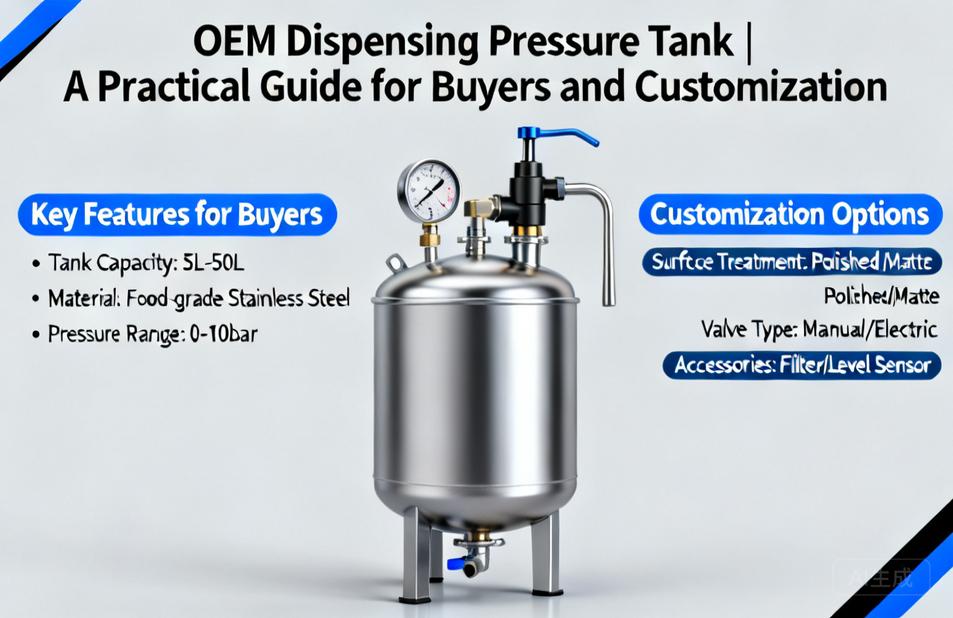
An OEM dispensing pressure tank is a sealed vessel designed to store and steadily deliver fluids, adhesives, sealants, lubricants, or other low-to-medium viscosity materials under regulated air pressure. In industrial production lines, it acts as a reliable reservoir that feeds dispensing valves, spray guns, or metering systems, ensuring consistent output without pulsation. This type of tank is widely used in automotive assembly, electronics manufacturing, packaging, and general industrial maintenance. For international buyers, working with an experienced dispensing pressure tank manufacturer or OEM supplier can significantly improve system compatibility and long-term operational efficiency.
What Is a Dispensing Pressure Tank and How Does It Work?
A dispensing pressure tank, also known as a pressure vessel or sealed fluid reservoir, operates on a simple principle: compressed air is introduced into the top of the tank, which applies uniform pressure onto the surface of the fluid. The fluid is then forced out through an outlet at the bottom or through an attached hose and dispensing valve. This design helps maintain a steady flow rate with minimal fluctuation, which is essential for consistent application of adhesives, solvents, or coatings in a production environment.
Unlike pumps that rely on mechanical action, pressure tanks are often preferred in applications where a smooth, continuous flow is required or where the fluid may be shear-sensitive. The pressure level is usually controlled by a regulator, and the tank can be refilled without interrupting the dispensing process when equipped with an appropriate refill valve. When you procure an OEM dispensing pressure tank, you are buying not just a simple container but a system component that must match your existing fluid delivery setup.
Key Features That Matter in an OEM Dispensing Pressure Tank
When evaluating a dispensing pressure tank for industrial use, several features directly influence performance and ease of maintenance. First, the internal surface finish is critical. A smooth interior, often achieved by electropolishing, prevents material buildup and reduces contamination risks. Second, the quality of the lid and clamping mechanism affects seal integrity and operator safety. A quick-open lid with a proper locking system shortens downtime during refills or cleaning. Third, the pressure rating of the vessel must align with your operating air pressure range, and a reliable safety relief valve should always be included.
Other features to look for include a sight glass for fluid-level monitoring, a pressure gauge, a bottom outlet with a valve arrangement that minimizes dead volume, and the ability to adjust stirring or agitation if you are handling settling materials such as pigments or fillers. Many custom pressure tank factories offer options like a stainless steel follower plate or a diaphragm to physically separate air from the fluid, which is beneficial for sensitive materials. Those additional components allow for better control of viscous or reactive fluids, so you should always discuss your specific material properties with the supplier.
Materials and Construction
The most common material for a dispensing pressure tank is 304 or 316 stainless steel. Stainless steel offers excellent corrosion resistance, is easy to clean, and is compatible with a broad range of chemicals, solvents, and food-related materials. For highly corrosive fluids or applications that demand higher purity, 316L stainless steel is preferred due to its lower carbon content and added molybdenum, which enhances resistance to pitting and chloride stress corrosion. The tank wall thickness, welding quality, and surface treatment are all factors that determine the vessel’s durability under repeated pressurization cycles.
While mild steel tanks exist for non-corrosive, low-cost applications, they are rarely suitable for OEM dispensing equipment because of rust and contamination risks. Therefore, when you ask a dispensing tank supplier about materials, always verify the exact grade of stainless steel and whether material certificates are available. A professional supplier will be transparent about weld seams, heat-affected zones, and the internal surface roughness, typically expressed in Ra values. This is important because finish quality dictates how easy it is to clean the tank between material changes, which in turn affects your production flexibility.
Industrial Applications and Fluid Compatibility
An OEM pressure tank is never a one-size-fits-all piece of equipment. Different industries require different flow rates, fluid viscosities, and pressure stability. The equipment is commonly used for applying adhesives on automotive interior trims, dispensing grease or oil in machinery assembly, sealing gaps with silicone in electronics enclosures, and coating parts with protective lacquers or paints. In pharmaceutical and food packaging lines, a dedicated stainless steel pressure tank may be used with a clean-in-place (CIP) arrangement to maintain hygiene. In textile and leather processing, it can feed dyes or finishing agents to a coating station.
Because the fluid directly contacts the tank interior, compatibility with the material is the number one requirement. For instance, chlorinated solvents may attack certain elastomeric seals, while acidic adhesives may corrode a poorly passivated stainless steel surface. Consequently, a reliable OEM pressure tank manufacturer should ask about your fluid composition, operating temperature, and required cleaning chemicals before recommending a standard or custom design. They can then advise on the appropriate gasket material, such as PTFE or FKM, and the correct valve type.
How to Choose the Right Dispensing Pressure Tank for Your Process
Selecting the right size is one of the most frequent challenges for buyers. A tank that is too small leads to frequent refills and process interruptions, while an oversized tank occupies floor space and increases the volume of fluid at risk if a batch goes bad. The ideal volume depends on the target flow rate and the expected refill interval. For example, a production rate of 1 liter per minute with a 10-minute refill cycle might suggest a 10- to 15-liter tank to allow safe buffer capacity. However, these calculations should always account for future production increases.
Beyond size, check the maximum operating pressure and the inlet air pressure required to achieve the desired flow. Some materials are thixotropic or require a higher pressure to start flowing; in such cases, you might need a tank rated for higher pressure or with a mechanical stirrer. You also need to decide the mounting style: portable units with wheels are convenient for maintenance or multiple stations, while stationary tanks with leg mounts are easier to integrate into a fixed production line. If you are retrofitting an existing line, it’s essential to confirm the thread connections and hose fittings to avoid extra adapter costs.
OEM and Customization Options
Every production environment is unique, which is why many companies prefer working with a custom pressure tank factory to get exactly what they need. OEM manufacturers can alter the height, the number of outlets, the location of the inlet, the type of lid, and even the shape of the bottom to match specific space constraints. They can also add accessories such as low-level alarms, air-operated stirrers, higher-grade seals, and custom nameplates or branding. In truly bespoke cases, your engineer can provide a drawing, and the manufacturer will produce a prototype or short-run sample for your in-house testing.
One common misconception is that OEM means simply putting your logo on a standard product. In a competent partnership, OEM manufacturing involves collaboration from material selection to final testing. For instance, if you handle abrasive media, the manufacturer might add a hardened inner lining or suggest a different outlet valve that minimizes wear. Or, if you need to meet specific food safety standards, they can provide documentation on surface finish and gasket materials. Therefore, choose a partner who is willing to discuss your application in detail and provide engineering input rather than a salesperson reading a catalog.
Buying Considerations and Supplier Selection
When you compare offers from multiple dispensing pressure tank suppliers, pay attention to more than just the unit price. Look for a supplier that can provide the complete package: pressure relief valve certificates, operational manuals, proof of pressure testing, and clear warranty terms on both the vessel and its metal components. The reputation of the manufacturer is also crucial; established factories are more likely to have consistent quality control procedures, including weld inspections and hydrostatic testing. If possible, request references from customers in your industry, and ask if you can visit the factory or arrange a remote video tour.
Another important point is spare parts availability. A pressure tank can be in service for many years, but seals, gauges, and valves will inevitably require replacement. Confirm that the supplier stocks spare parts for the model you plan to buy, or that they can provide a list of interchangeable standard components. Additionally, clarify the average lead time for both standard and custom units. While you should not demand unrealistically fast delivery, a transparent timeline indicates good production planning. Finally, ensure you understand the shipping terms, especially if the tank contains an air vent or demister, as some countries may treat pressure vessels as controlled goods.
Frequently Asked Questions
What is the difference between a pressure tank and a pump for dispensing fluid?
A pump uses mechanical action to move fluid, which is suitable for high flow rates or when a continuous supply is required directly from a bulk container. A pressure tank applies steady air pressure to the fluid surface, offering a more consistent and pulse-free flow, which is easier to control for variable-speed dispensing. In practice, some systems combine a tank with a small metering pump to obtain both precise volume control and smooth discharge.
Can I use one dispensing pressure tank for different materials?
It is possible, but it depends on material compatibility and the effort required for cleaning. If you change between materials of similar chemical nature, thorough flushing with a compatible solvent may be enough. For materials with very different properties, such as a curing adhesive and an oil, you may need to disassemble the entire fluid path, including the tank, hose, and gun, for cleaning. Many OEM tanks feature smooth surfaces and easy-open designs to simplify temperature changes and shorten cleaning time.
How can I verify the quality of an OEM company?
A quality-oriented OEMM supplier will provide production drawings, material test certificates, pressure test reports, and perhaps a sample unit for destructive testing. You should also investigate how they handle non-conformances and returns. Customer feedback, online reviews, and third-party factory audit reports are practical ways to assess a manufacturer. A reputable factory will not disappear after the purchase; they will be responsive to technical questions and after-sales needs.
What capacity of pressure tank should I choose?
Capacity is selected based on your expected material consumption per hour, the refill frequency you can tolerate, and the need to keep unused materials from curing or settling inside the tank. Consider a buffer of 20 to 30 percent beyond your average usage. For example, if you consume about 8 liters per hour, a 10-liter tank gives you little time margin, while a 15-liter tank is safer. Always calculate with your peak production rate and avoid assuming that a larger tank is always better, because leftover material may expire.
Conclusion
Selecting the right OEM dispensing pressure tank is a decision that affects product quality, worker productivity, and maintenance costs. The ideal tank combines correct volume, fitting material, pressure rating, and operational features that align with your specific fluid and production line. When you engage with an OEM manufacturer, treat the relationship as an engineering collaboration: share your substrate materials, cleaning procedures, and cycle times. This approach enables the supplier to propose the most robust and cost-effective design. With a reliable partner, you can achieve consistent dispensing results and a seamless integration of your equipment into a broader production system. To move forward, document your application conditions and contact a specialist to request a tailored proposal and obtain detailed specifications for your review.