

Adhesive Supply Tank | A Practical Guide for Industrial Bonding and Coating Operations
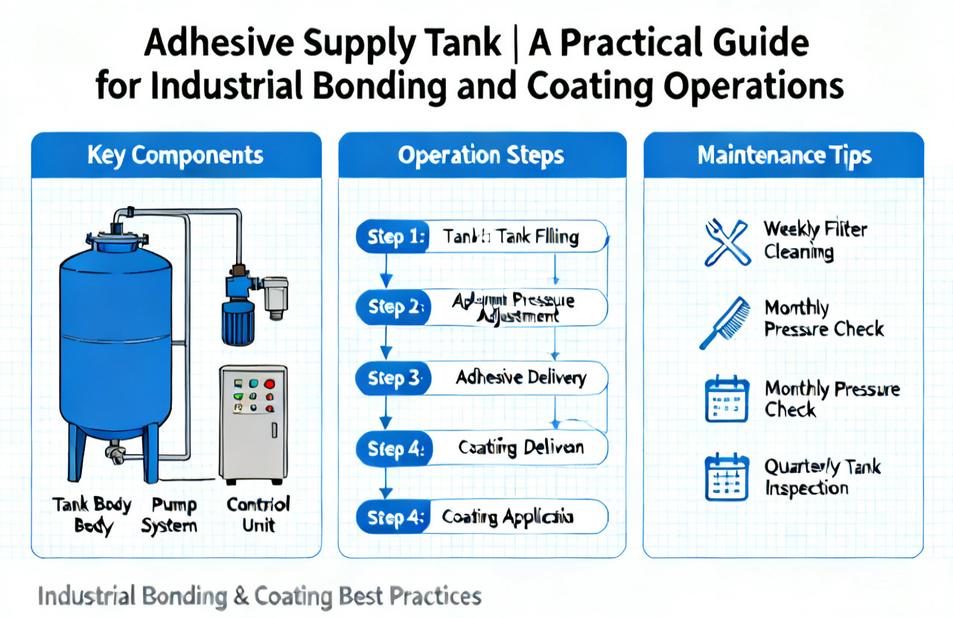
An adhesive supply tank is a dedicated vessel designed to store, condition, and continuously deliver adhesives or sealants to downstream application equipment such as dispensing guns, rollers, spray nozzles, or extrusion systems. In high-volume bonding, lamination, or coating operations, these tanks serve as a central source point that helps maintain consistent material flow, reduce manual refilling, and minimize production interruptions. This guide explains what an adhesive supply tank does, how it works, and what factors industrial buyers should evaluate when sourcing this equipment from a manufacturer or supplier.
Product Overview: Role of a Supply Tank in Adhesive Systems
In many production lines, adhesives are applied in a continuous process that requires a steady, uninterrupted feed of material. A supply tank sits upstream of the application head, receiving adhesive either manually or through a pump and feeding it to the point of use. It is common in industries such as woodworking, packaging, automotive assembly, filter manufacturing, and construction material production. Depending on the system design, the tank can be pressurized to push adhesive toward the nozzle, or it can work with a separate pump that draws material from the tank. Some models include heating elements to maintain a stable temperature for hot-melt or reactive adhesives, while others are designed for cold-applied products like water-based or solvent-based formulations.
Beyond simple storage, an adhesive supply tank often functions as a conditioner that helps control viscosity, degassing, or the mixing of components before application. For example, in a system using a two-part epoxy, the tank might hold the base resin before it is mixed with the hardener further downstream. This role makes the tank a critical component that affects the consistency and quality of the final bond line.
Key Features to Consider in an Adhesive Supply Tank
When evaluating a tank for adhesive handling, buyers typically look at a combination of functional and structural features. The most important include the tank material, capacity, heating or cooling capability, stirring or agitation, level monitoring, and the type of discharge connection.
Material and Construction
The vessel must be compatible with the specific adhesive chemistry being handled. Stainless steel, particularly grades such as 304 or 316, is the most common choice for tanks used with solvent-based, water-based, or reactive adhesives because it resists corrosion and is easy to clean. Carbon steel with an appropriate coating may be acceptable for certain non-corrosive formulations, but it is generally less recommended for frequent changeovers. A well-designed tank should also have a smooth interior finish with no dead zones where material can stagnate, which is important for preventing curing or residue buildup.
Capacity and Sizing
Tank volumes range widely, from small pilot units of a few liters to large vessels that hold several hundred liters or more. Choosing the right size depends on the adhesive consumption rate per shift and the logistics of refilling. A larger tank reduces the frequency of refilling but requires more floor space and a higher initial investment. It is important to consider whether the production line works continuously or in staggered batches, as that affects whether a tank should act as a buffer or simply as a day-tank.
Heating and Temperature Control
Many adhesives, especially hot-melt types, require precise heating to maintain the correct viscosity at the point of application. In such cases, the tank is fitted with electric heaters, thermal oil jackets, or steam coils. Temperature control accuracy and uniformity across the tank are critical because localized overheating can degrade the adhesive, altering its performance. For cold-applied adhesives, the tank may need active cooling in warm environments or simply insulation to stabilize temperature fluctuations.
Stirring and Mixing
Certain adhesives contain fillers or require agitation to keep the formulation homogeneous. A supply tank can include an agitator, usually a slow-speed stirrer or a recirculation pump, that prevents pigment separation or the settling of particles. This feature is often necessary in systems for sealants, mastics, or filled adhesives. The stirrer design must be gentle enough to avoid creating air bubbles, which can cause foam and voids in the adhesive layer.
Level Monitoring and Controls
Automating the level management in a supply tank helps reduce downtime and avoid running the application system dry. Simple float switches or more advanced continuous level transmitters can trigger alarms or automatically activate the filling pump. Some systems integrate a low-level sensor that signals a control unit to pause the line until the tank is replenished, preventing application defects.
How an Adhesive Supply Tank Works with Other Equipment
An adhesive supply tank rarely works alone. It is part of a system that includes pumps, filters, hoses, and application heads. The tank may be fed by a melt unit or a drum pump, and it discharges to a main distribution manifold. In a centralized system, one large supply tank can feed multiple application stations, each with its own flow control. In such a layout, consistent pressure and viscosity are necessary to ensure each station receives the same quality of adhesive. The tank inlet and outlet positions, as well as the presence of a return line for excess material, influence how well the system maintains stable flow. A well-designed supply tank should facilitate easy purging and cleaning, especially when the production schedule requires frequent adhesive changes.
Industrial Applications of Adhesive Supply Tanks
These tanks support a broad range of applications. In the converting industry, they supply adhesives for laminating films and foils. In furniture production, they feed edge-banding or veneer laminating equipment. The packaging sector uses them in case sealing and label applying lines. They are also present in the manufacture of composites, where they deliver resin or adhesive to a fiber applicator. For each application, the tank material, heating system, and discharge method must align with the specific adhesive type and the speed of the process. For example, a line applying a reactive polyurethane adhesive may require a tank with a sealed design and inert gas blanket to prevent moisture contact, whereas a hot-melt tank will prioritize heating uniformity and melt capacity.
How to Choose the Right Adhesive Supply Tank
Selecting a suitable tank for your production environment is a matter of translating process requirements into equipment specifications. Start by listing the physical and chemical properties of your adhesive, such as viscosity at application temperature, cleaning solvent required, and sensitivity to heat or air. Then, convert your usage rate into a minimum tank volume that avoids frequent refills but allows you to keep inventory moving. The tank should also fit into your floor layout, with appropriate clearances for opening the lid and removing the agitator. Additionally, think about how the tank will be filled: manually from pails, from a bulk container via a transfer pump, or through an automatic system. In all cases, it is wise to ask the manufacturer if the tank can be adapted to your existing pumps, filters, and lines.
Customization and OEM Options
Many industrial tank manufacturers provide standard models but also offer custom engineering services to meet unique requirements. Customization can include special flanges or threaded connections, alternative heating fluid circuits, specific agitator designs, and modifications to the tank height or mounting feet. It is also possible to add accessories like a diaphragm level switch, a pressure gauge, or a thermocouple. For companies that build adhesive application machines, obtaining an adhesive supply tank as an OEM component with a tailored interface is a common practice. When requesting a quote, give the supplier complete information about the adhesive, the expected duty cycle, and the space constraints. Clear specifications allow the manufacturer to propose a design that not only works but also meets any compliance or safety standards relevant to your region.
Buying Considerations for Adhesive Supply Tank Suppliers
Reliability of the tank construction and its control system is the most critical factor when comparing suppliers. A tank that leaks, heats poorly, or is difficult to clean will cause regular production problems. When evaluating a manufacturer or supplier, ask about their experience with similar adhesive systems and request references of installations that process the same generic type of adhesive. Also, check the quality of their documentation, including dimensional drawings, material certificates, and operating manuals. It is often useful to review whether the supplier can provide spare parts quickly and offer technical support for installation or troubleshooting. Since adhesive tanks are frequently located near the production floor, a design that emphasizes operator safety, such as guards on heated surfaces and pressure relief devices, is also fundamental.
Frequently Asked Questions
What is the difference between a pressurized and non-pressurized adhesive supply tank?
A pressurized tank uses air or inert gas pressure to push adhesive to the application point, which is helpful when no separate pump is available or when a constant pressure is needed. A non-pressurized tank works with an external feed pump that pulls adhesive out. The choice depends on the required flow rate and the available ancillary equipment.
Can an adhesive supply tank handle hot-melt and cold adhesives in the same unit?
Generally no, because hot-melt tanks require heating jackets and insulation, while cold adhesive tanks may need cooling or no thermal control. Trying to combine them in one tank complicates the design. It is better to use dedicated tanks for each type of adhesive temperature requirement.
How often should an adhesive supply tank be cleaned?
Cleaning frequency depends on the adhesive’s open time, residue properties, and production schedule. For reactive adhesives, cleaning is typically required at the end of each shift or before a product change. Solvent-based systems may allow longer intervals. Always follow the adhesive manufacturer’s guidelines and ensure the tank design permits easy access to all interior surfaces.
Conclusion
An adhesive supply tank is an indispensable element in any continuous bonding or coating operation that demands stable material delivery and consistent quality. The right choice depends on careful assessment of your adhesive formulation, process speed, and facility constraints. Never overlook the importance of construction material, thermal control, and cleaning convenience. Partnering with a reputable supplier or manufacturer who understands industrial adhesive handling can help you obtain a tank that is reliable, efficient, and tailored to your specific application, whether you need a standard unit or an OEM design. Contact an experienced supplier today to discuss your requirements, and request a tank configuration that matches your production goals.