

Industrial Glue Dispensing Pressure Tank | A Practical Guide for Buyers and Engineers
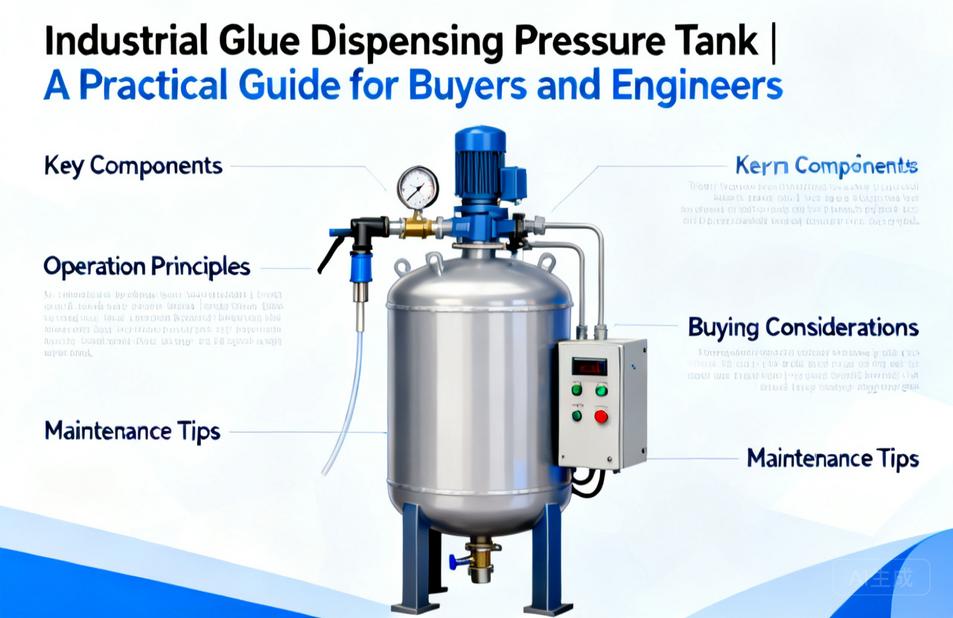
An industrial glue dispensing pressure tank is a sealed vessel that uses compressed air to deliver adhesives, sealants, and other viscous fluids to a dispensing valve or applicator. It is widely used in manufacturing lines, assembly operations, and maintenance workshops where consistent glue flow is required. Unlike manual caulking guns or pump-based systems, a pressure tank offers stable output pressure, reduces operator fatigue, and supports a range of container sizes from small cartridges to larger bulk reservoirs. This guide is intended for procurement managers, process engineers, and maintenance teams who are evaluating pressure tanks for adhesive dispensing in their facility.
What Is an Industrial Glue Dispensing Pressure Tank?
An industrial glue dispensing pressure tank is essentially a portable or stationary pressure vessel that holds adhesive in a removable or fixed cup. The tank is connected to a compressed air supply, and the air pressure pushes the glue through a hose to a hand-held applicator, spray gun, or automated dispenser. The operator controls the flow using a trigger or a separate air switch, which allows for start-and-stop dosing without pulsation. These tanks are commonly used with solvent-based and water-based adhesives, hot melt adhesives (when heated), silicone, polyurethane, and other one-component or two-component sealing materials. The main advantage is that the glue is not subjected to pump shear, which makes the system suitable for abrasive, filled, or shear-sensitive formulations.
Key Features to Evaluate Before Purchasing
When comparing glue pressure tanks from different manufacturers, several features determine performance and long-term reliability. First, pressure rating is critical: most tanks operate in the range of 0.1 to 1.0 MPa (15 to 150 psi), but you must select a model that matches your air supply and the viscosity of your glue. Second, the tank capacity affects productivity: common sizes include 5 liters, 10 liters, 20 liters, and 30 liters, but custom volumetric options are available from many factories. Third, the lid and clamping mechanism must allow fast refilling and safe pressurization. A quick-release toggle clamp is convenient for frequent batch changes. Fourth, the pressure gauge and safety valve must be accurate and durable, as these are your primary control and protection devices. Finally, consider the air regulator: a precision regulator with a filter and water separator is essential to protect the adhesive from moisture and to maintain consistent output.
Materials and Construction
Pressure tanks for industrial glue dispensing are most commonly made from stainless steel or carbon steel. Stainless steel (typically SUS304 or SUS316) is preferred for water-based adhesives, food-grade applications, or when the glue contains solvents that may corrode mild steel. Carbon steel tanks are often coated with a corrosion-resistant lining, such as epoxy or PTFE. For very reactive adhesives, a PTFE lined tank can provide additional chemical resistance. The inner surface finish also matters: a smooth finish reduces glue residue and makes cleaning easier. Welded seams should be ground polished to avoid trapped air or debris. Since pressure tanks are safety equipment, reputable manufacturers will conduct pressure testing and mark the vessel with working pressure and maximum allowable pressure. You should request a test certificate from your supplier, especially for custom-built tanks.
Common Applications in Manufacturing
Industrial glue pressure tanks are used across many assembly processes. In woodworking and furniture production, they apply edgebanding adhesive, contact cement, and PVA glue for laminating. In packaging lines, they deliver hot melt adhesive to carton sealing and case erecting machines. In automotive and electronics assembly, pressure tanks apply structural adhesives, conformal coatings, and thermally conductive pastes. In filter manufacturing, they are used for end caps and pleat bonding. Other industries include textile lamination, bookbinding, construction material production, and appliance assembly. The versatility of a pressure tank system is one of its primary selling points: a single tank can serve multiple stations if you use a manifold or multiple hoses. It also works well for low-volume manual applications where a full automatic dispensing robot is not justified.
How to Choose the Right Pressure Tank for Your Glue System
Selecting the correct industrial glue dispensing pressure tank involves matching the tank size, pressure range, and fittings to your adhesive characteristics and floor layout. Start by calculating your average glue consumption per day or per shift. If you use more than one liter per hour, a 10-liter or larger tank is practical to avoid frequent refills. Then, consider the glue viscosity: a thicker adhesive may require higher air pressure or a wider outlet tube. If your adhesive is corrosive or contains solvents, choose stainless steel or a lined tank. Also, check the inlet and outlet connections: most tanks have a 1/4-inch NPT outlet, but your existing hoses and dispenser may require adapters. Do not forget to confirm the maximum operating temperature if you are handling hot melt adhesive; a heated pressure tank jacket or a heating plate is often necessary.
Customization and OEM Options
Many factories offer customization for glue dispensing pressure tanks. You can specify the tank capacity, number of outlets, type of pressure gauge (analog or digital), and additional features such as an agitator to prevent separation of filled adhesives. For OEM manufacturing, you can have the tank painted with your brand color, add a custom nameplate, or modify the outlet valve configuration to suit your own dispensing guns. Custom pressure tanks are typically built in batches, and the lead time depends on the complexity of the order. If you are sourcing for a new product line, it is wise to provide the supplier with a complete set of specifications, including adhesive type, maximum operating pressure, required flow rate, and the environment in which the tank will be used. This allows the manufacturer to recommend the correct seals and gaskets, as many adhesives are incompatible with nitrile rubber but work well with Viton or EPDM.
Buying Considerations: Safety, Certifications, and Supplier Reliability
When buying an industrial glue pressure tank, do not base your decision solely on price. Safety is paramount because the tank is a pressure vessel that operates in a workspace with flammable solvents or hot materials. Confirm that the tank complies with relevant standards such as CE, PED (Pressure Equipment Directive), or ASME in regions where it is required. Request a data sheet that lists maximum allowable working pressure, test pressure, and minimum and maximum operating temperature. Also, ask about the seal materials and whether they are suitable for your adhesive chemistry. A reputable supplier should willingly provide this information. Check the supplier’s manufacturing capability: does the factory have their own welding, machining, and testing equipment? Look for an ISO 9001 certification, which indicates a structured quality management system. If possible, ask for a sample or visit the factory to inspect the build quality. Many suppliers in this segment are located in China, India, and other manufacturing hubs, but you can also source from established Western brands. The key is to balance cost with durability and after-sales support.
Frequently Asked Questions
What size pressure tank do I need for a low-volume adhesive application?
For intermittent use, such as maintenance or prototype assembly, a 5-liter or 10-liter tank is sufficient. It is easier to refill and clean than a larger tank, and it can still deliver a consistent bead for several hours. If you are running multiple dispensing stations, consider a larger central tank with a distribution manifold.
Can I use the same pressure tank for different types of glue?
Yes, but you must thoroughly clean the tank, hoses, and valves between adhesive changes. Adhesive residues can cross-contaminate, affecting bond strength. Some adhesives are chemically aggressive, so you may need to replace the seals when switching to a solvent-based product. It is advisable to have dedicated tanks for different adhesive families to reduce changeover time.
What is the difference between a pressure tank and a pump-based dispensing system?
A pressure tank relies on compressed air to push the adhesive, while a pump system uses a piston or gear pump to draw and discharge the fluid. Pressure tanks are simpler, cheaper, and easier to clean, but they have a lower maximum flow rate. Pumps offer steadier volume for high-speed automation, but they are more expensive and can shear shear-sensitive adhesives. For most manual and semi-automatic applications, a pressure tank is the preferred choice.
How often should I perform maintenance on a glue pressure tank?
Daily, drain any condensation from the air filter. Weekly, inspect the hoses for abrasion or leaks. Monthly, check the safety valve by pulling the ring briefly. Annually, have the pressure gauge calibrated and check the internal lining for corrosion. The tank should also be hydrostatically tested periodically, following local regulations for pressure vessels.
Conclusion
An industrial glue dispensing pressure tank is a reliable and cost-effective solution for controlling adhesive flow in a wide range of production and maintenance tasks. By understanding how pressure, capacity, and materials affect performance, you can make an informed choice that reduces waste and improves consistency. Always consult with a manufacturer or supplier about your specific adhesive type, operating pressure, and required fittings to ensure compatibility. If you are considering a custom configuration or OEM supply, request a technical drawing and a sample before placing a bulk order. A well-chosen pressure tank will provide years of service, so it is worth investing time in supplier evaluation and specification review. Contact several factories, compare their documentation, and ask detailed questions to find the source that matches your application needs.