

Sanitary Stainless Steel Tank | Applications, Construction, and Buying Guide
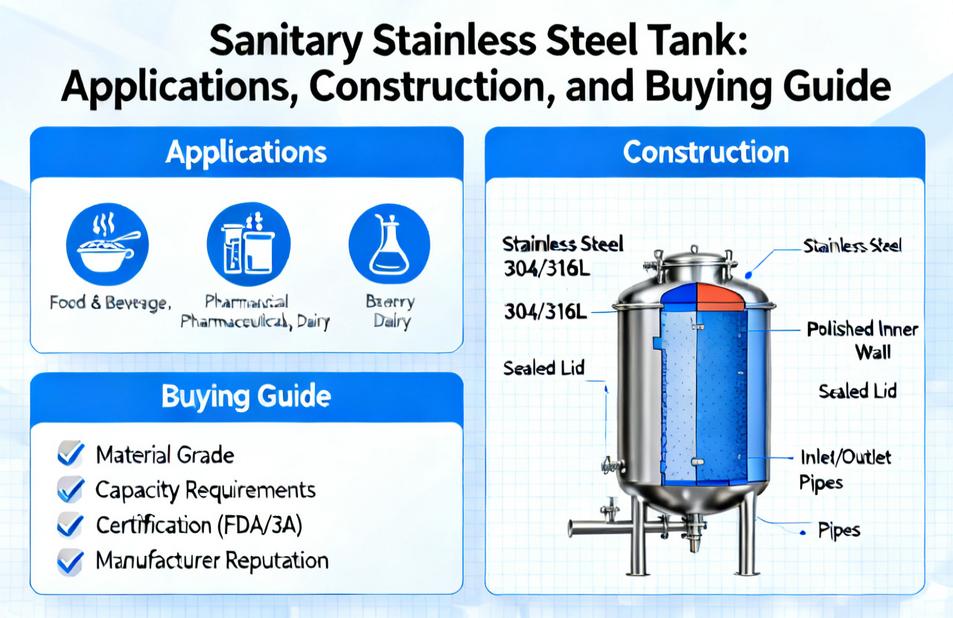
A sanitary stainless steel tank is a critical piece of process equipment designed for industries where hygiene, cleanability, and product purity are non-negotiable. Commonly found in food and beverage processing, pharmaceutical manufacturing, cosmetics production, and biotechnology, these tanks are built to meet strict sanitary standards and are typically used for storing, mixing, heating, cooling, or transporting liquid ingredients and intermediate products. Understanding the design, material, surface finish, and operational requirements of a sanitary stainless steel tank is essential for buyers who need reliable, long-term performance in regulated environments.
What Is a Sanitary Stainless Steel Tank?
A sanitary stainless steel tank is a closed or open-top vessel constructed from food-grade or pharmaceutical-grade stainless steel, usually type 304 or 316L, with a smooth, polished interior surface that prevents bacterial growth and facilitates cleaning. Unlike industrial storage tanks used for non-food chemicals, these tanks meet hygienic design principles, such as crevice-free welding, rounded corners, and selectable surface finishes like 0.8 µm Ra or better. Their primary purpose is to maintain product integrity during processing cycles, whether the tank is used for short-term storage, fermentation, blending, or as a surge vessel in a continuous production line. They are often integrated with a clean-in-place (CIP) system and can be equipped with agitators, heating jackets, level sensors, and sampling valves to support automated and manual operations.
Key Features to Consider in Sanitary Tank Construction
Not all stainless steel tanks labeled as sanitary are suitable for every process. Buyers should examine several design features that directly affect functionality and compliance. The material grade is the first consideration: 304 stainless steel provides good corrosion resistance for many food applications, while 316L, with its low carbon content and added molybdenum, offers superior resistance to chlorides and acidic media, making it a common choice for pharmaceutical and high-temperature processes. Surface finish is equally important. Standard sanitary tanks have an interior surface polished to at least 180 grit, but for critical applications such as parenteral drug storage, a higher polish like 320 grit or electrolytic polishing is preferred to minimize particle entrapment. Additionally, welds must be continuous, fully penetrated, and ground smooth to eliminate pits and crevices.
Types of Sanitary Stainless Steel Tanks
Depending on the process application, these tanks come in various configurations. Storage tanks are simple vertical vessels used to hold raw materials or finished liquid products. Mixing and blending tanks feature an agitator, baffles, and often a dual-purpose jacket for heating or cooling. Fermentation tanks include a closed design with ports for inoculation, sampling, and gas exchange, sometimes with a sight glass and lighting for visual inspection. Reactor vessels are more complex, allowing controlled temperature and pH adjustments. For downstream processes, pressure-vacuum rated sanitary tanks may be used to transfer liquids through a plant, while insulated tanks maintain temperature consistency. All of these are available as standard product lines or custom-engineered units from a sanitary tank manufacturer, depending on capacity, space constraints, and process parameters.
Common Industrial Applications for Sanitary Stainless Tanks
The versatility of these tanks makes them indispensable across diverse sectors. In the dairy and beverage industry, they are used for milk pasteurization hold-up, juice blending, and beer conditioning. In the food sector, they store edible oils, sauces, and marinades, often requiring a scraped-surface or paddle agitator for viscous products. The pharmaceutical and biotech industries rely on these tanks for formulating buffer solutions, cultivating cells, and holding intermediates under aseptic conditions. Cosmetics and personal care manufacturers also use them for producing lotions, shampoos, and liquid soaps, where batch consistency and cleanability are required. Beyond these well-known applications, sanitary tanks can be found in specialty chemical processes that require food-grade materials, such as producing fragrance compounds or flavoring essences. Regardless of the industry, the tank should be matched with the product composition, operating temperature, and cleaning frequency to avoid contamination or premature wear.
How to Choose the Right Sanitary Stainless Steel Tank
Selecting an appropriate tank involves assessing a combination of process parameters and practical constraints. First, determine the required working volume and whether you need full vacuum or pressure rating. A common mistake is ignoring the operating pressure of an atmospheric tank when connected to a transfer pump, which can cause structural deformation. Next, evaluate the liquid characteristics: high solids content or sticky materials may require a steep conical bottom with a large discharge valve, while foaming media might need a foam-breaking spray ball. Consider the temperature range and whether the product requires external heating or cooling; jacketed tanks are available in dimple, half-pipe coil, and full vacuum jacket styles, each offering different heat transfer efficiency and cost. Another key point is the cleanability: verify that the tank is compatible with your CIP system, including spray devices and pipeline orientation. Finally, think about future expansion—a modular design with flexible ports and interchangeable components may save costs later.
Material Finish and Compliance
For buyers selling into regulated markets, compliance is a top priority. The most common standards referenced in sanitary tank specifications are FDA (for food contact materials), 3-A Sanitary Standards (for dairy and food) and ASME BPE (for biopharmaceutical equipment). However, the tank manufacturer’s compliance does not end with fabricating a vessel; they also need to provide material certificates, weld documentation, and a surface finish inspection report. When you contact a factory, always ask for a clear understanding of the surface roughness average, the polishing method, and whether passivation has been performed after welding. For pharmaceutical use, a sanitary tank may also need to meet requirements for ferrite content or product-contact surface testing using a surface comparator. Choosing a supplier with in-house quality control guarantees consistency across multiple batches, reducing the risk of out-of-specification materials.
OEM and Custom Sanitary Tank Options
Most sanitary stainless steel tank suppliers offer both standard models and custom-engineered solutions. If you have an existing footprint and specific port locations, OEM manufacturing allows you to adapt the tank to your unique piping and structural supports. Custom tanks might also include specialized fitting types, such as Tri-Clamp, DIN, or SMS connectors, or specialized internals like a spray ball with a fixed rotation pattern. When requesting a custom proposal, provide a detailed specification sheet that includes capacity, dimensions, material grade, surface finish, pressure and temperature limits, agitation requirements, heating or cooling method, and any applicable regulatory codes. This information enables the factory to supply an accurate quotation and manufacturing drawing. In most cases, custom orders are subject to a one-time tooling charge, but due to the simplicity of stainless steel fabrication, a tank with minor modifications often carries a modest premium over a standard unit.
Buying Considerations: Quality, Price, and Delivery
When evaluating potential manufacturers or suppliers, it is wise to look beyond the initial quoted price. A thorough due-diligence process should include factory audits or request for photographs and video of similar tanks in production. Check if the supplier is capable of advanced welding techniques, such as orbital welding for the pipework, which ensures consistent weld quality. Ask about their average lead time: standard tanks with a capacity from 1,000 to 10,000 liters are often delivered in 4-8 weeks, while specialized or fully custom tanks may take up to 12-16 weeks. But these timelines are only approximations, and you should always verify current delivery schedules with the supplier. Also, clarify the terms of warranty and after-sales support, including spare parts availability. Since a sanitary tank is a long-term investment, prioritize a supplier who demonstrates strong engineering knowledge and responsive communication, as this will greatly simplify installation and future maintenance.
Installation and Maintenance Tips
Proper installation is essential for safe operation and longevity. Ensure the tank is installed on a level foundation with adequate clearance for inspection and cleaning. All connections, including electrical, process, and utility lines, should be routed to minimize stress on nozzles. Before first use, the entire system should be thoroughly cleaned and passivated if required. On a routine basis, visually inspect the interior and exterior for any signs of pitting, stress corrosion, or mechanical damage. Calibrate temperature sensors and level transmitters according to the manufacturer’s schedule. If the tank is used for products with high chloride content, more frequent inspection is recommended due to the slightly higher risk of corrosion on non-316L grades. Also, always replace worn gaskets and seals, as they are a common point of contamination and leakage.
Frequently Asked Questions
What is the difference between a sanitary tank and a regular industrial stainless steel tank?
A sanitary stainless steel tank is specifically designed for hygienic processes where product cannot be contaminated by microorganisms or residues. The interior is polished to a smooth finish, there are no dead zones where product can accumulate, and it often includes sanitary fittings that are easy to disassemble and clean. A regular industrial tank may have a weld seam that is not ground flush and a rougher internal finish, which can harbor bacteria and make cleaning difficult. Sanitary tanks also conform to stricter design standards for welding and material traceability.
How do I know if I need a 304 or 316L grade tank?
For most food and beverage applications with mild corrosive media at moderate temperatures, 304 stainless steel is suitable and more affordable. Choose 316L when the product contains chlorides, such as salt brine or seawater, or when using strong acid cleaners or sanitizers, because the addition of molybdenum in 316L improves corrosion resistance. In pharmaceutical injectables where any risk of metal ion migration is unacceptable, 316L is often preferred. Consult your tank supplier with complete details of the chemicals in contact, maximum temperature, and cleaning chemicals to make an informed decision.
Can a sanitary stainless steel tank be used for both mixing and storage?
Yes. Many storage tanks can be fitted with an optional side-mounted or top-entry agitator, and the tank can be insulated or jacketed to maintain temperatures. However, if you are mixing thick pastes or powders into a liquid, a higher-horsepower agitator with a special blade design and bottom support may be required. A dual-purpose tank also requires sufficient freeboard to accommodate vortex and splashing. It is often simpler to have a dedicated mixing tank and a separate storage tank, but your process conditions will ultimately decide.
What kind of documentation should I request from a sanitary tank supplier?
At a minimum, request material test certificates (mill certificates) showing the chemical composition of the stainless steel, a surface finish report or profilometer reading, weld maps and/or welder qualification records, and a pressure test certificate for pressurized vessels. If the tank is for pharmaceutical use, ask for a breakdown of the surface polish and a final inspection checklist. This documentation helps satisfy regulatory audits and provides confidence in the equipment quality.
Conclusion
A sanitary stainless steel tank is an important investment for any manufacturer who values product purity and process reliability. The best choice depends on a thorough evaluation of your application, the physical and chemical properties of your products, cleaning and sterilization requirements, and the regulatory environment you operate in. By focusing on material grade, surface finish, weld quality, and compliance, you can secure a tank that will perform for many years. Always ask potential suppliers for detailed specifications, lead times, and after-sales service terms. If you have a unique volume or space requirement, explore OEM or custom options because most experienced tank manufacturers can adapt their standard designs. Contact us with your specific capacity, media composition, and operating temperature, and our engineering team will provide a tailored recommendation and quotation for your next sanitary stainless steel tank project.
Related Reading
- Automatic Dispensing Tank | How It Works and How to Select the Right Unit for Your Production Line
- Coating Supply Pressure Tank | Working Principle, Material Options and Selection Guide for Industrial Coating Systems
- Non Standard Pressure Tank | Custom Solutions for Specialized Industrial Applications