

Coating Supply Pressure Tank | Working Principle, Material Options and Selection Guide for Industrial Coating Systems
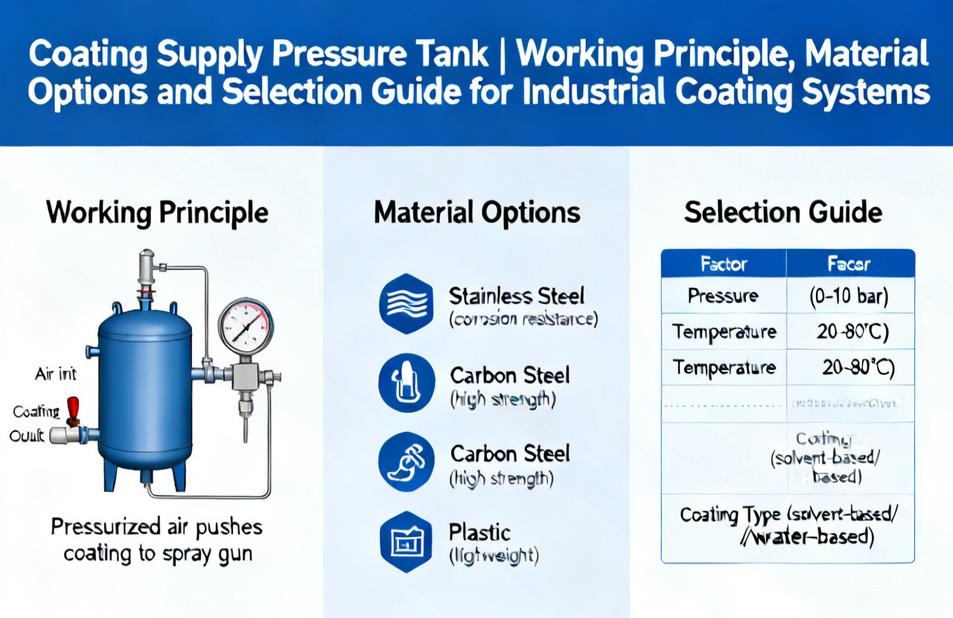
A coating supply pressure tank is a key component in industrial fluid handling systems, widely used to store and deliver paints, lacquers, varnishes, primers, adhesives, and other low-to-medium viscosity coating materials under regulated pressure. Instead of relying on a pump, a coating supply pressure tank uses compressed air to push coating material from the tank through a hose to the application tool, such as a spray gun, automatic spray station, or dispensing valve. This pressure-fed method is common in wood finishing, metal coating, furniture manufacturing, automotive refinishing, and general industrial painting operations where a steady, pulsation-free material flow is required. For B2B buyers looking for a coating pressure pot, understanding the design, materials, working mechanism, and key selection criteria is essential before contacting a coating supply pressure tank manufacturer or supplier.
What Is a Coating Supply Pressure Tank and How Does It Work?
A coating supply pressure tank, also referred to as a pressure pot, pressure vessel, paint pressure tank, or pressure feed tank, is a sealed container that holds coating material and applies air pressure to its surface, forcing the liquid upward through a dip tube and out to the spray gun or applicator. The system usually consists of a tank body, a quick-opening or bolted lid, a pressure regulator with gauge, an air inlet valve, a material outlet valve, a safety valve, and a stirring mechanism or agitator for tanks used with materials that tend to settle. The operator adjusts the incoming air pressure to achieve the desired material delivery rate and atomization quality. Because the coating remains inside a sealed tank, contamination is minimized, evaporation is reduced, and the working environment is cleaner than with open pressure cups. This working principle makes the unit suitable for both manual spraying and automated coating lines, where a consistent supply of material can help maintain uniform film thickness and reduce rejects.
Key Features to Evaluate Before Buying a Paint Pressure Tank
When searching for a coating supply pressure tank for sale, industrial buyers should evaluate several features that affect performance, safety, and maintenance. First, the tank capacity is an important practical factor. Pressure vessels are commonly available in capacities ranging from small portable units of 2 to 5 liters for touch-up operations up to 20, 30, 40, or 60 liters for continuous industrial spraying. Second, the maximum allowable working pressure is a serious design parameter directly related to operator safety. A standard coating pot may be designed for a working pressure between 2 and 8 bar, but the actual rating depends on the vessel construction, wall thickness, and applicable pressure vessel standards in the destination country. Third, the type of pressure gauge and regulator should be precise and easy to read, allowing fine adjustments to avoid material starvation or over-pressurization. Fourth, look for an agitator option if you plan to use metallic paints, ceramic coatings, or materials with heavy pigments that settle quickly. A manual or air-driven stirrer keeps the coating homogeneous during operation. Fifth, consider whether the unit includes a quick-opening lid with clamps or a c-clamp design, which makes cleaning and refilling easier, reducing downtime between color changes or batch operations.
Materials and Construction of a Coating Pressure Pot
The construction material of a coating supply pressure tank is a decisive point for compatibility and service life. Carbon steel tanks are generally less expensive, but they require an internal protective lining to prevent rusting and chemical attack when used with water-based or corrosive coatings. Stainless steel pressure tanks, often made of SS304 or SS316, offer excellent corrosion resistance, cleanliness, and durability, which is why stainless steel models are preferred for food-related coatings, waterborne paints, pharmaceutical lacquers, and high-purity applications. Some stainless steel tanks are supplied with an electropolished interior to reduce coating buildup and simplify cleaning. The lid sealing system should use a compatible gasket material, such as PTFE, Viton, or Nitrile, selected according to the solvent content of the coating. If you require a tank for solvent-based paints, check that the gasket is solvent-resistant and that all wetted parts do not become brittle or swell. Suppliers may also offer an interior liner made of polyethylene for quick color changes and to protect the tank body. Always confirm the material certificate if your process demands traceability or if the tank will be used in regulated industries.
Industrial Applications of Coating Supply Pressure Tanks
Coating supply pressure tanks are used across a wide spectrum of industrial applications. In the furniture and woodworking sector, they supply lacquers, sealers, stains, and topcoats to manual spray guns, providing an even feed that helps produce a smooth finish on cabinet doors, panels, and architectural millwork. In metal fabrication and machinery manufacturing, these tanks deliver primers, anti-corrosive paints, and finish paints to coating lines or robotic spray equipment. Another active application is in the automotive refinishing and trailer manufacturing sector, where a pressure tank is often used for underbody coatings, cavity wax, and heavy-bodied materials that are difficult to pump. In the production of electrical enclosures and control cabinets, operators often rely on a small or medium pressure feeding tank to supply conductive coatings or EMI shielding paints. Beyond liquid coatings, a modified pressure pot can also serve as a reservoir for applying release agents, mold coatings, adhesives, sealants, and grease in assembly processes. Whether you are a coating contractor, an original equipment manufacturer, or a coating job shop, a reliable pressure feed system supports better transfer efficiency and a more consistent finish film.
How to Choose a Suitable Coating Supply Pressure Tank for Your System
Choosing the right coating supply pressure tank is not simply about picking a large tank from a coating pressure tank supplier. You should first consider the nature of your coating material. High-viscosity materials need higher pressure or a larger bore outlet and shorter hoses. For paint that contains abrasive pigments, you may need a tank with a reinforced lid and large internal passages to reduce clogging. Second, calculate the required material consumption rate of your spray gun or applicator, which depends on the nozzle size, fluid tip, and atomization pressure. If your gun consumes a high volume per minute, a tank with too small a capacity may need frequent refilling, which interrupts production. Third, think about the operating environment. Stationary tanks inside a clean production booth may not require handles or wheels, while portable tanks used on different workstations benefit from a sturdy cart. Fourth, check the compatibility of the tank with your existing air supply. Confirm the air consumption and the required supply pressure range, and ensure that your compressor can deliver enough air to maintain the set pressure without excessive fluctuation. Fifth, consider the ease of cleaning, because coating residue can harden and contaminate the next batch. Removable lids, smooth internal surfaces, and all-welded joints without crevices are significant advantages.
Customization and OEM Options for Pressure Feed Tanks
For buyers with special requirements, many coating tank manufacturers offer customization or OEM services. You may request alterations such as a special tank capacity not available in the standard catalog, an additional second outlet to feed two spray guns simultaneously, an alternative regulator range, or a different mounting bracket for robotic integration. Custom markings, colors, and labeling are also possible for brands that wish to sell pressure pots under their own name. If you need equipment that meets your national pressure vessel code, you should tell your supplier early so that design calculations, inspection documentation, and certification can be prepared accordingly. Some factories provide a custom dip tube length to suit a specific container height or angle of installation, as well as special quick-connect fittings for your existing hoses and couplings. When requesting a quote, it is helpful to provide your target viscosity, maximum working pressure, operating temperature, and available air supply flow rate. Meanwhile, for standard units, a direct purchase from a professional coating supply pressure tank factory can save both cost and lead time, especially if the factory has a complete production line from welding, polishing, testing to final assembly.
Buying Considerations: Supplier Selection, Quality Inspection, and After-Sales Support
The reliability of your coating supply pressure tank supplier is as critical as the product itself. A reputable supplier should be able to provide basic product documentation, material certificates for the pressure-containing parts, and test certificates for pressure testing. Quality inspection before shipment often includes an air pressure test underwater or using a leak detection solution, checking that the regulator holds the set pressure without drift, confirming that the pressure release valve opens at the designated set point, and examining the internal surface for rough welds or weld spatter. Ask the supplier about the after-sales support, especially the availability of spare parts such as gauges, regulators, gaskets, hoses, and foot valves, since these consumable parts require replacement over time. Also consider the logistics costs, as pressure tanks are heavy and may be classified as dangerous goods if shipped with residual pressure or with solvent residues in the tank. A good coating supply pressure tank manufacturer will clean and dry the tank thoroughly before export and fix all the valves and fittings to avoid damage in transit. You should also compare the warranty period and the procedure for submitting claims if a defect appears after receipt. In many overseas purchasing scenarios, it is wise to ask for product photos and videos before shipment, and if possible, arrange for a third-party inspection to verify that the delivered goods match the agreed specifications.
Frequently Asked Questions
What is the difference between a pressure tank and a pressure cup?
A pressure cup is a small vessel that is mounted on the spray gun itself or connected close to the gun, with a typical capacity of less than one liter. A pressure tank is a floor-standing or wall-mounted pressure vessel with a much larger capacity, designed to supply material continuously to a spray gun or automatic applicator through a long hose. Pressure cups are suitable for short production runs and frequent color changes, while pressure tanks are preferred for longer production runs because they reduce refill cycles and help maintain a more consistent fluid pressure.
Can the same pressure tank be used for solvent-based and water-based coatings?
It depends on the tank material and the gasket compatibility. Stainless steel tanks are generally safe for both solvent-based and water-based coatings, as long as the gasket material is compatible with the solvent. Carbon steel tanks need an internal lining or coating to avoid corrosion when used with waterborne materials. If you use the same tank for different coating types, you must clean it thoroughly between changes to avoid cross-contamination and possible reactions between different resins.
How do I determine the correct air pressure for my spray gun?
The recommended air pressure is typically indicated in the spray gun manual, and the coating supply pressure should be adjusted according to the viscosity, fluid tip size, and desired flow rate. A common practice is to start with a low material pressure and gradually increase until the spray pattern is stable and free from spitting or orange peel. If you notice paint starvation at the end of the stroke, the pressure may be too low. Conversely, if the pattern becomes too wide or excessive overspray occurs, reduce the pressure. Using a pressure tank regulator with a clear gauge is helpful to monitor the exact delivery pressure.
What safety features should I expect in a coating supply pressure tank?
Standard safety features include a safety relief valve that opens when the pressure exceeds the preset maximum limit, a pressure regulator to prevent over-pressurization, and a pressure gauge to indicate the internal pressure. The tank lid should have a locking mechanism that prevents accidental opening when the tank is under pressure. Before opening a tank, the operator must relieve the internal pressure completely using the air exhaust valve. Reputable suppliers will pressure-test each tank before delivery according to a specified test pressure, and some tanks are marked with an identification plate showing the maximum allowable working pressure, test pressure, and date of manufacture.
Conclusion
Selecting the right coating supply pressure tank can have a direct influence on the productivity and finish quality of your coating operation. From checking the material compatibility and capacity to verifying safety valves and looking for customization options, buyers should perform an evaluation that match the tank to the specific coating type, spray equipment, and production environment. Working with an experienced coating supply pressure tank factory can help you avoid the common pitfalls of leaking seals, inaccurate pressure control, or poor surface finishes. Before you place an order, consult your supplier with details about your coating viscosity, typical batch size, and the number of applicators to be fed, so that the recommended tank is neither over-specified nor undersized. When you are ready to make a purchase, ask a reliable coating supply pressure tank manufacturer for a product specification sheet and a prompt quotation, and feel free to inquire about OEM branding or custom modifications to suit your production line. Choosing the correct pressure vessel is a straightforward process if you base your decision on technical compatibility and supplier accountability rather than price alone.