

How to Choose a Reliable Pressure Tank Manufacturer for Industrial Applications
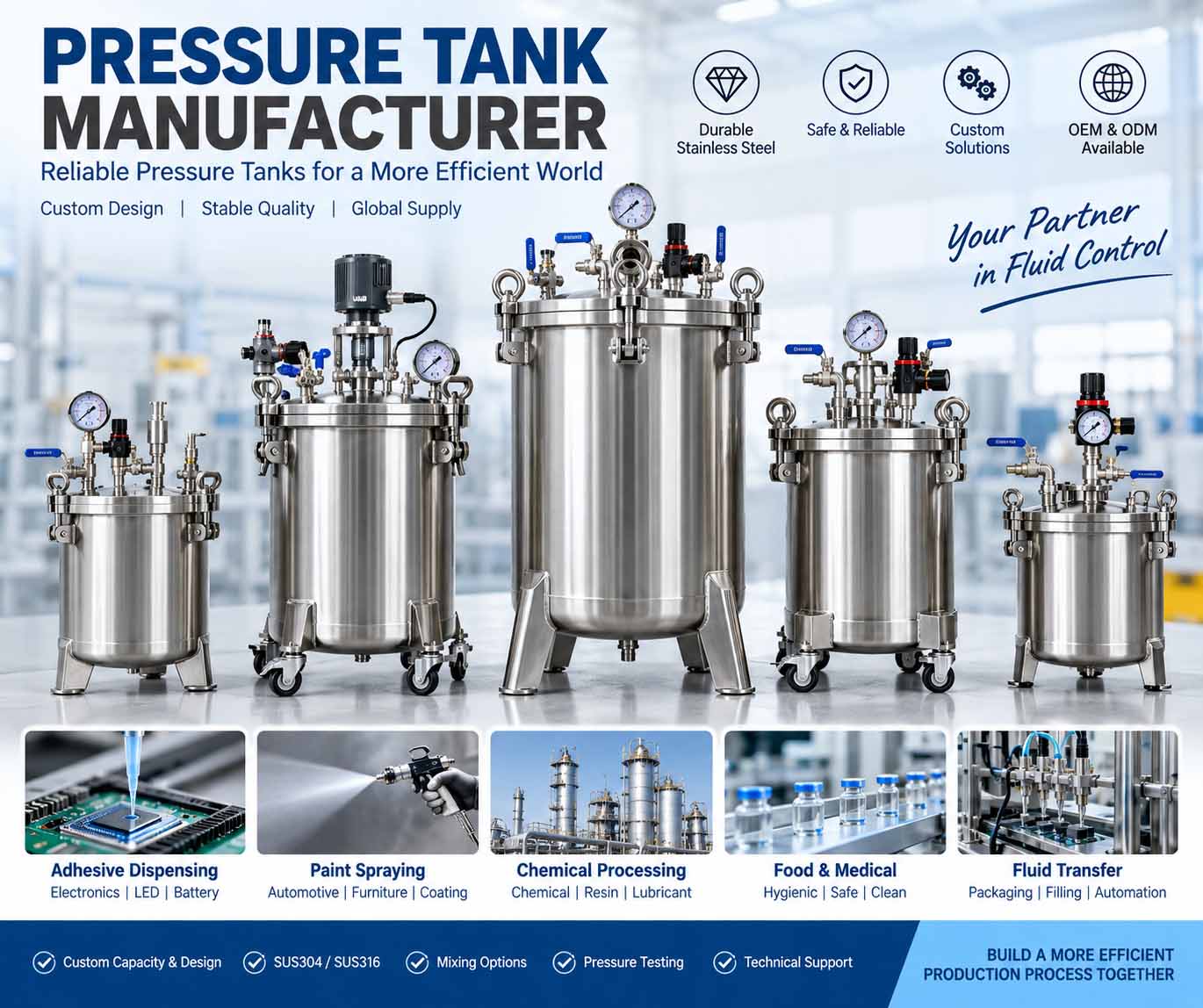
Choosing the right pressure tank manufacturer is an important decision for companies that depend on stable fluid storage, dispensing, mixing, spraying, or transfer systems. A well-designed pressure tank can improve production efficiency, maintain consistent pressure, and support safer industrial operation.
Pressure tanks are widely used in adhesive dispensing, paint spraying, coating, chemical processing, electronics manufacturing, food processing, laboratory systems, and automated production lines. Because different industries have different requirements, buyers should evaluate not only the tank itself but also the manufacturing capability, material quality, customization options, and technical support of the supplier.
What Does a Pressure Tank Manufacturer Provide?
A professional pressure tank manufacturer designs and produces tanks that can safely hold liquids or materials under controlled pressure.
Depending on the application, manufacturers may supply:
- Stainless steel pressure tanks
- Adhesive dispensing pressure tanks
- Paint pressure tanks
- Pneumatic pressure tanks
- Mixing pressure vessels
- Small pressure vessels
- Industrial dispensing tanks
- Custom pressure tanks
- Sanitary stainless steel tanks
- Fluid transfer tanks
Some manufacturers focus on standard models, while others provide OEM and custom fabrication services for special production requirements.
Why Stainless Steel Is Commonly Used
Stainless steel is one of the most popular materials for industrial pressure tanks because it offers a strong combination of durability, corrosion resistance, and clean appearance.
A reliable stainless steel pressure tank manufacturer may offer different grades such as SUS304 and SUS316, depending on the fluid being processed and the operating environment.
SUS304 is commonly used for many industrial applications, while SUS316 may be preferred when stronger corrosion resistance is required.
The correct material should be selected according to:
- Fluid composition
- Chemical compatibility
- Operating pressure
- Working temperature
- Cleaning requirements
- Production environment
Material selection directly affects tank performance and service life.
Custom Pressure Tank Manufacturing
Standard tanks are not suitable for every production line.
For this reason, many buyers prefer working with a custom pressure tank manufacturer that can adjust the tank design according to specific operating conditions.
Customization may include:
- Tank capacity
- Working pressure
- Stainless steel grade
- Tank diameter and height
- Inlet and outlet size
- Lid structure
- Hose connections
- Pressure gauge
- Pressure regulator
- Safety relief valve
- Liquid level sensor
- Agitator
- Heating system
- Insulation
- Mounting structure
Customized tanks can also be designed to fit automatic dispensing machines, robotic systems, spray equipment, filling machines, and other industrial production systems.
Pressure Tanks for Adhesive Dispensing
Adhesive dispensing is one of the most common applications for industrial pressure tanks.
A pressure tank can provide a continuous supply of glue, resin, sealant, silicone, coating, or other fluid to a dispensing valve.
Compared with frequent manual refilling, a pressure tank can support longer production cycles and more stable material feeding.
A professional pressure tank manufacturer should understand important factors such as adhesive viscosity, flow rate, hose length, outlet size, and required pressure.
For low- and medium-viscosity adhesives, compressed air is commonly used to push the material from the tank toward the dispensing point.
For higher-viscosity materials, other feeding methods may be required.
Pressure Tanks with Mixing Systems
Some materials may settle or separate during storage.
In these applications, a pressure tank can be equipped with a pneumatic or electric agitator.
A mixing pressure tank helps keep the material more uniform during production and is often used for:
- Adhesives
- Coatings
- Paints
- Resins
- Chemical liquids
- Suspensions
- Filled materials
The mixing speed should be selected carefully. Excessive agitation may introduce air bubbles or affect material performance.
An experienced manufacturer can recommend a more suitable mixing structure according to fluid characteristics.
What to Check Before Choosing a Pressure Tank Manufacturer
When comparing suppliers, price should not be the only consideration.
A reliable pressure tank manufacturer should demonstrate stable manufacturing processes, quality control, and technical knowledge.
Buyers can evaluate several important factors.
1. Manufacturing Experience
A manufacturer with experience in pressure tanks is more likely to understand pressure control, sealing, welding, surface treatment, and safety requirements.
2. Material Quality
The supplier should clearly identify the stainless steel grade and provide consistent material quality.
3. Welding and Fabrication
Good welding quality is especially important for pressure-bearing equipment. Welds should be clean, strong, and suitable for the intended working conditions.
4. Pressure Testing
Pressure tanks should be tested according to the designed working pressure and applicable requirements before shipment.
5. Safety Components
Pressure gauges, regulators, relief valves, seals, and connectors should be properly selected and installed.
6. Customization Capability
For OEM projects, buyers should confirm whether the manufacturer can produce according to drawings, samples, or application requirements.
7. Technical Support
A strong supplier should be able to help customers select tank capacity, pressure range, material, outlet size, and optional accessories.
Common Pressure Tank Capacities
Pressure tanks are available in many different sizes.
Typical capacities may include:
- 2L
- 5L
- 8L
- 10L
- 20L
- 30L
- 50L
Larger or special capacities can also be customized.
The correct tank size depends on production volume, fluid consumption, refill frequency, available space, and operating conditions.
A larger tank can reduce refill frequency, but it also requires more installation space and may not be necessary for low-volume production.
Applications of Industrial Pressure Tanks
Pressure tanks can be used in a wide range of industries and production processes.
Common applications include:
- Glue dispensing
- Electronic assembly
- Automotive manufacturing
- Battery production
- LED production
- PCB processing
- Paint spraying
- Surface coating
- Chemical processing
- Packaging
- Furniture production
- Medical device assembly
- Fluid transfer
- Laboratory equipment
Because each application has different requirements, tank configuration should always be matched to the actual process.
OEM Pressure Tank Solutions
For equipment manufacturers and distributors, OEM services can provide greater flexibility.
An OEM pressure tank manufacturer may support custom sizes, fittings, labels, packaging, materials, and accessories.
OEM cooperation is especially useful for companies developing complete dispensing systems or industrial equipment under their own brand.
Providing detailed drawings, working pressure, fluid information, and connection requirements can help reduce development time and avoid design problems.
How to Improve Pressure Tank Service Life
Proper operation and maintenance are important for long-term performance.
Users should regularly inspect:
- Sealing rings
- Pressure regulators
- Safety valves
- Hoses
- Connectors
- Pressure gauges
- Tank interior
- Mixing components
The tank should be cleaned according to the fluid being processed.
Users should also avoid exceeding the rated working pressure.
Correct maintenance can help reduce downtime and extend equipment service life.
Conclusion
A dependable pressure tank manufacturer should provide more than a basic metal container. The supplier should understand pressure control, material compatibility, industrial dispensing, customization, and safety.
When selecting a manufacturer, buyers should consider material quality, fabrication capability, pressure testing, technical support, and customization options.
Whether the application involves adhesives, coatings, paint, chemicals, or other industrial fluids, the right pressure tank can improve feeding stability, production efficiency, and system reliability.
For companies with specialized requirements, working with an experienced custom pressure tank manufacturer can make it easier to develop a solution that matches the production line, operating pressure, tank capacity, and fluid characteristics.