

Agitated Pressure Tank for Industrial Fluid Handling | Selection and Sourcing Guide
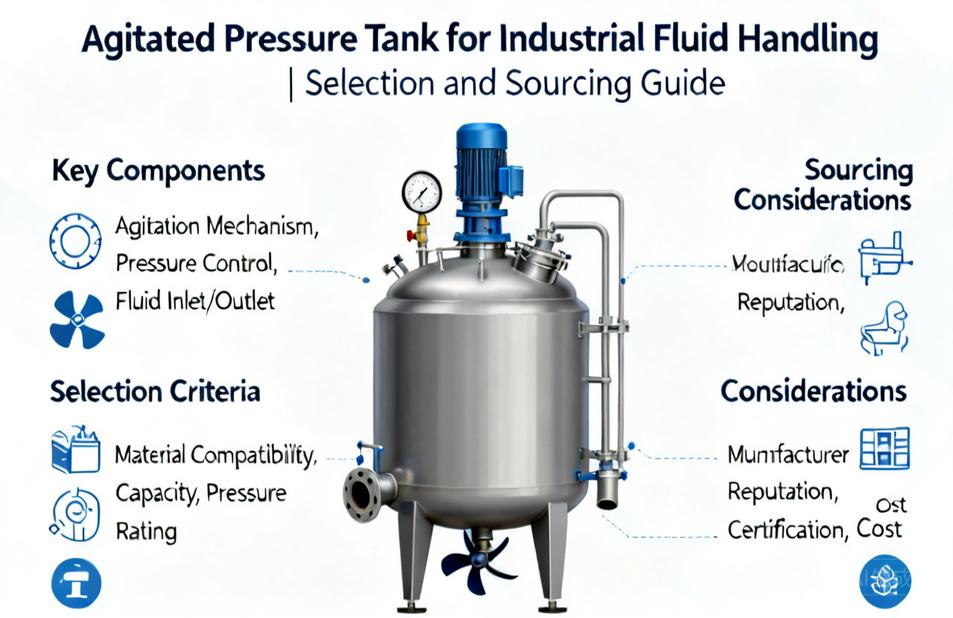
An agitated pressure tank is a closed vessel that combines controlled internal pressure with mechanical or pneumatic agitation to keep fluids, slurries, or suspensions uniformly mixed during storage, transfer, or dispensing. Unlike a standard pressure tank that simply holds liquid under pressure, an agitated unit prevents settling, stratification, and inconsistent concentration, making it suitable for processes where the material must remain homogeneous before it reaches a pump, spray nozzle, reactor, or filling line. Overseas buyers often search for this equipment when dealing with coatings, sealants, adhesives, chemical intermediates, food ingredients, or wastewater treatment chemicals that tend to separate over time. Understanding how these tanks work, where they are used, and how to specify them correctly helps procurement teams avoid costly mismatches between the vessel and the rest of the process.
What Is an Agitated Pressure Tank and How Does It Work?
The tank body is typically a cylindrical pressure vessel with a dished or conical bottom and a removable or bolted top cover. Inside, an agitator assembly creates circulation. Depending on the application, the agitator may be a top-mounted paddle, propeller, turbine, or anchor impeller driven by an electric motor, or it may use compressed gas to induce mixing in a pneumatic design. The vessel is sealed so that internal pressure can be maintained while the agitator runs. A pressure regulator, relief valve, gauges, and inlet and outlet ports complete the system. In operation, the tank receives material, the agitator keeps solids in suspension or blends multiple liquids, and the internal pressure pushes the mixture out through a discharge line at a controlled rate. This combination is useful when gravity alone cannot move viscous or settling products and when the downstream process requires a steady, well-mixed feed.
Key Design Features Buyers Should Review
Several design details determine whether an agitated pressure tank will perform reliably in a given line. The agitator type and speed must match the viscosity and solids content of the product; a high-shear impeller may be needed for fine dispersions, while a low-speed paddle is often sufficient for gentle blending. The pressure rating of the shell, head, and seals must align with the supply pressure and any downstream restrictions. Port sizes and locations should correspond to existing piping, and the discharge arrangement should allow complete drainage without trapping material. A sanitary or industrial finish may be required depending on the industry. Buyers should also consider whether the tank needs a jacket for heating or cooling, a sight glass for level observation, or a load cell for weight-based batching. Each of these options affects cost, lead time, and maintenance planning.
Materials and Construction Considerations
Material selection is driven by the chemical compatibility, temperature, and hygiene requirements of the process. Carbon steel is common for general industrial service where corrosion is not a concern. Stainless steel grades are frequently chosen for water-based products, food contact, and mildly corrosive chemicals. For aggressive acids, chlorides, or high-purity applications, higher-alloy stainless steels or non-metallic linings may be appropriate. Welded construction provides a robust pressure boundary, while sanitary designs use crevice-free welds and polished interior surfaces. Gaskets, seals, and diaphragms must also be compatible with the product, because elastomer failure can cause leaks or contamination. When requesting a quotation, buyers should specify the product chemistry, operating temperature range, and cleaning method so the manufacturer can recommend a suitable build without over-engineering the vessel.
Typical Industrial Applications
Agitated pressure tanks appear across many sectors. In adhesives and sealants, they keep filled formulations uniform before dispensing. In coatings and inks, they prevent pigment settling during circulation. Chemical plants use them for intermediate storage and controlled transfer of reactive or viscous liquids. Food and beverage processors employ sanitary versions for sauces, syrups, and concentrates. Water treatment facilities may use them to hold and dose coagulants or polymers that must stay mixed. Pharmaceutical and cosmetic operations use them where gentle agitation and cleanability are important. Because the tank combines mixing and pressure transfer, it can replace a separate mixer and pump in some layouts, simplifying the system and reducing space requirements.
How to Choose the Right Agitated Pressure Tank
Selection starts with the process objective: is the goal to keep a product homogeneous, to blend ingredients, to feed a downstream operation at pressure, or to do all three? Define the working volume, the viscosity range, the solids particle size, and the required discharge rate. Next, establish the maximum operating pressure and temperature, because these determine wall thickness, flange rating, and seal type. Consider the available floor space, ceiling height for agitator removal, and utility connections for the motor. If the product is shear-sensitive, choose a low-shear agitator; if it is prone to foaming, consider a design that minimizes air entrainment. Maintenance access is another factor: top-entry agitators are easier to service when the tank is small, while side-entry or bottom-entry arrangements may suit large vessels. A clear specification sheet given to an agitated pressure tank supplier will produce more accurate proposals and fewer change orders later.
OEM and Customization Options
Many industrial buyers need a vessel that fits an existing skid, cabinet, or process line rather than a catalog standard. Custom fabrication can address non-standard dimensions, special port orientations, unique agitator mounting, or integrated controls. OEM arrangements are common when an equipment builder needs a private-label tank to complete a larger system. Custom options may include variable-frequency drives for agitator speed, explosion-proof motors for hazardous areas, sanitary fittings, insulation, and programmable logic controller integration. Buyers should confirm that the factory can provide drawings for approval, material certificates where required, and documentation for pressure-boundary components. Clear communication about the interface points between the tank and the rest of the equipment prevents installation problems.
Buying Considerations and Supplier Selection
When comparing quotations, look beyond the initial price. Evaluate the manufacturer’s experience with similar fluids and pressure ranges, the quality of welds and surface finishes, and the availability of spare parts such as seals, gaskets, and impellers. Ask how the agitator shaft is supported and whether the design accounts for shaft deflection at the intended speed. Confirm the testing and inspection procedures that will be performed before shipment, and request documentation that matches your compliance needs without assuming certifications that have not been verified. A supplier that asks detailed questions about your process is often a better long-term partner than one that quotes immediately without understanding the application. Factory audits, reference projects, and sample drawings can help assess capability. For international orders, clarify packing, marking, and shipping terms early so that the vessel arrives without damage and with the correct paperwork.
Frequently Asked Questions
Can an agitated pressure tank handle high-viscosity products?
Yes, provided the agitator and motor are sized for the viscosity range. High-viscosity products may require an anchor or helical impeller, a larger drive, and sometimes a jacketed vessel to reduce resistance. The discharge method should also be reviewed, because viscous materials may need a positive-displacement pump rather than pressure alone.
What information should I provide to get an accurate quotation?
Provide the product description, viscosity, solids content, operating pressure, temperature range, required volume, discharge rate, available utilities, and any sanitary or hazardous-area requirements. Sketches of the installation space and details of connected equipment help the manufacturer propose a suitable configuration.
How do I maintain uniform mixing during pressure discharge?
Keep the agitator running while the tank is discharging, and select an impeller that maintains flow even as the liquid level drops. In some cases, a baffle or a bottom-mounted agitator improves mixing at low levels. The discharge port location should avoid dead zones where solids can accumulate.
Is an agitated pressure tank suitable for food or pharmaceutical use?
Sanitary versions are available with polished stainless steel contact surfaces, crevice-free welds, and cleanable seals. The suitability depends on the specific hygiene standard, cleaning method, and product contact requirements, so these details should be discussed with the manufacturer before ordering.
Conclusion
Choosing an agitated pressure tank is a matter of matching the vessel and agitator to the fluid, the process pressure, and the installation environment. Buyers who define viscosity, solids, pressure, temperature, and discharge requirements clearly will receive more precise proposals and fewer surprises during commissioning. Whether the need is a standard unit or a custom or OEM build, working with a manufacturer that asks the right questions and provides transparent documentation is the most reliable path to a successful installation. If you are evaluating options for an upcoming project, share your specifications and application details with a qualified supplier to discuss sizing, materials, agitation, and customization.
