

Pressure Tank With Mixer | A Practical Guide for Industrial Buyers
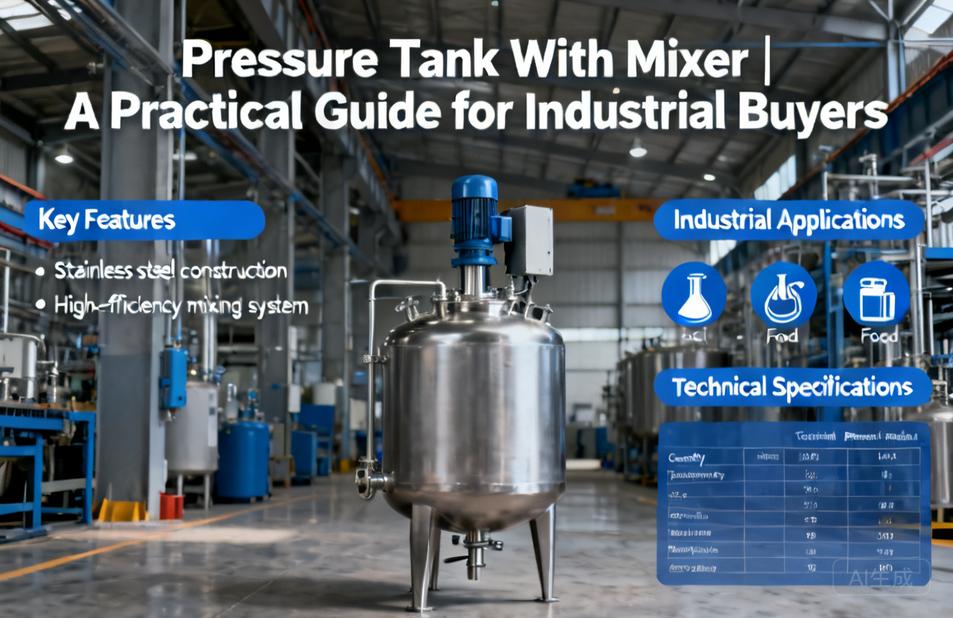
A pressure tank with mixer is a combined vessel that stores liquids or slurries under pressure while an integrated agitator keeps the product homogeneous before it is discharged into a process line. Overseas buyers often search for this equipment when they need to feed coatings, adhesives, sealants, resins, food ingredients, or chemical formulations at a consistent pressure without allowing solids to settle or separate. Unlike a simple pressure pot, the mixer-equipped version adds continuous or intermittent agitation, which helps maintain viscosity, improve flow, and reduce waste during dispensing, spraying, or transfer operations.
What a Pressure Tank With Mixer Does in a Process Line
The basic function is straightforward: the tank holds material under regulated air or gas pressure, and the internal mixer prevents stratification. In many industrial applications, the tank acts as a buffer between bulk storage and a downstream pump, valve, spray gun, or filling head. When the material contains fillers, pigments, fibers, or other suspended solids, the mixer becomes essential. Without agitation, these components can settle on the tank bottom, causing inconsistent output, clogged lines, and frequent manual cleaning.
A pressure tank with mixer is also useful when the product must be kept at a specific consistency before application. For example, in adhesive dispensing, the mixer can maintain a uniform blend of resin and additives. In food processing, it can help keep sauces, syrups, or purees moving smoothly. In chemical dosing, it can prevent crystallization or separation that would otherwise affect pump performance.
Key Design Features Buyers Should Review
When evaluating a pressure tank with mixer, procurement teams should look at how the agitator, pressure boundary, and discharge path work together. Important features include the tank orientation, the mixer type, the sealing arrangement, and the method of pressure control. A vertical tank with a top-mounted agitator is common for moderate viscosity products, while horizontal or portable designs may suit mobile dispensing stations. The mixer can be direct-drive, gear-driven, or magnetic-drive, depending on the required torque and the sensitivity of the product to shear.
Other practical details include the inlet and outlet sizes, the lid closure method, the pressure relief device, and the level indicator. For sanitary applications, the internal surface finish and drainability become more critical. For abrasive slurries, wear-resistant linings or replaceable mixing blades may be preferred. Buyers should also confirm how the tank will be cleaned between batches, because a mixer can create additional crevices where residue may accumulate.
Materials and Construction
Material selection depends on the chemical compatibility, operating temperature, and hygiene requirements of the application. Stainless steel grades are frequently specified for their corrosion resistance and cleanability. Carbon steel may be acceptable for certain non-corrosive industrial fluids, provided the interior is protected with a suitable coating. For aggressive chemicals, higher-alloy stainless steels or non-metallic linings may be considered. The mixer shaft and impeller should be made from materials that resist both the product and the cleaning agents used in the facility.
Construction details such as weld quality, surface roughness, and gasket selection can influence service life and maintenance frequency. A pressure tank with mixer that is designed for easy disassembly will usually reduce downtime during inspection and cleaning. Buyers should request dimensional drawings and material certificates where traceability is required, but they should verify these documents against their own engineering standards rather than relying on general marketing claims.
Typical Industrial Applications
Pressure tanks with mixers appear across many sectors. In the automotive and aerospace industries, they support sealant and adhesive dispensing. In construction, they may be used for pumping grouts, fillers, and two-component systems. In food and beverage production, they can handle viscous ingredients that must remain blended before filling. In pharmaceutical and cosmetic manufacturing, they may be part of a larger dosing or coating system. Other applications include printing inks, ceramic slurries, lubricants, and agricultural chemicals.
Each application places different demands on the equipment. A tank used for a low-viscosity solvent may need a simple agitator and a fast pressure response. A tank used for a high-solids slurry may require a heavier mixer drive, a larger discharge port, and more frequent maintenance access. Understanding the product rheology and the duty cycle is therefore more important than selecting a tank based on capacity alone.
How to Choose the Right Pressure Tank With Mixer
Start by defining the material to be processed: its viscosity, density, solids content, temperature, and chemical nature. Then determine the required flow rate and discharge pressure at the point of use. These two inputs will guide the tank size, the pressure rating, and the mixer power. The mixer should be sized to create sufficient motion without damaging the product or introducing excessive heat. In some cases, a slow-speed paddle or anchor agitator is enough; in others, a high-shear disperser may be needed.
Next, consider the installation environment. Available floor space, headroom, and utility connections can rule out certain configurations. If the tank must be moved between stations, a portable frame with casters and a handle may be appropriate. If it will be integrated into an automated line, the buyer should discuss control interfaces, level sensors, and pressure regulators with the supplier. Finally, review the maintenance plan. Easy access to the mixer seal, bearings, and discharge valve will lower long-term operating costs.
Customization and OEM Options
Many manufacturers offer custom pressure tanks with mixers to match specific process requirements. Customization can include tank dimensions, port locations, mixer type and speed, surface finish, insulation, jacket heating or cooling, and mobility features. OEM arrangements may involve private labeling, special control panels, or compatibility with an existing dispensing system. When requesting a custom build, buyers should provide detailed process data and a clear description of the interface with upstream and downstream equipment. A supplier with engineering support can propose a configuration that balances performance, cleanability, and cost.
Buying Considerations and Supplier Selection
Price is only one part of the total cost of ownership. Buyers should compare quotations on the same technical basis, including materials, mixer specifications, pressure ratings, and documentation. Ask the supplier about their quality control process, lead time for standard and custom units, and availability of spare parts. A factory with in-house machining, welding, and assembly capabilities can often respond faster to custom requests and maintain tighter tolerances. If the tank will be used in a regulated industry, confirm that the supplier can provide the necessary material and test documentation without making unsupported certification claims.
It is also wise to discuss after-sales support. A pressure tank with mixer is a long-term asset, and access to technical advice, replacement seals, and mixer components can prevent costly downtime. Request references from similar applications where possible, but evaluate them on the basis of technical fit rather than brand reputation alone.
Frequently Asked Questions
Can a pressure tank with mixer handle high-viscosity materials?
It depends on the mixer design and the tank configuration. High-viscosity products may require a slow-speed, high-torque agitator and a larger discharge opening. The supplier should review the product rheology before recommending a model.
Is the mixer necessary if the material does not settle quickly?
If the material is a stable solution with no suspended solids, a mixer may not be required. However, for formulations that can separate over time or during pressure cycling, agitation helps maintain consistency and reduces manual intervention.
Can the tank be customized for an existing dispensing system?
Yes. Many suppliers offer custom port layouts, pressure ratings, and control interfaces to match an existing line. Providing drawings and process data will help the supplier propose a suitable configuration.
What information should I provide when requesting a quote?
Include the material type, viscosity, temperature, required flow rate, discharge pressure, available space, and any cleaning or sanitation requirements. This information allows the supplier to recommend the appropriate tank, mixer, and accessories.
Conclusion
Selecting a pressure tank with mixer is a matter of matching the vessel and agitator to the product, the process, and the working environment. Buyers should focus on material compatibility, mixer performance, pressure control, and maintenance access rather than capacity alone. Custom and OEM options are widely available, so it is worth discussing specific requirements with a manufacturer or supplier early in the project. If you are evaluating equipment for a particular application, sharing your process details with a qualified factory can help you identify a practical and reliable configuration.
