

Agitated Pressure Tank | A Practical Guide for Industrial Buyers and OEM Projects
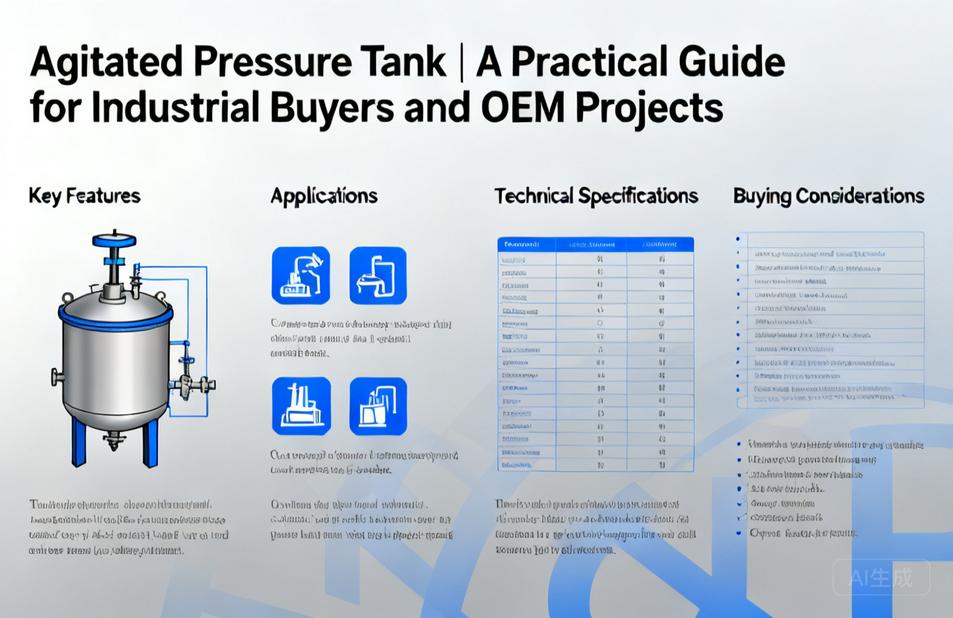
An agitated pressure tank is a pressure vessel fitted with a mechanical or magnetic agitator that keeps liquids, slurries, or suspensions moving while they are stored or dispensed under pressure. It is commonly used in chemical processing, food and beverage production, pharmaceutical mixing, water treatment, and adhesive or coating supply systems. Unlike a standard pressure tank, the agitation prevents solids from settling, maintains a consistent mixture, and improves flow stability in downstream equipment.
What an Agitated Pressure Tank Does in a Process Line
The tank works as both a holding vessel and a pressure source. Compressed air or inert gas enters the vessel and pushes the product toward a spray nozzle, dispenser, reactor, or filling head. At the same time, the agitator, which may be top-mounted, side-mounted, or bottom-mounted, keeps the product homogeneous. This combination is important when a process requires a stable concentration, temperature distribution, or viscosity over time.
Industrial buyers often specify agitated pressure tanks when a simple gravity tank cannot deliver enough pressure or when the product tends to separate. Typical configurations include vertical cylindrical tanks, dished or conical bottoms, and removable lids for cleaning and maintenance.
Key Features Buyers Look For
Agitation System
The agitator type depends on product viscosity and shear sensitivity. Propeller and turbine agitators suit low to medium viscosity liquids. Anchor or paddle agitators are used for higher viscosity materials or for scraping the tank wall. Magnetic drive agitators can be selected when shaft sealing is a concern, while mechanical seals are common in general industrial service.
Pressure and Level Control
A well-designed agitated pressure tank includes a pressure regulator, safety relief valve, pressure gauge, and level indicator. Some systems use level transmitters or sight glasses so operators can monitor the batch. For automated lines, pressure and level signals can be integrated into a PLC or control panel.
Ports and Connections
Inlet, outlet, vent, drain, and instrument ports should be positioned to suit the process. Sanitary connections are common in food and pharmaceutical applications, while flanged or threaded connections are typical in chemical and industrial service.
Materials and Construction
Material selection is a critical decision for any pressure vessel. Common choices include carbon steel, 304 stainless steel, 316L stainless steel, and sometimes duplex stainless steel. The right grade depends on product chemistry, cleaning method, and operating environment. For corrosive chemicals, higher alloy content or internal coatings may be required. For food and pharmaceutical use, surface finish, weld quality, and cleanability become important.
A reputable agitated pressure tank manufacturer will provide material certificates, weld maps, and dimensional drawings. Buyers should confirm whether the vessel is designed and built to a recognized pressure vessel standard, and whether third-party inspection is available.
Industrial Applications
Agitated pressure tanks appear in many industrial settings. In chemical production, they feed reactors and mixers with a consistent slurry. In water treatment, they dose coagulants, flocculants, or pH adjustment chemicals. In the adhesive and sealant industry, they supply dispensing systems with filled or pigmented materials. Food and beverage plants use them for sauce, syrup, and concentrate transfer. Pharmaceutical and cosmetic producers rely on them for emulsion and suspension handling.
Because agitation maintains uniformity, these tanks are also useful in processes where a product must be kept in suspension before filling, coating, or spraying. A custom agitated pressure tank can be configured for a specific nozzle, pump, or filling machine.
How to Choose the Right Tank
Start with the product characteristics: viscosity, density, solids content, temperature, and chemical compatibility. Then define the required pressure, flow rate, and discharge pattern. The tank volume should match the production batch and the available floor space. Agitator speed and impeller geometry should be selected to avoid vortexing, dead zones, or excessive shear.
Next, review the installation environment. Will the tank be indoors or outdoors? Is washdown required? Are there space limits for agitator removal? Finally, consider maintenance access, spare parts availability, and whether the supplier can support future capacity changes.
For OEM projects, it helps to provide a process description, P&ID, and interface requirements. A capable agitated pressure tank supplier can then propose a design that fits the existing line rather than forcing a standard catalog unit into an incompatible process.
Customization and OEM Options
Many industrial buyers need more than a standard tank. Customization can include tank volume, agitator type and speed, material grade, surface finish, connection style, insulation, jacketing, and control integration. Skid-mounted packages with pumps, valves, and instruments are also available. If you are developing a private-label product or integrating the tank into your own equipment, discuss OEM options early so that dimensions, ports, and controls align with your design.
When requesting a quote, provide a clear specification sheet. This reduces back-and-forth and helps the factory return an accurate proposal. Avoid vague requirements such as a standard tank; instead, state the product, pressure, temperature, agitation need, and connection details.
Buying Considerations and Supplier Selection
Price is only one factor. Evaluate the supplier’s engineering capability, manufacturing equipment, quality control process, and experience with similar applications. Ask for dimensional drawings, material certificates, and test reports. Confirm lead time, packaging, and shipping terms. If the tank will operate in a regulated industry, verify that the supplier understands the relevant documentation requirements.
A reliable agitated pressure tank manufacturer will ask questions about your process before quoting. They will also explain the trade-offs between different agitator designs, materials, and control options. This technical dialogue is often a better indicator of long-term support than a low initial price.
Frequently Asked Questions
What is the difference between an agitated pressure tank and a standard pressure tank?
A standard pressure tank stores and dispenses liquid under pressure but does not mix it. An agitated pressure tank adds an agitator to keep the product uniform, which is essential for slurries, suspensions, and materials that separate over time.
Can an agitated pressure tank be customized for my application?
Yes. Most industrial suppliers offer custom and OEM configurations, including tank size, agitator type, material grade, connections, and control integration. Providing detailed process data helps ensure the final design matches your line.
How do I select the right agitator for my product?
Agitator selection depends on viscosity, solids content, shear sensitivity, and tank geometry. Low-viscosity products often use propellers or turbines, while high-viscosity or settling products may require anchors, paddles, or scrapers. Your supplier can recommend a suitable design based on your process data.
What information should I provide when requesting a quote?
Include the product description, viscosity, density, temperature, required pressure and flow, tank volume, connection types, material preference, and any industry-specific documentation needs. A dimensional drawing or P&ID is also helpful.
Conclusion
Choosing an agitated pressure tank is a process decision, not just a purchasing decision. The right unit keeps your product homogeneous, supports stable downstream flow, and fits your available space and control system. Focus on material compatibility, agitator design, pressure control, and maintenance access. For custom or OEM projects, work with a supplier who asks the right technical questions and provides clear documentation. If you are evaluating options for your application, contact a qualified manufacturer to discuss your specifications and receive a tailored proposal.