

Semiconductor Glue Supply Tank | A Complete Guide for Dispensing Systems
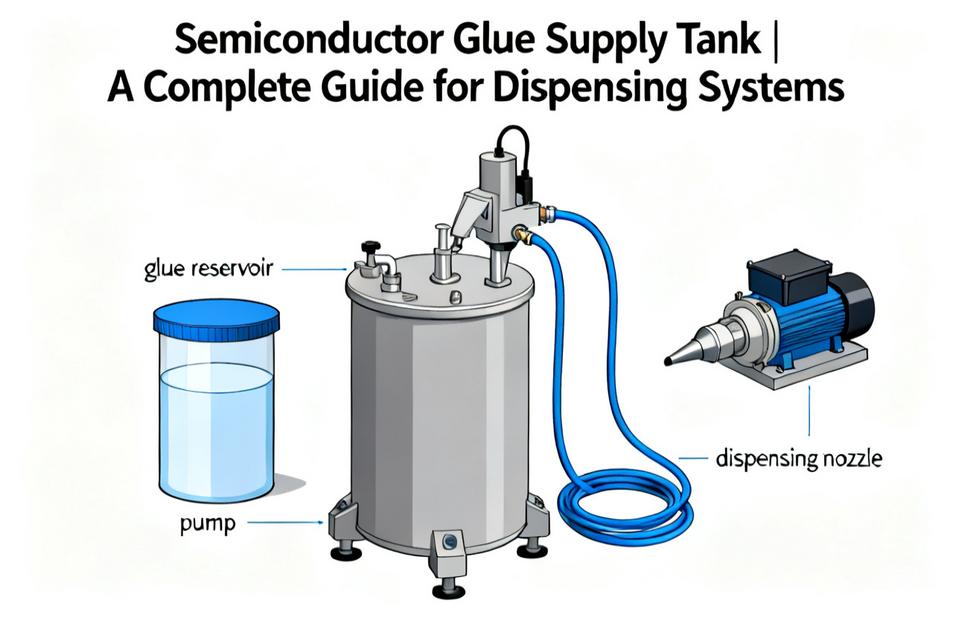
A semiconductor glue supply tank is a specialized fluid delivery component used in precision dispensing systems within semiconductor manufacturing and advanced electronics assembly. It stores, conditions, and feeds adhesives, encapsulants, underfills, and other sensitive materials to dispensing valves or nozzles with consistent pressure and minimal contamination. Unlike general-purpose pressure vessels, these tanks are designed to handle the strict cleanliness, degassing, and thermal stability requirements of semiconductor processes. For procurement teams and process engineers, understanding how these tanks work and how to specify them is essential for maintaining yield and reducing downtime in high-value production lines.
What Is a Semiconductor Glue Supply Tank?
A semiconductor glue supply tank is a sealed reservoir that holds dispensing material under controlled pressure or via a pump-assisted feed system. It connects to dispensers, jet valves, or syringe-based tools through tubing and fittings. The tank may be pressurized with dry air or nitrogen to push material toward the dispense point, or it may use a follower plate and pump to minimize waste and prevent air entrapment. In semiconductor packaging, LED assembly, and microelectronics, these tanks help maintain consistent bead width, dot volume, and flow rate. The term is often used interchangeably with adhesive supply tank, glue pressure tank, or dispensing reservoir in B2B sourcing contexts.
Key Features and Working Principles
Most semiconductor glue supply tanks share several functional characteristics. They provide a closed environment that limits exposure to moisture, oxygen, and particulate contamination. Many designs include a removable lid or quick-release clamp for fast refilling and cleaning. Pressure regulation is typically managed by an external regulator and gauge, allowing operators to set and repeat dispense pressure. Some tanks incorporate level sensors to trigger refill alarms, while others use transparent or semi-transparent sight glasses for visual level checks. Degassing ports and vacuum-compatible seals are common in models intended for bubble-sensitive materials. The working principle is straightforward: material is loaded into the tank, the tank is sealed, pressure is applied, and the material flows through a hose or tube to the dispense valve. When the valve opens, the pressure pushes a controlled amount of adhesive onto the substrate.
Materials and Construction
Because semiconductor adhesives can be reactive, abrasive, or sensitive to ionic contamination, the wetted materials of a glue supply tank matter. Common construction materials include stainless steel, PTFE, PFA, and high-purity polymers. Stainless steel offers durability and chemical resistance for many industrial adhesives. PTFE and PFA linings or components reduce adhesion and help prevent cured material buildup. Seals are often made from FFKM or other high-performance elastomers to withstand aggressive chemistries. Surface finish, weld quality, and passivation are important for cleanroom compatibility. Buyers should confirm that the tank construction is compatible with the specific adhesive chemistry, curing method, and cleaning protocol used in their facility.
Typical Industrial Applications
Semiconductor glue supply tanks appear in multiple production environments. In semiconductor packaging, they feed underfill, die attach, and encapsulant materials to dispensing systems. In LED manufacturing, they supply phosphor-loaded silicone or epoxy. In PCB assembly, they support conformal coating and surface mount adhesive dispensing. Other applications include microelectromechanical systems, camera module assembly, and precision optics bonding. Because these industries demand high repeatability, a properly sized and correctly configured supply tank can reduce material waste and improve process stability. The tank is often part of a larger dispensing system that includes a controller, valve, nozzle, and motion platform.
How to Choose the Right Supply Tank
Selecting a semiconductor glue supply tank requires matching the tank to the material, the dispense process, and the production environment. Begin by reviewing the adhesive specifications, including viscosity, pot life, filler content, and sensitivity to moisture or air. Next, consider the required pressure range and whether the system uses pressure-time dispensing, volumetric pumping, or jetting. Tank capacity should align with production volume and refill frequency; too small a tank causes frequent interruptions, while too large a tank may expose material to extended residence times. Port configuration, fitting types, and tubing compatibility are also critical. For cleanroom use, verify that the tank can be cleaned and that its external surfaces do not shed particles. Finally, think about integration with existing dispensers and whether the supplier can provide matching fittings, level sensors, or mounting hardware.
Customization and OEM Options
Many industrial dispensing applications require a supply tank that fits a specific footprint or connects to a proprietary valve. Custom and OEM options may include modified port layouts, special seal materials, alternative surface finishes, integrated level sensing, or unique mounting brackets. Some manufacturers also offer private-label programs for distributors and system integrators. When discussing customization, provide the supplier with drawings, material specifications, and process conditions. A capable factory will review chemical compatibility and suggest practical modifications without compromising the tank’s integrity. Avoid assuming that a standard tank will work for every adhesive; custom engineering often prevents costly dispensing defects.
Buying Considerations for Overseas Procurement
When sourcing from an international supplier, request detailed product data sheets, material certificates, and dimensional drawings. Confirm that the tank is compatible with your adhesive and cleaning chemicals. Ask about the manufacturing process, quality control procedures, and packaging suitable for long-distance shipping. For semiconductor-related purchases, cleanliness and documentation are especially important. Evaluate the supplier’s experience with dispensing systems and their ability to provide technical support after delivery. It is also useful to understand their lead time for standard and custom units, as well as their capacity to handle repeat orders. Working with a manufacturer that understands both fluid handling and semiconductor process requirements can reduce integration risk.
Frequently Asked Questions
What materials are semiconductor glue supply tanks made from?
Common materials include stainless steel, PTFE, PFA, and high-purity polymers. The best choice depends on the adhesive chemistry, required cleanliness level, and cleaning method. Suppliers should provide material compatibility information for the specific glue being used.
Can a supply tank be used with different types of adhesives?
In some cases, yes, but the tank must be thoroughly cleaned and the seals and wetted parts must be compatible with each material. Switching between reactive adhesives may require dedicated tanks to avoid cross-contamination and curing issues.
How do I determine the right tank capacity for my process?
Calculate your average adhesive consumption per shift or per production run, then consider refill frequency and material pot life. A tank that is too small causes interruptions, while an oversized tank can lead to material waste or extended exposure to air and moisture.
Do suppliers offer OEM or custom supply tanks?
Many manufacturers provide OEM and custom options, including modified ports, special seals, level sensors, and private-label configurations. Provide drawings and process details so the factory can recommend a suitable design.
Conclusion
Choosing a semiconductor glue supply tank is a balance of material compatibility, pressure control, cleanliness, and integration with your dispensing system. Whether you need a standard reservoir or a custom-engineered solution, working with an experienced manufacturer or supplier can help you avoid dispensing defects and production delays. If you are evaluating options for your semiconductor, LED, or electronics assembly line, contact a qualified factory to discuss your adhesive, process conditions, and OEM or customization requirements.
