

Electronics Adhesive Dispensing Valve | A Buyer Guide for Precision Fluid Dispensing
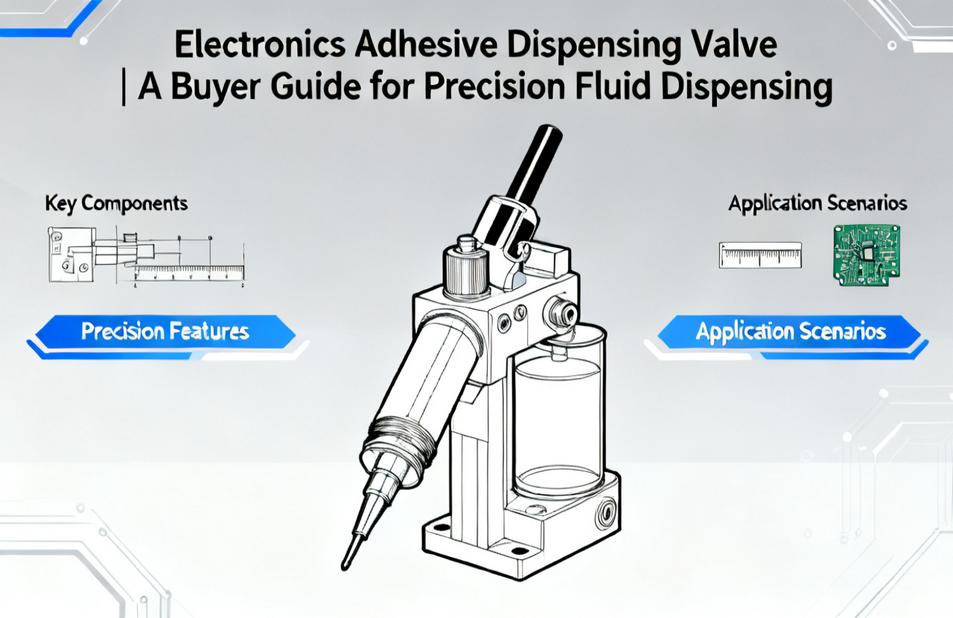
An electronics adhesive dispensing valve is a precision fluid-control component used to apply adhesives, conformal coatings, sealants, potting compounds and other low-to-medium viscosity materials onto printed circuit boards, electronic modules and small assemblies. In electronics manufacturing, the valve sits between the material reservoir and the dispensing nozzle and determines how much material is released, how consistently it is applied and how well the deposit matches the required bond line, encapsulation area or coating pattern. For purchasing teams sourcing dispensing hardware, understanding how these valves work, where they fit and how to match them to existing equipment is essential before requesting a quote from a manufacturer or supplier.
How an Electronics Adhesive Dispensing Valve Works
Most dispensing valves for electronics adhesives use one of several working principles: time-pressure, positive displacement (such as piston or auger types), or spray and jetting configurations for conformal coating. In a time-pressure valve, controlled air pressure pushes material through an orifice for a set dispense time, making it a simple and flexible option for many adhesive types. Positive displacement valves meter material mechanically, which generally improves repeatability when bead size and shot volume must remain stable across long production runs. Jetting valves release droplets without touching the substrate, which suits high-speed, non-contact applications on delicate boards.
The valve body, wetted parts, nozzle and control interface all influence performance. A well-matched valve helps reduce adhesive waste, avoid board contamination and maintain consistent deposits as material viscosity or supply pressure changes during a shift.
Typical Industrial Applications
These valves appear in many electronics assembly and protection processes, including:
- Surface mount adhesive dots for component placement
- Underfill and edge-bond adhesives for chip-scale packages
- Conformal coating of PCB assemblies
- Potting and encapsulation of sensors, connectors and power modules
- Sealing and gasketing of housings and display modules
- Thermal interface material dispensing for heat-generating components
Because electronics adhesives range from low-viscosity coatings to thixotropic pastes, the valve must be selected around the specific material, deposit size and production speed rather than treated as a universal accessory.
Key Features Buyers Should Evaluate
When reviewing valve options, procurement and process engineers typically compare several practical characteristics. Repeatability and shot-size consistency are usually the first concerns, followed by compatibility with the adhesive chemistry. Wetted-part materials should suit the adhesive and any solvents used for cleaning. Adjustability matters when operators need to fine-tune deposit size without changing hardware. A compact footprint helps when the valve must fit into tight machine envelopes or robotic cells.
Control compatibility is another important feature. Some valves integrate with existing dispensing controllers, while others require a matched driver or interface. Easy maintenance and accessible seals reduce downtime during color changes or material swaps. For high-volume lines, non-contact jetting or automated purge functions may be worth considering.
Materials and Construction Considerations
Electronics adhesives can be abrasive, chemically aggressive or sensitive to cure inhibition. Valve construction should therefore be reviewed against the material safety data and process requirements. Stainless steel wetted parts are common for durability, while polymer seals and diaphragms must be chosen for chemical compatibility. Nozzle geometry affects deposit shape and break-off behavior, especially for high-viscosity pastes. Buyers should confirm that the valve can be cleaned with the solvents used in their facility without damaging seals or internal surfaces.
How to Choose the Right Valve for Your Line
Selecting a dispensing valve starts with the adhesive, not the hardware. Document the material viscosity, fillers, pot life, required deposit size and cycle time. Then consider the dispensing method: contact vs non-contact, single dot vs continuous bead, and manual vs fully automated operation. Check whether the valve will be mounted on a robot, a gantry or a benchtop station, and confirm the air, power and control signals available.
It also helps to review the full fluid path, including reservoir, tubing and fittings, because inconsistent material supply can affect valve performance regardless of valve quality. Where possible, request a sample dispense trial with the actual adhesive before committing to a production order.
OEM and Customization Options
Many industrial valve manufacturers offer OEM and custom configurations for machine builders and brand owners. Customization may include nozzle size and shape, mounting brackets, wetted-material options, control connectors and labeling. OEM supply can help equipment integrators standardize a valve across several machine models. When discussing custom requirements, provide drawings, material specifications and target deposit dimensions so the factory can confirm feasibility without guesswork. Avoid assuming that any modification is available; confirm each change against the supplier’s engineering capacity.
Buying Considerations and Supplier Selection
For overseas buyers, a reliable supplier should be able to explain valve selection clearly, provide dimensional and material information, and support sample evaluation. Ask how the supplier handles spare parts, seal kits and technical questions after delivery. Review whether the factory can support small trial orders before volume production, and confirm the documentation available for incoming inspection. Communication speed and engineering responsiveness often matter as much as unit price when dispensing valves are part of a production line.
It is also wise to compare total cost of ownership, including maintenance frequency, replacement part availability and operator training needs. A valve that is easy to service and well matched to the adhesive usually delivers more stable production than a lower-cost unit that requires frequent adjustment.
Frequently Asked Questions
Can one valve handle different electronics adhesives?
In some cases, yes, but compatibility must be checked for each material. Viscosity, filler content, solvent resistance and cure behavior all affect whether a single valve can run multiple adhesives reliably. Changing nozzles or seals may be necessary.
How do I match a dispensing valve to my existing machine?
Confirm the mounting interface, control signal type, air supply and available space. Share your machine details and adhesive specification with the supplier so they can recommend a compatible configuration.
Do suppliers offer OEM or custom valve configurations?
Many manufacturers support OEM projects and custom modifications such as nozzle geometry, mounting hardware and material options. Feasibility depends on the specific request and should be confirmed during the quotation stage.
What information should I prepare before requesting a quote?
Prepare the adhesive type and viscosity, required deposit size, production speed, machine interface and any cleaning or maintenance constraints. Clear process details help the supplier propose a suitable valve and avoid later adjustments.
Conclusion
Choosing an electronics adhesive dispensing valve is largely a process-matching exercise. Start with the adhesive and deposit requirements, then evaluate working principle, materials, control compatibility and serviceability. Buyers who document their application clearly and discuss OEM or custom needs early tend to receive more accurate recommendations. If you are comparing options for a new line or replacing an existing valve, contact a qualified supplier with your specifications and application details to confirm the right configuration for your production setup.