

Industrial Automation Dispensing Valve | A Practical Buyer’s Guide for OEM and Custom Projects
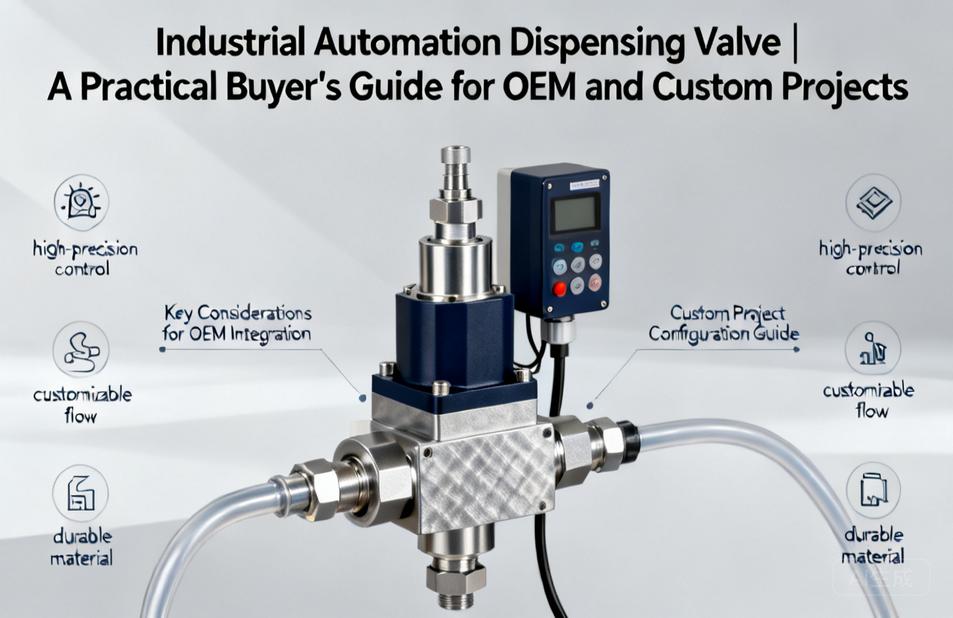
An industrial automation dispensing valve is a precision fluid control component used to apply adhesives, sealants, lubricants, solder paste, coatings, and other media in automated production lines. It sits at the point of dispense and works together with a controller, pressure or feed system, and robotic or gantry motion platform to deliver a repeatable amount of material to a defined location. Buyers searching for a reliable valve often need to match the valve to the fluid, the dispense pattern, the cycle time, and the existing equipment interface. This guide explains how these valves work, where they are used, and what to check before you contact a manufacturer or supplier for a custom or OEM solution.
What an Automation Dispensing Valve Does
The valve is the final control element in a dispensing system. It opens and closes in response to a signal from a dispenser controller or PLC, allowing material to flow through a nozzle or needle. The duration and frequency of the open-close cycle, combined with feed pressure and nozzle size, determine the dispense volume. In automated production, the valve must respond consistently at high cycle rates and remain stable over long shifts. Common designs include time-pressure valves, positive displacement valves, spray valves, jet valves, and needle valves. Each type suits different viscosities, fillers, and pattern requirements, so selection should start with the fluid and the process rather than the valve alone.
Key Features Buyers Should Evaluate
When reviewing an industrial automation dispensing valve, look beyond the basic body dimensions. Important features include the wetted materials, the seal arrangement, the actuation method, and the adjustment range. A valve with fine stroke adjustment helps operators tune the dispense amount without changing nozzles. Quick-release fluid paths simplify cleaning and maintenance. Modular mounting interfaces make it easier to integrate the valve with robots, linear actuators, or custom fixtures. For abrasive or filled materials, wear-resistant internal components and accessible seal kits are practical considerations. Response time and repeatability matter in high-speed lines, while for manual or semi-automatic stations, ease of setup may be more important than maximum cycle rate.
Materials and Construction
Wetted materials must be compatible with the dispensed medium. Common constructions use stainless steel for the fluid path, aluminum for the body, and elastomer seals selected for chemical resistance. The choice of seal material depends on solvents, acids, and temperature in the process. Some applications require a valve with a chemically inert fluid path, while others need a robust body for harsh factory environments. Buyers should request a material compatibility chart from the supplier and confirm that the valve body, seals, and nozzle are suitable for the specific adhesive, coating, or flux. Housing design also affects cleanability and protection in dusty or washdown areas, so match the valve enclosure to the production environment.
Typical Industrial Applications
These valves appear across many automated assembly and finishing processes. In electronics manufacturing, they dispense solder paste, conformal coating, underfill, and bonding adhesive. In automotive assembly, they apply sealants, structural adhesives, and lubricants to components. In medical device production, they handle precise adhesive beads on disposable assemblies. Packaging lines use them for glue application on cartons and labels. General industrial applications include potting, gasketing, dot dispensing, and line dispensing on metal, plastic, and glass surfaces. Because the right valve depends on the fluid and the motion system, buyers should describe the application in detail, including viscosity, filler content, required dot or bead size, and cycle time, when requesting a recommendation.
How to Choose the Right Valve for Your Line
Start with the fluid. Low-viscosity liquids may suit a time-pressure valve, while high-viscosity or filled materials often need positive displacement or auger-based feeding. Consider the dispense pattern: dots, lines, beads, or spray. Then review the required volume and tolerance. The valve must be able to repeat that volume within the process window. Check the actuation signal and control compatibility with the existing dispenser or PLC. Confirm mounting options and space constraints at the robot end effector. Review maintenance access, seal life, and spare parts availability. Finally, ask the supplier whether the valve can be tested with your material or whether they can recommend a proven configuration for similar industrial applications. A structured selection process reduces trial and error on the production floor.
Customization and OEM Options
Many dispensing valve projects require customization. A manufacturer may offer OEM versions with specific mounting brackets, nozzle adapters, inlet fittings, or signal connectors. Custom seal materials can be selected for aggressive fluids. Some suppliers provide private-label or custom-configured valves for machine builders and system integrators. When discussing customization, provide drawings of the mounting interface, the fluid supply arrangement, and the control signal. Ask about the minimum order quantity, engineering review process, and whether custom parts are documented for future replacement. A factory with in-house machining and assembly can often adapt a standard valve platform to a specific application more efficiently than a trading company that only resells catalog products.
Buying Considerations and Supplier Selection
Price is only one factor. Evaluate the supplier on application knowledge, technical documentation, and after-sales support. A reliable supplier should be able to explain valve operation, recommend suitable models, and provide maintenance guidance. Ask for dimensional drawings, material specifications, and available spare parts. Confirm whether the supplier is a manufacturer or a distributor, because this affects customization flexibility and lead-time communication. For export orders, check packing standards and documentation support. Review the supplier’s experience with your industry and their ability to communicate in technical English. Request references from similar industrial applications where possible, and clarify warranty and repair terms before placing an order.
Frequently Asked Questions
How do I know which dispensing valve type fits my material?
The fluid viscosity, filler content, and required dispense pattern are the main factors. Share the material data sheet and process requirements with the supplier. They can recommend a time-pressure, positive displacement, spray, or jet valve based on similar applications.
Can the valve be integrated with my existing robot or controller?
Most automation dispensing valves use standard mounting and signal interfaces. Provide the robot model, controller output type, and available space at the end effector. The supplier can confirm compatibility or propose an adapter.
Do you offer OEM or custom valve configurations?
Many manufacturers support OEM projects with custom brackets, fittings, nozzles, and seal materials. Discuss your requirements early, including estimated annual usage and any drawing or interface constraints.
What information should I prepare before requesting a quote?
Prepare the fluid type, viscosity, required dot or bead size, cycle time, control signal, mounting space, and production environment. This helps the supplier select a suitable valve and provide a meaningful quotation.
Conclusion
Choosing an industrial automation dispensing valve starts with a clear understanding of the fluid, the dispense pattern, and the equipment interface. Evaluate materials, actuation, adjustment range, and maintenance access against your actual production conditions. If standard models do not fit, discuss OEM or custom options with a manufacturer that understands your application. For specification questions, sample evaluation, or custom dispensing valve projects, contact a qualified supplier with your process details and let their engineering team help you narrow down the right configuration.
