

Paint Feeding Tank | What It Is, How to Choose, and Where It Fits
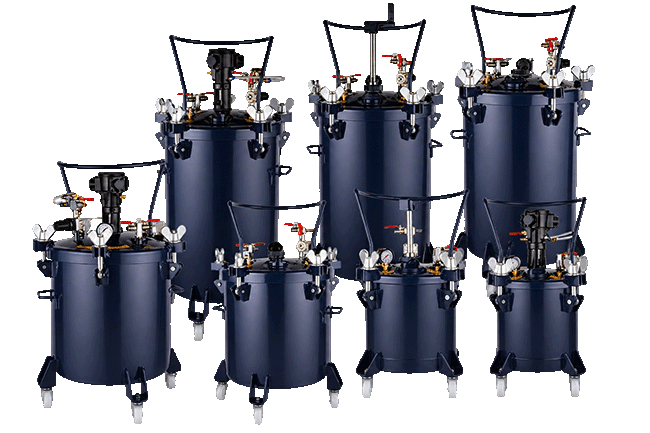
What is a paint feeding tank?
A paint feeding tank is a sealed pressure vessel that stores paint, coating, ink, adhesive, or a similar liquid and delivers it to a spray gun, coating valve, dispensing tool, or automatic applicator under controlled air pressure. Compressed air enters the tank through a regulator; that pressure pushes the fluid out through a fluid outlet and delivery hose to the application point. In everyday industrial language it is also called a paint pressure tank, paint pressure pot, coating pressure tank, or paint supply pressure tank.
The purpose is simple: replace gravity cups, siphon cups, or open containers with a steady, adjustable supply of material. That usually means longer production runs between refills, more consistent flow, and less operator fatigue.
How a paint feeding tank works
- The tank is filled with paint or another liquid and the lid is sealed.
- Clean, dry compressed air is fed in through an air inlet and pressure regulator.
- Internal pressure forces the fluid through the fluid outlet and delivery hose.
- A pressure gauge lets the operator monitor and fine-tune outlet pressure to match coating viscosity and spray tip requirements.
- A safety relief valve protects the vessel from over-pressurization.
Because the material is pushed rather than pulled, flow tends to stay more stable than with gravity-fed or siphon-fed systems, especially over long spray or dispensing cycles.
Key features to evaluate when selecting a paint feeding tank
Tank material
Stainless steel tanks offer corrosion resistance and are often preferred for water-based coatings. Carbon steel tanks are frequently chosen for solvent-based materials where economy matters more than corrosion resistance. The right choice depends on the chemistry of the fluid being handled.
Capacity
Capacity should match consumption rate and how often refilling is acceptable. Small tanks suit low-volume or intermittent work; larger tanks support longer continuous production. There is no single correct size — it is a trade-off between refill frequency, floor space, and weight when full.
Lid design and sealing
A quick-opening clamp or bolted cover affects how fast the tank can be refilled and cleaned. A reliable gasket prevents air leakage during operation, which directly affects pressure stability.
Pressure control
An air regulator and pressure gauge are essential for setting and monitoring outlet pressure. Without them, matching flow to coating viscosity and spray tip becomes guesswork.
Safety components
A safety relief valve is a standard expectation on a pressure vessel. Confirm that the tank’s working pressure is appropriate for the application and that pressure-relief provisions are present.
Agitation
For materials that settle, separate, or need to stay mixed — some paints, resins, and pigmented coatings — an optional pneumatic or electric agitator can help maintain consistency. Not every application needs one.
Ports and connections
Air inlet, fluid outlet, and connection thread sizes must match the rest of the system. Mismatched connections are a common integration problem.
Where paint feeding tanks are used
Typical applications include:
- Industrial coating and spraying lines
- Automotive refinishing
- Wood coating and furniture finishing
- General manufacturing where a steady material flow is required
- Adhesive, ink, resin, primer, release agent, and sealant dispensing
- Automatic fluid feeding for dispensing machines and production equipment
They are most valuable where gravity or siphon feed cannot keep up — long cycles, higher viscosity materials, or automated systems that need repeatable flow.
Standard vs. custom paint feeding tanks
Standard tanks cover many general-purpose coating and dispensing tasks. Custom configurations become relevant when the existing equipment imposes constraints that a standard unit cannot meet. Customization can involve tank capacity, diameter and height, stainless steel material, working pressure, wall thickness, lid structure, air inlet, fluid outlet, connection thread, pressure regulator, pressure gauge, safety valve, agitator system, and mounting method.
A practical example: an automatic dispensing machine with limited internal installation space may be better served by adjusting tank dimensions to the available space than by rebuilding the machine to fit a standard tank. Similarly, specific outlet threads, multiple fluid outlets, or special gauges may be required to match an existing line.
Common selection mistakes to avoid
- Choosing capacity by habit rather than consumption rate. Too small means constant refilling; too large can mean unnecessary weight and space.
- Ignoring fluid chemistry. Water-based coatings and solvent-based materials can call for different tank materials.
- Overlooking connection compatibility. Thread and port mismatches create avoidable integration work.
- Skipping pressure control. A regulator and gauge are not optional if consistent flow matters.
- Assuming agitation is always needed — or never needed. It depends on whether the material settles or separates.
Frequently asked questions
What is the difference between a paint feeding tank and a pressure pot?
They generally refer to the same type of equipment: a sealed vessel that uses compressed air to push coating material to a spray gun or dispensing tool. “Paint pressure pot” and “paint pressure tank” are common alternative names.
Should I choose a stainless steel or carbon steel tank?
Stainless steel offers corrosion resistance and is often preferred for water-based coatings. Carbon steel is frequently more economical and is commonly used with solvent-based materials. The decision should follow the fluid being handled.
Do I need an agitator?
Only if the material settles, separates, or must stay mixed during use. Many paints and pigmented coatings benefit from agitation; other low-viscosity fluids may not require it.
Can a paint feeding tank be customized?
Yes. Custom pressure tanks can be configured by capacity, dimensions, material, working pressure, wall thickness, lid structure, ports, threads, regulator, gauge, safety valve, agitator, and mounting method to fit specific equipment and processes.
What information should I prepare before requesting a quote?
Useful details include the fluid type and viscosity, required flow rate or consumption, desired working pressure, available installation space, connection sizes and thread types, whether agitation is needed, and the downstream equipment the tank will feed.
About DGYAKOO
DGYAKOO manufactures glue pressure tanks, adhesive and dispensing pressure tanks, and related pressure tank solutions for industrial fluid handling. Product information is available at madetank.com. For application-specific requirements, contact the manufacturer directly with your fluid, pressure, and connection details.
