

Precision Assembly Dispensing Valve | What OEM Buyers Should Know Before Sourcing
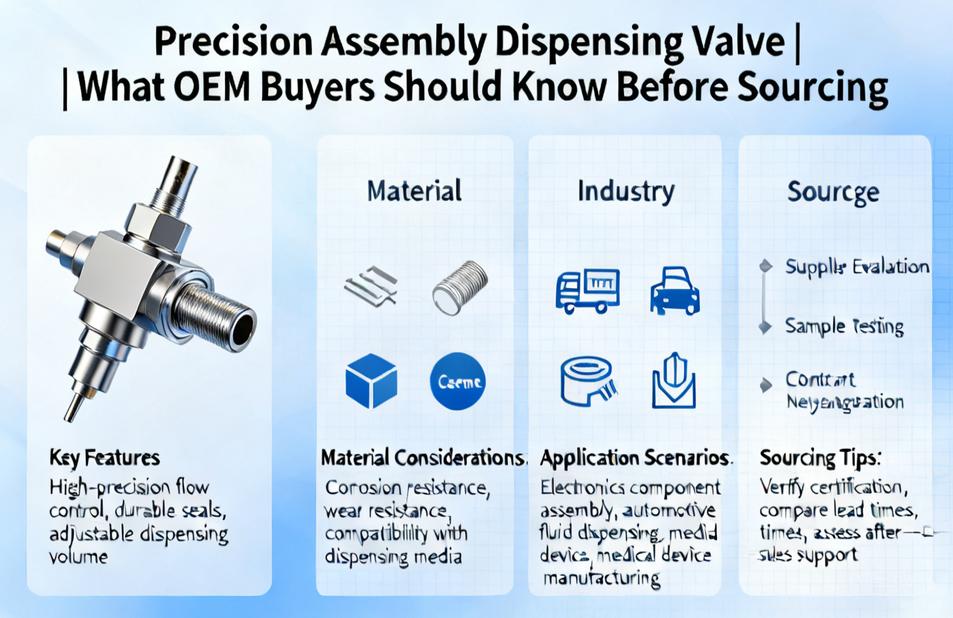
A precision assembly dispensing valve is a flow-control component used to apply adhesives, sealants, lubricants, epoxies, and other fluids in exact, repeatable amounts during automated or semi-automated assembly. Instead of relying on operator timing, these valves use mechanical, pneumatic, or electro-mechanical actuation to release a controlled shot or bead at the point of assembly. They are common in electronics, automotive sub-assembly, medical device manufacturing, and small-parts joining, where excess material or inconsistent deposits can cause scrap, rework, or weak bonds. For purchasing teams, the main questions are usually fit, repeatability, material compatibility, and whether a supplier can support custom mounting and OEM integration.
How a Precision Assembly Dispensing Valve Works in Production
In a typical setup, the valve receives fluid from a syringe, cartridge, pressure pot, or bulk supply. A pneumatic or electric signal opens the internal sealing element for a defined interval, then closes it to cut off the flow. The result is a discrete deposit or a continuous bead that follows the robot or gantry path. The valve itself does not meter volume independently in most configurations; the combination of fluid pressure, nozzle size, open time, and material viscosity determines the deposit. That is why buyers need to share the full fluid path details with a manufacturer rather than selecting a valve by body size alone.
Precision assembly valves are often paired with a controller that manages open and close signals, and sometimes with a vacuum retract feature to prevent dripping between cycles. In high-throughput assembly, the valve response time and shut-off behavior directly affect cycle time and deposit consistency.
Key Features Buyers Compare
Shut-off and drip control
Clean cut-off matters for low-viscosity fluids and for beads that must start and stop at exact positions. Needle-seat, diaphragm, and spool designs behave differently, so the choice depends on fluid rheology and the acceptable amount of tailing or drooling.
Adjustable stroke or flow setting
Many precision assembly dispensing valves offer a mechanical adjustment for needle stroke or flow restriction. This helps production engineers fine-tune deposit size without changing nozzles for every product changeover.
Mounting and actuator options
Valves may be mounted directly to a robot wrist, a fixed bracket, or a multi-valve manifold. Pneumatic actuation is common, while electric actuation is preferred where air supply is limited or where tighter signal control is required. Confirm the mounting pattern, port orientation, and actuator signal with the supplier before ordering.
Wetted parts and fluid compatibility
The wetted path may include stainless steel, aluminum, PTFE, PEEK, or elastomer seals. Buyers should match these materials to the adhesive or solvent being dispensed. For aggressive fluids, a custom wetted-path configuration from an experienced manufacturer is often necessary.
Industrial Applications and Typical Assembly Scenarios
These valves appear in electronics assembly for underfill, conformal coating dots, and component bonding; in automotive for gasket beads, thread locking, and sensor potting; in medical device production for small adhesive deposits; and in general OEM assembly for lubricant placement and housing sealing. The common thread is a need for a compact valve that can reach into fixtures and deliver a repeatable deposit without disturbing placed parts.
Application details that affect valve selection include deposit size, fluid viscosity, open time, cycle rate, nozzle standoff, and whether the valve travels with a robot or stays fixed. A supplier who understands these process variables can recommend a body style and nozzle combination rather than simply quoting a catalog number.
How to Choose the Right Valve for Your Assembly Line
Start with the fluid datasheet: viscosity, filler content, cure behavior, and solvent content. Then define the deposit: shot size, bead width, and tolerance. Next, review the motion system: robot speed, acceleration, and repeatability. Finally, check the plant utilities: air pressure quality, electrical signal type, and available mounting space. If the application uses abrasive-filled materials, ask about wear-resistant seat and nozzle options. If changeovers are frequent, consider quick-release fluid path components and labeled stroke settings.
Buyers should also request a sample evaluation when possible. A valve that performs well in a bench test may behave differently at production speed, especially with fast-curing or high-viscosity materials. Document the setup parameters and keep them with the asset record for future maintenance.
OEM and Customization Options
Many precision assembly dispensing valve suppliers offer OEM and custom configurations for machine builders and integrators. Custom options can include mounting brackets, manifold layouts, nozzle geometry, actuator voltage, and branding. For OEM projects, provide drawings, target deposit specifications, and the expected annual volume so the factory can confirm tooling and production feasibility. Avoid assuming that every catalog valve can be customized; ask which components are modular and which require new tooling.
When evaluating a custom request, a responsible manufacturer will ask about fluid compatibility, cleaning method, and maintenance access. These details influence seal selection and disassembly design, and they are often more important than the valve body material alone.
Buying Considerations and Supplier Selection
Price should be evaluated against maintenance cost and production risk. A low-cost valve that requires frequent seal replacement or causes inconsistent deposits can cost more than a better-matched unit. Ask suppliers about spare parts availability, seal kits, nozzle options, and technical documentation. For export orders, confirm the scope of supply: valve only, valve with controller, or a complete dispensing kit.
When selecting a supplier or factory, look for experience with your fluid type and assembly environment. Request dimensional drawings, material declarations, and setup guidance. A supplier that can explain how the valve interacts with your pump, controller, and robot is more useful than one that only lists specifications. If you need OEM or custom work, ask for a clear project review process and sample approval steps.
Frequently Asked Questions
Can one valve handle both dots and beads?
In many cases yes, but the nozzle and stroke setting may need to change. Discuss the full range of deposit patterns with the supplier so the valve and nozzle combination can be matched to both requirements.
How do I know which nozzle size to start with?
Nozzle selection depends on fluid viscosity, deposit size, and cycle time. Suppliers often recommend a starting size based on the fluid datasheet and application details, followed by sample testing.
Is an electric actuator better than a pneumatic one?
Neither is universally better. Pneumatic valves are common and simple to integrate. Electric actuation can offer different signal control characteristics. The choice depends on the machine design and plant utilities.
Can you supply custom mounting for an existing robot cell?
Many manufacturers offer custom brackets and manifold arrangements. Provide the mounting interface drawing and available space so the factory can confirm feasibility.
Conclusion
Selecting a precision assembly dispensing valve is a process-match exercise, not a catalog lookup. Focus on fluid compatibility, deposit repeatability, shut-off behavior, mounting, and long-term spare parts support. If your application involves OEM integration or a custom fluid path, share the drawings and process details with a qualified supplier early. A practical review of your assembly requirements will help narrow the options and reduce integration risk.
