

LED Potting Dispensing Valve | A Buyer’s Guide to Selection, Application and Customization
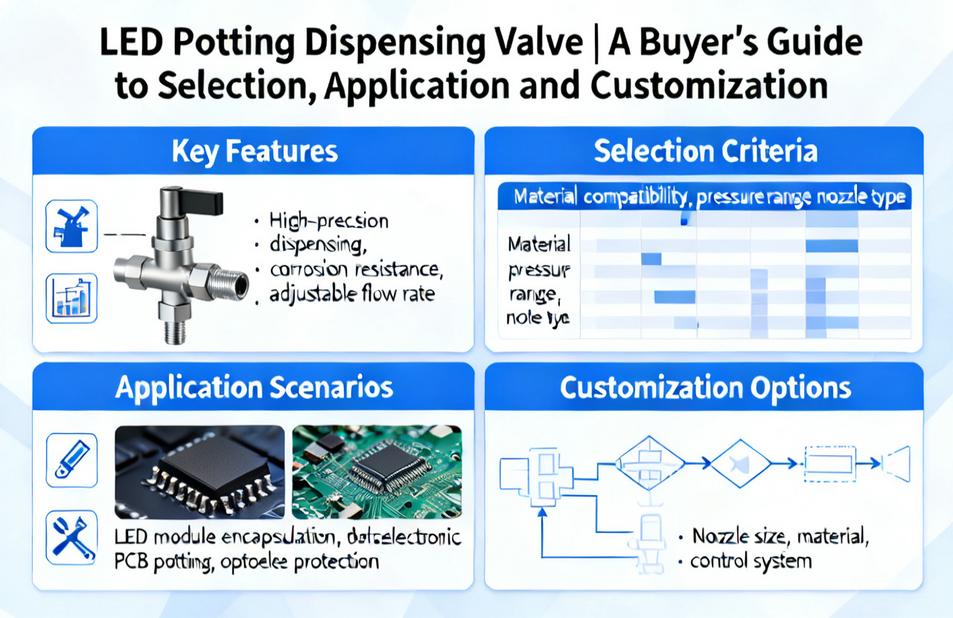
An LED potting dispensing valve is a specialized fluid control component used to meter, mix and dispense potting compounds, encapsulants, silicone, epoxy and other protective resins into LED modules, drivers and lighting assemblies. In LED manufacturing, the potting process protects sensitive components from moisture, vibration, thermal cycling and environmental contamination, so the dispensing valve directly affects fill accuracy, bubble control and repeatable output. For overseas buyers sourcing dispensing equipment for LED production lines, understanding how these valves work and what to evaluate before ordering is essential for stable process performance.
What the Valve Does in an LED Potting Line
Potting is different from simple gluing. LED potting compounds are often filled, abrasive or fast-curing, and the valve must deliver a consistent shot volume without clogging or dripping. A dispensing valve for LED potting typically works with a pressure tank, syringe barrel or pump-fed material supply and is triggered by a solenoid, pneumatic signal or automatic controller. The valve opens for a set time to release material into the LED housing or reflector cup, then closes cleanly to prevent stringing or excess resin on the lens area.
Because LED packages vary from small single emitters to large modules and linear light engines, the valve must match the required shot size, viscosity and production cycle. In many automated lines, the valve is mounted on a gantry or robot arm and coordinated with vision positioning, conveyor indexing and curing stations. The goal is not only accurate volume but also stable filling height, minimal air entrapment and repeatable coverage over the LED die and wire bonds.
Key Features Buyers Should Look For
When evaluating an LED potting dispensing valve, purchasing teams usually focus on several practical features. First, the valve should offer adjustable dispense time or stroke control so operators can fine-tune shot size without changing hardware. Second, the wetted path should be compatible with the intended potting chemistry, including two-part silicone, polyurethane and epoxy systems that may have different curing and wear characteristics. Third, anti-drip or suck-back capability helps prevent material from accumulating on the nozzle and dropping onto finished parts.
- Consistent shot repeatability across long production runs
- Easy cleaning and maintenance of the valve body and nozzle
- Compatibility with filled and abrasive compounds where applicable
- Compact mounting for robot, gantry or bench-top integration
- Simple air and electrical connections for line automation
Another important consideration is whether the valve is designed for contact or non-contact dispensing. Contact dispensing can suit recessed LED cavities, while non-contact jetting may be preferred for high-speed lines or uneven surfaces. Buyers should confirm the dispensing method with the valve supplier based on their product geometry and throughput target rather than assuming one style fits all applications.
Materials and Construction
The construction of an LED potting dispensing valve affects both service life and process cleanliness. Valve bodies and nozzles are commonly made from stainless steel, aluminum alloy or engineering plastics, depending on the material being dispensed and the required chemical resistance. Seals must be selected for compatibility with the potting compound, especially when solvents, curing agents or abrasive fillers are present. A well-built valve usually allows access to internal parts for inspection and replacement without special tools.
For OEM and custom projects, the factory may offer different nozzle diameters, mounting brackets, wetted-material options and actuator configurations. Buyers should request material compatibility information from the manufacturer rather than relying on general assumptions, particularly when switching between potting resins or running multiple LED product families on the same line.
Typical Industrial Applications
LED potting dispensing valves are used in several production scenarios beyond general lighting. They appear in LED module encapsulation, power supply and driver potting, sensor and optoelectronic component protection, automotive lighting assembly and outdoor luminaire sealing. In each case, the valve must handle the specific fill pattern, whether that is a small dot over an LED die, a perimeter seal around a lens or a full cavity fill for a driver housing.
Other industrial applications can include electronics protection, small-component encapsulation and precision resin dosing where repeatable output matters. Buyers should describe their material, shot size, cycle time and substrate to the supplier so the valve can be matched to the actual process rather than selected only by product category.
How to Choose the Right Valve for Your Line
Selecting an LED potting dispensing valve starts with the material. Viscosity, filler content, pot life and curing behavior all influence valve type and nozzle design. Next, define the required shot size and tolerance, then confirm the expected cycle time and whether the valve will run in a manual, semi-automatic or fully automated station. The mounting interface, air supply and control signal should also be checked against existing equipment.
Purchasing teams should ask the supplier for a technical datasheet, dimensional drawings and recommended operating parameters. If the application is new, a sample test or video demonstration can help confirm whether the valve suits the potting compound. It is also wise to discuss spare parts, seal kits and nozzle options before placing an order, since these items affect long-term maintenance planning.
Customization and OEM Options
Many dispensing valve manufacturers and suppliers offer OEM and custom configurations for equipment builders and brand owners. Customization may include nozzle geometry, mounting adapters, valve body materials, actuator voltage, cable length and labeling. For OEM projects, buyers should provide drawings or samples of the LED part, material specifications and target output so the factory can propose a suitable configuration. Clear communication about tolerances and interface dimensions helps avoid integration issues later.
Buying Considerations and Supplier Selection
When comparing suppliers, look for experience with dispensing equipment and a clear understanding of LED potting processes. A reliable manufacturer should be able to explain valve operation, maintenance intervals and material compatibility without making unverifiable claims. Request drawings, product photos and available documentation, and confirm whether the supplier supports small trial orders before mass production.
Consider the total cost of ownership rather than unit price alone. Maintenance frequency, spare parts availability and technical support all affect line uptime. For custom or OEM requests, confirm the supplier’s engineering communication process and lead time expectations in writing. Visiting a factory or reviewing its production and inspection workflow can also help buyers assess consistency and quality control.
Frequently Asked Questions
What type of potting compound can an LED potting dispensing valve handle?
Compatibility depends on the valve’s wetted materials and seal selection. Common compounds include silicone, epoxy and polyurethane, but filled or abrasive materials may require specific valve and nozzle designs. Always confirm compatibility with the supplier before ordering.
Can the valve be integrated into an existing automated dispensing system?
Many valves are designed for pneumatic or electrical triggering and can be mounted on robots, gantries or bench-top stations. Buyers should share mounting dimensions, control signal details and air supply requirements with the supplier to confirm integration.
Is custom nozzle or OEM configuration available?
Many manufacturers offer custom nozzle sizes, mounting brackets and private-label options for equipment builders. Provide part drawings, material details and target shot size so the factory can evaluate the request.
How do I maintain consistent dispensing quality?
Regular cleaning, checking seals and nozzles, and following the recommended operating parameters help maintain repeatability. Buyers should ask for a maintenance schedule and spare parts list when purchasing.
Conclusion
Choosing an LED potting dispensing valve is a process-driven decision. Match the valve to your potting material, shot size, cycle time and automation setup, then confirm maintenance and spare parts support before ordering. Whether you need a standard valve or a custom OEM solution, discussing your application details with an experienced supplier is the most practical way to reduce integration risk and keep LED potting output stable.
