

Motor Assembly Adhesive Dispensing Valve | A Buyer’s Guide to Selection and OEM Sourcing
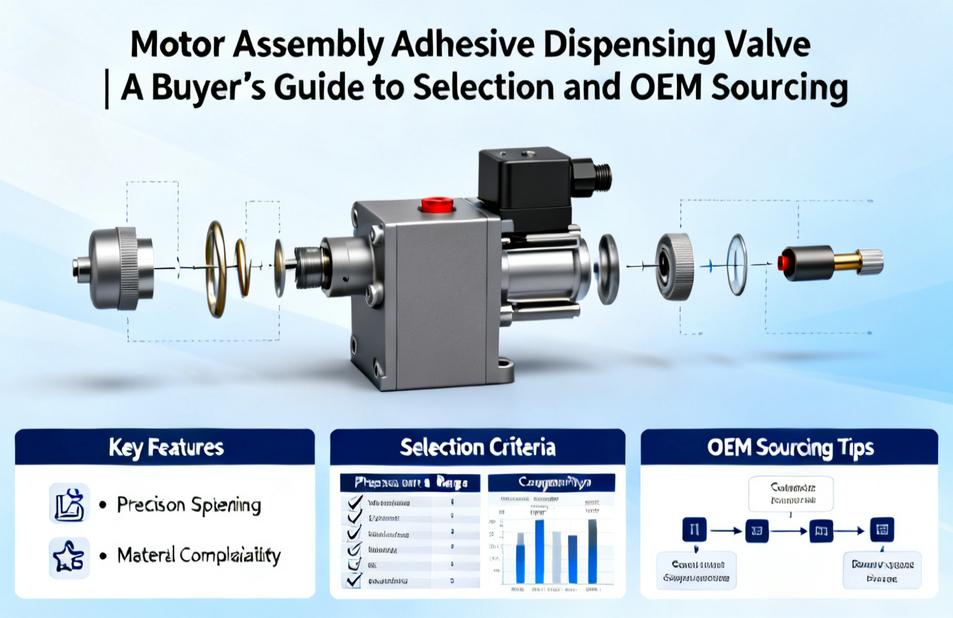
A motor assembly adhesive dispensing valve is a specialized fluid-control component used to apply adhesives, sealants, potting compounds, and other assembly fluids precisely during electric motor and related component manufacturing. In motor assembly, dispensing accuracy affects bond strength, thermal performance, vibration resistance, and overall production stability. This guide explains how these valves work, where they are used, what to evaluate during selection, and how OEM and custom sourcing typically works for overseas buyers.
What Is a Motor Assembly Adhesive Dispensing Valve?
A motor assembly adhesive dispensing valve is a valve module that controls the flow, volume, and placement of adhesive or potting material before it reaches the motor component. It is usually part of a dispensing system that includes a fluid reservoir, pump or pressure source, controller, and nozzle. The valve itself may be pneumatic, piezoelectric, screw-driven, or otherwise actuated, depending on the fluid characteristics and the required dispensing pattern.
In motor production, these valves are commonly used for magnet bonding, stator and rotor assembly, bearing retention, end-cap sealing, terminal potting, and sensor or connector bonding. They help reduce waste, improve repeatability, and support consistent adhesive beads or dots across high-volume lines.
How a Dispensing Valve Fits Into Motor Assembly
Motor assembly often involves multiple bonding and sealing steps, and each step may require a different adhesive chemistry and dispensing profile. A valve designed for one fluid may not perform well with another. For example, high-viscosity epoxy for magnet bonding behaves differently from low-viscosity thread-locking fluid or thermal potting gel.
The valve works with the dispense controller to open and close at the right moment, while the motion system or operator positions the nozzle. In automated lines, the valve may be integrated with a Cartesian robot, SCARA robot, or indexing conveyor. In semi-automatic stations, it may be mounted on a bench fixture with a foot pedal or manual trigger.
Key Features Buyers Usually Evaluate
Fluid Compatibility and Wetted Materials
The wetted path should be compatible with the adhesive chemistry. Two-part epoxies, anaerobic adhesives, silicone sealants, and polyurethane potting compounds can react differently with metals, elastomers, and plastics. Buyers should confirm the valve body, seal, and nozzle materials with the supplier before specifying a model.
Dispensing Repeatability
For motor assembly, small volume variations can affect balance, bond strength, and thermal contact. Look for valve designs that offer stable shot-to-shot repeatability and clear adjustment for flow rate, open time, and nozzle size. Avoid relying only on general catalog descriptions; request application-specific recommendations.
Actuation Method and Speed
Pneumatic valves are common for general adhesive dispensing, while piezoelectric or high-speed valve technologies may suit small dots and fast cycles. The right choice depends on the adhesive viscosity, required dispense frequency, and the motion platform.
Cleanability and Maintenance
Adhesive residue can clog nozzles and affect production uptime. A valve that can be purged, disassembled, or cleaned without special tooling is often easier to maintain. Buyers should ask about replacement parts, seal kits, and recommended cleaning procedures.
Typical Industrial Applications
- Magnet bonding in brushless DC motors and permanent magnet motors
- Stator potting and winding protection
- Rotor balancing adhesive application
- Bearing and shaft retention
- End-cap and housing sealing
- Terminal and connector encapsulation
- Sensor bonding in automotive and appliance motors
These applications vary in fluid type, dispense volume, and cycle time. A valve that works well for one motor program may need modification for another, which is why application details matter during supplier selection.
How to Choose the Right Valve for Your Motor Line
Start with the adhesive or potting material. Confirm its viscosity, filler content, cure characteristics, and pot life. Then define the required dispense pattern: dot, bead, circle, or fill. Next, review the production environment, including cycle time, automation level, and available air or power supply.
It is also important to match the valve to the dispensing controller and motion system. Communication interfaces, trigger signals, and mounting dimensions should be compatible with the existing equipment. For new lines, buyers may request a complete dispense solution rather than a standalone valve.
When comparing suppliers, ask for application questionnaires, dimensional drawings, and material compatibility information. A manufacturer with motor assembly experience can often recommend a suitable valve model and nozzle configuration based on the fluid and component geometry.
OEM and Customization Options
Many industrial dispensing valve suppliers offer OEM and custom options for motor assembly customers. Customization may include mounting brackets, nozzle geometry, fluid inlet fittings, trigger signal adaptations, and material changes for specific adhesives. Some suppliers can also provide private-label packaging or integrated manifold assemblies.
Buyers should clarify the customization scope early: whether the supplier can modify standard models, design a new valve, or provide a complete dispensing kit. Request drawings and sample evaluation units where possible, and confirm how custom specifications are documented in the purchase order.
Supplier Selection and Buying Considerations
For overseas buyers, supplier selection should go beyond price. Evaluate the supplier’s technical support, response time, documentation quality, and ability to handle small trial orders before mass production. Ask whether they are a factory or trading company, and confirm which production processes are in-house.
Check whether the supplier can provide consistent spare parts and seal kits, since adhesive valves are maintenance items. Also confirm shipping terms, packaging protection, and after-sales support. If the valve will be integrated into an automated line, ask for installation guidance and troubleshooting documentation.
Where certification is important for your market, request relevant documents directly from the supplier rather than relying on general statements. Do not assume compliance without written confirmation.
Frequently Asked Questions
How do I know which dispensing valve suits my adhesive?
Start with the adhesive data sheet, especially viscosity, filler content, and cure behavior. Share this information with the valve supplier and describe the required dot or bead size. A supplier with motor assembly experience can recommend a compatible valve type and wetted material combination.
Can a dispensing valve be retrofitted to an existing motor assembly line?
In many cases, yes, but compatibility depends on the controller, mounting space, trigger signal, and fluid supply. Provide drawings and photos of the existing station so the supplier can assess whether a standard valve or a custom mounting solution is needed.
What should I confirm before placing an OEM order?
Confirm the valve model, wetted materials, nozzle specification, mounting dimensions, signal interface, spare parts list, and packaging requirements. Also clarify whether custom modifications require a minimum order quantity or sample approval before production.
How can I evaluate a supplier for motor assembly dispensing valves?
Review their technical communication, application experience, documentation, and spare-parts support. Ask for dimensional drawings and material compatibility details. A supplier that asks detailed questions about your adhesive and process is usually better prepared to support long-term production.
Conclusion
Choosing a motor assembly adhesive dispensing valve requires matching the valve to the adhesive, the motor component, and the production process. Buyers should focus on fluid compatibility, repeatability, maintenance, automation fit, and supplier support rather than specifications alone. For OEM or custom requirements, early technical discussion helps avoid integration problems later. If you are evaluating dispensing valves for a motor assembly project, contact the supplier with your adhesive type, dispense pattern, and equipment details to discuss suitable specifications and customization options.
