

Liquid Gasket Dispensing Valve Selection Guide
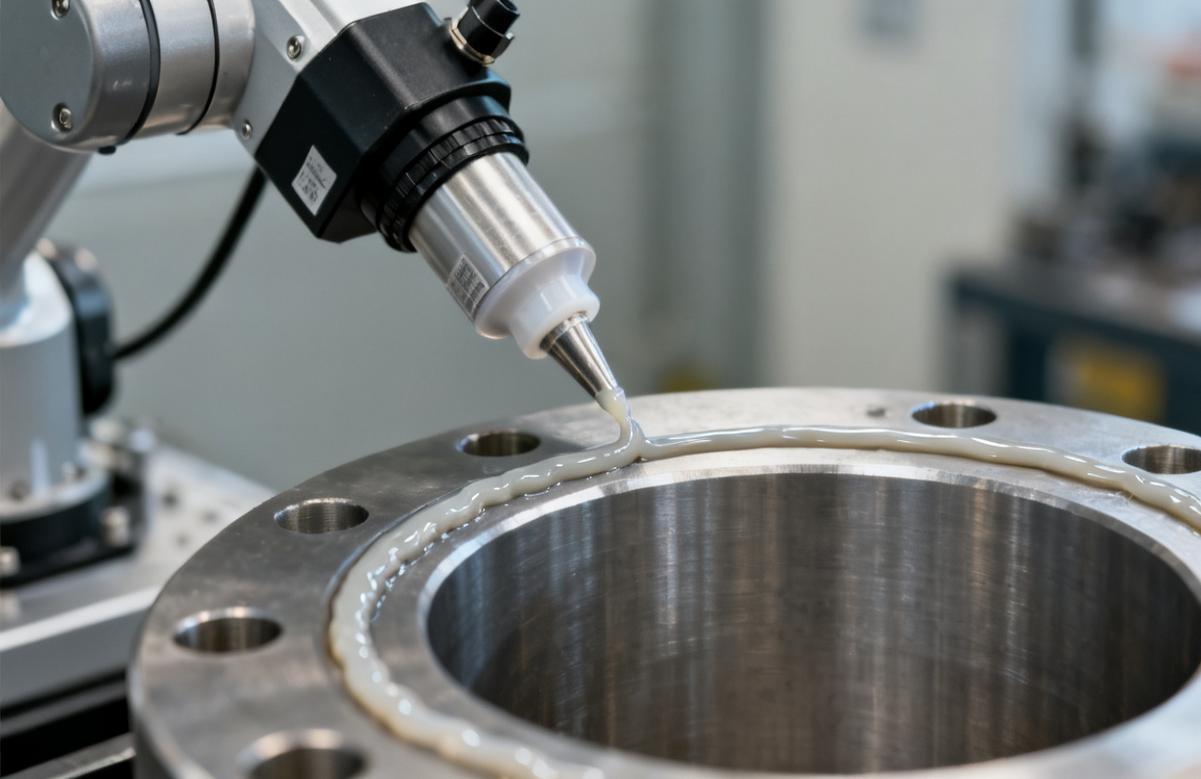
A liquid gasket dispensing valve is a fluid-control valve mounted on a dispensing robot or manual gun that starts, stops, and shapes a formed-in-place gasket bead, typically for anaerobic flange sealants, silicone FIPG, or similar liquid gasket materials. Selection depends on the fluid’s viscosity, cure behaviour, required bead size, valve wet-side material compatibility, and the actuation control that keeps bead start and stop consistent.
Where a liquid gasket dispensing valve sits in the process
Liquid gasket materials replace or supplement cut gaskets in applications such as machined flange sealing on gearboxes, pump housings, and covers. The dispensing valve is only one element of the system: material is usually supplied from a cartridge, pail, or pressure vessel, moved by a pump or pressure feed, and metered through a valve that opens and closes on command. Tank pressure, regulator settings, hose length, and valve design all affect the bead, so treat valve selection as part of the whole fluid path rather than an isolated component.
The valve’s main job is repeatable bead formation: a clean start, a stable body, and a controlled stop with minimal stringing or drool. Those three behaviours matter more for gasket forming than maximum flow capacity.
Valve types used for gasket forming
Several valve architectures are used for liquid gasket work. The right choice depends on the fluid and the bead requirement, not on a single ‘best’ design.
- Poppet or needle-seat valves: a moving stem closes against a seat. Often chosen for low-to-medium viscosity sealants and where a compact shut-off is needed.
- Diaphragm valves: the fluid contacts a flexible diaphragm rather than a sliding seal. Useful when the fluid cures, settles, or is sensitive to shear, but diaphragm material compatibility must be checked.
- Pinch or tube valves: the fluid is contained inside a disposable or replaceable tube that is pinched closed. Attractive for moisture-curing or fast-setting materials where internal cleaning is difficult.
- Spray or swirl valves: not typical for bead gaskets, but relevant where a wider deposit is required.
For anaerobic sealants and other curing materials, the risk of material curing inside the valve is a design constraint. Ask how the valve is flushed, purged, or replaced, and whether the design permits that in production conditions.
Wetted materials and fluid compatibility
Compatibility is the first technical gate. The valve body, seat, seals, and nozzle contact the gasket material, and the material chemistry may attack some elastomers or metal surfaces. Anaerobic sealants, silicones, and solvent-containing formulations each impose different demands. The required information is the manufacturer’s chemical compatibility data for the exact fluid and the exact wetted materials.
Do not assume a stainless-steel body or a particular seal compound is suitable because it is common. Confirm the grade and the elastomer with the valve supplier and the fluid supplier. Where the fluid supplier recommends a specific contact material, treat that as a constraint, not a preference.
What determines bead size and quality
| Factor | Why it matters | What to confirm |
|---|---|---|
| Nozzle orifice and tip geometry | Shapes the bead width and height | Available tip sizes and replacement method |
| Fluid viscosity and rheology | Affects flow, drool, and bead stability | Recommended viscosity range in the datasheet |
| Feed pressure | Drives flow through the valve | Rated inlet pressure and regulation method |
| Valve opening and closing time | Controls bead start and stop | Actuation type and control signal |
| Robot or gun speed | Sets bead cross-section for a given flow | Compatible motion and trigger timing |
These factors interact. A larger orifice does not guarantee a better bead if the valve closes slowly or the feed pressure fluctuates. Specify the target bead width and height, the tolerance, and the robot speed, then let the supplier confirm whether the valve and tip can meet that combination.
Actuation and control options
Pneumatic actuation is common in industrial dispensing because it is simple and fast. Electric or motor-driven actuation may offer finer control over opening and closing profiles. The choice should follow the required bead start and stop accuracy and the controls already used on the line.
Consider how the valve is triggered: a simple solenoid signal, an analogue or digital controller, or an integrated dispenser. Also consider whether the valve needs a suck-back or snuff-back feature to reduce drool at the end of a bead. Whether that feature is built in, optional, or absent must be confirmed with the manufacturer.
Installation and maintenance questions
Before ordering, ask how the valve mounts to the robot or gun, what the inlet connection is, and whether a filter is recommended upstream. For curing materials, ask about purge and cleaning procedure and the expected service interval for seals and seats. A valve that is difficult to clean can become a production bottleneck even if its dispensing performance is good.
Also confirm spare-parts availability and whether wear parts are user-replaceable. This is a practical selection criterion, not a performance claim.
Information to give a supplier
- The exact gasket material and its viscosity range.
- Target bead width, height, and tolerance.
- Required flow rate and robot or gun speed.
- Feed method and available inlet pressure.
- Control signal and integration environment.
- Cleaning and maintenance constraints.
- Any fluid-supplier material restrictions.
Quotation factors for a liquid gasket dispensing valve typically include valve architecture, wetted materials, tip and nozzle options, actuation and control electronics, and spare-parts scope. Prices and lead times vary by configuration and should be requested from the supplier for the specific specification.
Limitations to recognise early
A dispensing valve is not a metering pump. If the process requires a precise volumetric dose independent of pressure and time, a different metering approach may be needed. If the fluid cures rapidly, the valve may need a design that isolates the fluid from dead zones. If the bead tolerance is very tight, the robot motion, feed stability, and valve dynamics all need to be evaluated together. Pressure-containing supply equipment must be selected and operated according to its nameplate, manufacturer documentation, and applicable local requirements, with qualified engineering review.
Frequently Asked Questions
What is a liquid gasket dispensing valve used for?
It controls the start and stop of a formed-in-place gasket bead, usually for anaerobic flange sealants, silicone FIPG, or similar liquid gasket materials on flanges, covers, and housings.
How do I choose between a needle valve and a diaphragm valve for gasket material?
Consider the fluid’s curing behaviour, viscosity, and chemical compatibility. Diaphragm valves isolate the fluid from sliding seals, while needle or poppet valves offer compact shut-off. Confirm wetted materials and cleaning method with the manufacturer.
What specifications should I confirm before ordering?
Confirm the rated inlet pressure, recommended viscosity range, wetted materials, nozzle or tip options, actuation and control signal, mounting interface, and spare-parts availability in the datasheet.
Can a liquid gasket dispensing valve also meter a precise volume?
Not by itself. A valve controls flow on and off; volumetric dosing depends on feed pressure, time, and fluid behaviour. If precise volume is required, discuss metering or closed-loop control with the supplier.
Why does the bead drool or string at the end?
Drool and stringing relate to fluid rheology, nozzle geometry, closing speed, and whether suck-back is available. The right combination must be confirmed for the specific fluid and valve configuration.
