

Bottom Outlet Pressure Tank | A Practical Guide for Industrial Buyers and OEM Projects
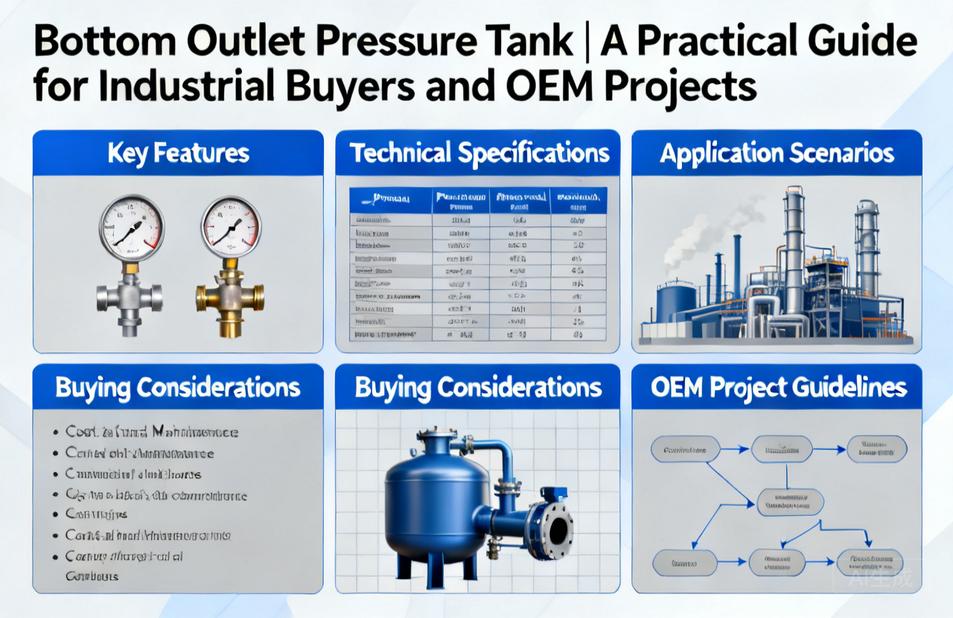
A bottom outlet pressure tank is a pressure vessel in which the fluid connection is positioned at the lowest point of the shell or dished bottom, allowing liquid, slurry, or viscous media to discharge by gravity or under controlled pressure. Unlike top outlet designs that require internal dip tubes or suction lines, a bottom outlet configuration simplifies drainage, reduces dead zones, and supports cleaner product evacuation in industrial processes. Buyers searching for a reliable pressure tank manufacturer often specify bottom outlet tanks for filtration systems, liquid transfer skids, chemical dosing stations, and sanitary processing lines where complete emptying and easy cleaning are important.
Product Overview and Working Principle
A bottom outlet pressure tank typically consists of a cylindrical shell, dished or conical heads, a bottom discharge nozzle, a top inlet or vent connection, and various instrument ports. The vessel stores liquid or semi-liquid media under pressure, and the bottom outlet allows the contents to flow directly into downstream equipment such as pumps, filters, mixers, or filling machines. In some systems, compressed air or inert gas is introduced above the liquid surface to push the product out through the bottom outlet in a controlled manner. This design is common in applications where product retention inside the tank must be minimized, where gravity discharge is preferred, or where the tank forms part of a closed-loop circulation system.
Because the outlet is at the bottom, the internal geometry can be kept simple, which helps reduce cleaning time and supports hygienic operation in food, beverage, pharmaceutical, and cosmetic processing. The actual pressure rating, temperature range, and outlet size depend on the specific process requirements and should always be confirmed with the pressure tank supplier before ordering.
Typical Configurations and Design Variations
Bottom outlet pressure tanks are available in several configurations to match different installation and process needs. Common variations include vertical tanks with dished bottoms and center outlets, vertical tanks with conical bottoms for solids-containing media, and horizontal tanks with bottom nozzles for space-limited skids. The outlet can be threaded, flanged, tri-clamp, or DIN style, depending on the connection standard used in the plant.
Some systems use a bottom outlet with a flush valve or diaphragm valve to control discharge, while others use a simple ball valve or butterfly valve. In sanitary applications, the bottom outlet may be designed as a zero dead leg connection to prevent product buildup. For abrasive or corrosive media, the outlet area may be reinforced or lined with a suitable material. These design choices should be discussed with a pressure tank factory during the specification stage, because they affect flow rate, cleanability, and service life.
Materials and Construction Considerations
Material selection for a bottom outlet pressure tank depends on the chemical compatibility, operating temperature, pressure, and cleanliness requirements of the application. Stainless steel grades such as 304, 316, and 316L are widely used in food, pharmaceutical, and chemical service because of their corrosion resistance and cleanability. Carbon steel tanks may be specified for less corrosive media where cost is a primary consideration, often with internal or external coatings. Specialty alloys and non-metallic linings are also available for aggressive chemicals, but these should be selected based on actual media data rather than general assumptions.
Construction details matter as much as the base material. Weld quality, surface finish, and nozzle reinforcement all influence the durability and hygiene level of the vessel. For sanitary models, internal surfaces may be mechanically polished or electropolished to reduce bacterial attachment. For industrial chemical service, the bottom outlet may be designed with additional thickness or a wear plate. Buyers should request material certificates and dimensional drawings when evaluating a pressure tank manufacturer, especially for custom or OEM projects.
Industrial Applications
Bottom outlet pressure tanks are used across many industries where reliable discharge and complete drainage are important. In water treatment, they may serve as chemical dosing tanks or filter backwash vessels. In food and beverage production, they are used for ingredient storage, mixing, and transfer of sauces, syrups, and dairy products. In pharmaceutical and biotech facilities, they support buffer preparation and liquid handling in clean environments. Chemical plants use them for intermediate storage and controlled feeding of reactive or viscous liquids. Other industrial applications include ink and coating supply systems, adhesive and sealant handling, wastewater treatment, and OEM equipment skids where a compact pressure vessel with bottom discharge is required.
Because the outlet is at the lowest point, these tanks are also suitable for processes that must avoid product stagnation or require gravity-assisted emptying. This makes them a practical choice for batch operations, cleaning cycles, and systems where residual liquid could affect product quality or cause cross-contamination.
How to Choose the Right Bottom Outlet Pressure Tank
Selecting a bottom outlet pressure tank starts with a clear definition of the process. Buyers should determine the media type, viscosity, temperature, pressure, flow rate, and required discharge method. The tank volume and dimensions should match the available installation space and the downstream equipment. The outlet size and connection type must be compatible with the existing piping or valve standard. Material selection should be based on corrosion data and cleaning requirements, not only on initial cost.
It is also important to consider whether the tank will operate under pressure, vacuum, or atmospheric conditions, because this affects wall thickness, head design, and support structure. For sanitary or high-purity applications, surface finish, drainage angle, and dead leg control should be reviewed. For hazardous media, additional safety features such as relief devices, level indicators, and secondary containment may be required. A qualified pressure tank supplier can help translate these requirements into a workable specification and avoid over- or under-designing the vessel.
Customization and OEM Options
Many industrial buyers need more than a standard catalog tank. Custom bottom outlet pressure tanks can be designed with specific dimensions, nozzle layouts, outlet orientations, support legs or skirts, and surface finishes. OEM pressure tank projects may involve private labeling, customized documentation, and integration with existing skids or process lines. When working with a custom pressure tank factory, buyers should provide detailed drawings, process data, and connection standards so the manufacturer can prepare an accurate proposal.
Customization can also include special coatings, insulation, heating or cooling jackets, agitation, level sensors, and pressure gauges. The goal is to match the tank to the actual process rather than forcing the process to fit a standard product. Clear communication during the design phase helps reduce revision cycles and ensures the final vessel meets both technical and regulatory expectations.
Buying Considerations and Supplier Selection
When comparing pressure tank suppliers, buyers should look beyond price and lead time. Evaluate the supplier’s engineering capability, fabrication experience, quality control process, and ability to handle custom or OEM orders. Ask for dimensional drawings, material certificates, and weld inspection records where applicable. A supplier that communicates clearly, asks detailed questions, and provides realistic technical feedback is often a better long-term partner than one that quotes a low price without understanding the application.
It is also useful to review the supplier’s experience with similar media, industries, and connection standards. If the tank will be used in a regulated environment, confirm that the manufacturer can provide the necessary documentation and traceability. For international buyers, consider logistics, packaging, and after-sales support as part of the total cost of ownership. A reliable bottom outlet pressure tank manufacturer should be able to support both standard and custom requirements without compromising on safety or workmanship.
Frequently Asked Questions
What is the advantage of a bottom outlet pressure tank compared with a top outlet design?
A bottom outlet pressure tank allows fluid to discharge from the lowest point of the vessel, which reduces dead zones and supports more complete drainage. It can simplify piping, improve cleanability, and make gravity-assisted emptying easier. Top outlet designs may still be preferred in some systems, but the bottom outlet is often chosen when product evacuation and hygiene are important.
Can bottom outlet pressure tanks be customized for OEM equipment?
Yes. Many manufacturers offer custom and OEM pressure tank solutions, including specific dimensions, nozzle arrangements, outlet types, surface finishes, and documentation. Buyers should provide process data and drawings so the supplier can design a vessel that fits the equipment and application.
How do I determine the right material for my application?
Material selection depends on the chemical compatibility, temperature, pressure, and cleaning requirements of the process. Stainless steel grades are common for sanitary and corrosive service, while carbon steel may be suitable for less aggressive media. Review the actual media data and consult the supplier before making a final decision.
What information should I provide when requesting a quote?
Provide the media type, operating pressure and temperature, required volume, outlet size and connection standard, installation orientation, and any special requirements such as insulation, agitation, or level instrumentation. This information helps the supplier prepare an accurate and technically suitable proposal.
Conclusion
Choosing the right bottom outlet pressure tank requires a clear understanding of the process, the media, and the installation environment. Buyers should focus on material compatibility, outlet design, cleanability, and the manufacturer’s ability to support custom or OEM requirements. Rather than comparing price alone, evaluate technical communication, documentation, and long-term service capability. If you are planning a new system or replacing an existing vessel, contact a qualified pressure tank supplier to discuss your specifications, application details, and customization needs.