

Stirred Pressure Tank for Industrial Mixing and Reaction Processes | A Buyer’s Guide
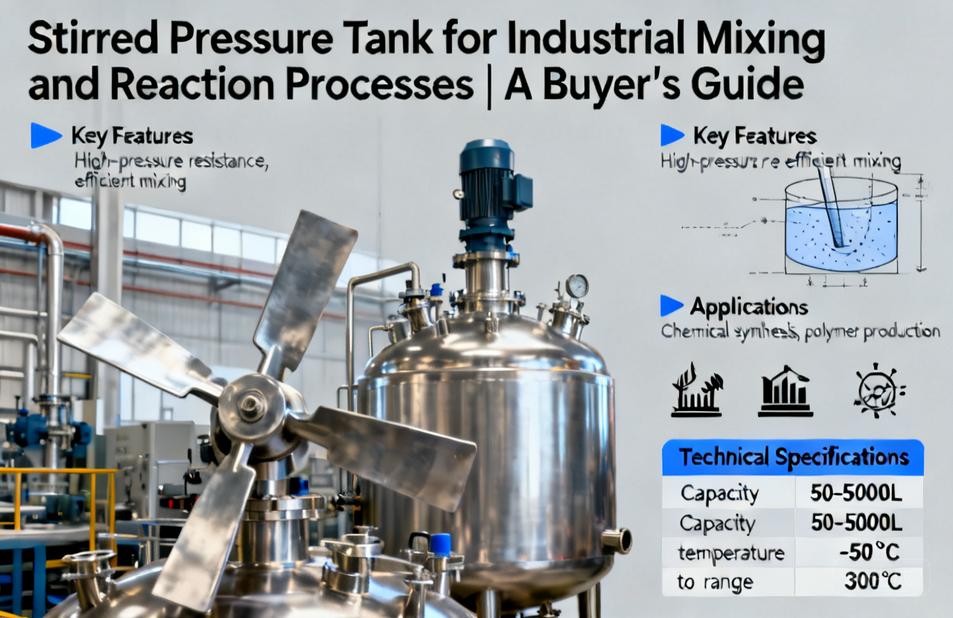
A stirred pressure tank is a closed vessel equipped with an agitator and designed to mix, blend, disperse, or react liquids and semi-liquids under controlled internal pressure. Unlike open mixing tanks, it allows processing to take place in a sealed environment, which helps contain vapors, prevent contamination, and support applications where pressure is part of the process. These tanks are commonly found in chemical processing, pharmaceutical intermediates, food and beverage production, adhesives and sealants, coatings, and specialty materials manufacturing. For overseas buyers, understanding how a stirred pressure tank works, what options are available, and how to match it to a process is essential before requesting a quotation from a manufacturer or supplier.
What Is a Stirred Pressure Tank?
A stirred pressure tank combines two functions in one unit: pressure containment and mechanical agitation. The vessel is typically cylindrical with dished or conical ends, and it is sealed to withstand internal pressure during operation. An agitator shaft enters the tank through a sealed top entry or bottom entry, driving an impeller that creates flow patterns inside the vessel. Depending on the process, the agitator may provide simple blending, high-shear dispersion, or gentle low-shear mixing.
The pressure rating, temperature range, and agitator type are not universal. They depend on the specific fluid, the required mixing intensity, and the process conditions. This is why most industrial stirred pressure tanks are engineered to order rather than selected from a fixed catalog. A reliable factory will ask detailed questions about viscosity, solids content, pressure and temperature cycles, cleaning requirements, and available utilities before proposing a design.
Key Features of a Stirred Pressure Tank
Vessel Design and Pressure Containment
The tank body is usually fabricated from plate or tube and formed into a cylindrical shell with heads. Closure may be bolted, clamped, or flanged, depending on access needs and pressure requirements. Sealing is critical: gaskets, O-rings, and mechanical seals must match the chemical compatibility and temperature of the process. For sanitary applications, the interior may be polished to reduce product retention and support clean-in-place procedures.
Agitation System
The agitator is the heart of a stirred pressure tank. Common configurations include top-entry agitators with a motor mounted above the tank, and bottom-entry or side-entry designs where space or process demands it. Impeller selection depends on the mixing task: pitched blade turbines for general blending, flat disk turbines for dispersion, and anchors or helical ribbons for high-viscosity products. Variable frequency drives are often used to adjust speed as the batch progresses.
Heating and Cooling Options
Many stirred pressure tanks include a jacket or coil for temperature control. A jacket surrounds the vessel shell and circulates steam, hot oil, or chilled water. Internal coils offer higher heat transfer surface but can interfere with agitation and cleaning. The choice depends on the required heating or cooling rate, the product’s sensitivity to temperature, and the cleaning method.
Materials and Construction
Material selection affects corrosion resistance, product purity, and service life. Stainless steel grades such as 304 and 316L are common for general chemical and food applications. For highly corrosive media, higher-alloy stainless steels, duplex grades, or lined carbon steel may be specified. The wetted parts of the agitator, shaft, and seals should be compatible with the same environment as the vessel. Surface finish, weld quality, and post-weld treatment also matter, especially in pharmaceutical and food-grade projects where hygiene and cleanability are priorities.
Buyers should request material certificates and, where applicable, documentation for pressure boundary components. While certifications vary by region and application, a professional supplier should be able to provide traceability and testing documentation that matches the project requirements.
Industrial Applications
Stirred pressure tanks serve processes where mixing and pressure go hand in hand. Typical industrial applications include:
- Chemical synthesis and intermediate reactions under controlled pressure
- Polymer and resin preparation where volatile components must be contained
- Adhesive, sealant, and coating production requiring dispersion under sealed conditions
- Food and beverage processing such as sauce, syrup, and concentrate blending
- Pharmaceutical and cosmetic emulsions where contamination control is important
- Waste treatment and neutralization where fumes or reactive gases are present
In each case, the tank must match the process fluid, the required mixing intensity, and the pressure and temperature profile. A tank that works well for low-viscosity blending may not be suitable for high-solids dispersion, and vice versa.
How to Choose the Right Stirred Pressure Tank
Choosing a stirred pressure tank starts with the process, not the equipment. Buyers should prepare a clear process description that includes:
- Fluid type, viscosity range, and solids content
- Batch size and required working volume
- Operating pressure and temperature, including cleaning and sterilization cycles
- Mixing objective: blending, dispersion, emulsification, or reaction
- Material compatibility and hygiene requirements
- Available utilities: power supply, steam, cooling water, compressed air
- Installation space, height restrictions, and access for maintenance
With this information, a manufacturer can recommend vessel geometry, agitator type, seal arrangement, and instrumentation. It is also important to discuss control philosophy: whether the agitator speed is fixed or variable, how pressure and temperature are monitored, and what safety interlocks are needed. For hazardous environments, explosion-proof motors and appropriate electrical classifications may be required.
Customization and OEM Options
Most stirred pressure tanks are built to order, so customization is standard rather than exceptional. Common custom options include special dimensions to fit an existing production line, alternative nozzle layouts, customized agitator configurations, sanitary finishes, and integrated control panels. OEM arrangements are also common when an equipment builder or process system integrator needs tanks branded or configured for a specific project.
When discussing customization, buyers should confirm the scope of supply: whether the supplier provides only the vessel, a complete skid with agitator and controls, or full documentation and testing. Clarifying these points early helps avoid gaps during installation and commissioning.
Buying Considerations and Supplier Selection
Price should not be the only factor. A stirred pressure tank is a pressure-containing vessel with moving parts, so engineering quality, material traceability, and after-sales support matter. Buyers should evaluate whether the supplier has experience with similar applications, can provide relevant references without disclosing confidential client information, and offers clear communication during design review and manufacturing.
A reliable manufacturer or supplier should be able to explain design decisions, provide drawings for approval, and respond to technical questions throughout the project. It is also useful to ask about warranty terms, spare parts availability, and whether installation and commissioning support can be provided remotely or on site. For projects requiring specific standards, confirm that the factory can work to the relevant design code and provide the necessary documentation.
Frequently Asked Questions
Can a stirred pressure tank be used for both mixing and reaction?
Yes. Many stirred pressure tanks are designed for combined mixing and reaction duties. The agitator provides contact between phases, while the sealed vessel maintains pressure and contains vapors. The design must account for heat generation, gas evolution, and any pressure rise during the reaction.
How do I decide between top-entry and bottom-entry agitation?
Top-entry agitation is more common because it is easier to maintain and seal. Bottom-entry agitation can be useful when headroom is limited or when the process requires a specific flow pattern. The choice depends on vessel geometry, viscosity, and maintenance access. A qualified supplier can recommend the most practical arrangement for your process.
What information should I provide for a custom stirred pressure tank quotation?
Provide the process fluid and its properties, working volume, pressure and temperature range, mixing objective, material preferences, utility details, and any space or connection constraints. Sketches, P&IDs, or existing equipment photos can also help the manufacturer understand the interface requirements.
Are sanitary designs available for food and pharmaceutical use?
Yes. Stirred pressure tanks can be supplied with sanitary finishes, crevice-free interiors, hygienic seals, and clean-in-place connections. The level of sanitary design should be specified based on the applicable hygiene standard and the product being processed.
Conclusion
A stirred pressure tank is a process-critical investment, and the right choice depends on a clear understanding of the fluid, the mixing task, and the operating conditions. Buyers should prioritize engineering support, material traceability, and customization capability over a simple price comparison. If you are evaluating options for a new project, contact a qualified manufacturer or supplier to discuss your application, review possible configurations, and request a custom or OEM proposal based on your actual process requirements.
