

Pressure Tank With Agitator | A Buyer’s Guide for Industrial Mixing and Dispensing
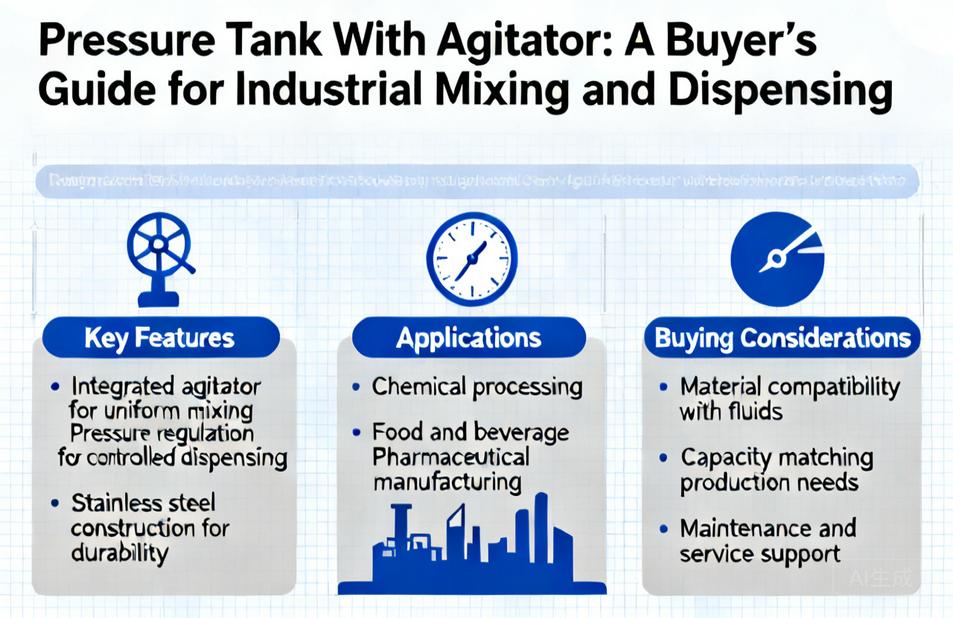
A pressure tank with agitator is a vessel that holds liquids, slurries, or viscous materials under controlled pressure while an internal agitation system keeps the product homogeneous. It is widely used in industrial applications where settling, separation, or inconsistent density can affect process quality, such as adhesive dispensing, chemical dosing, food processing, and pharmaceutical production. Unlike a standard pressure vessel, the agitator prevents solids from settling and maintains uniform viscosity, making it suitable for filled resins, pigments, sauces, and other formulations that require continuous mixing before or during discharge.
Product Overview
In a pressure tank with agitator, the tank body is sealed and pressurized with compressed air or an inert gas. The pressure pushes the product out through a discharge valve or dispensing nozzle. Inside, a shaft-mounted impeller or paddle assembly rotates to keep the material mixed. The agitator can be driven by an electric motor, an air motor, or a magnetic drive, depending on the application and the required torque. The combination of pressure and agitation allows the system to handle materials that would otherwise clog, separate, or harden in a static tank.
Because the agitator runs continuously or intermittently, the tank can maintain consistent particle suspension and temperature distribution. This is especially important when the product contains fillers, fibers, or multiple liquid phases that tend to separate over time.
Key Features and Working Principle
A typical pressure tank with agitator includes a pressure-rated shell, a removable or fixed top cover, a gasketed seal, an agitation shaft, an impeller, a pressure gauge, a safety relief valve, and inlet and outlet ports. The agitator may be top-mounted or bottom-mounted. Top-mounted designs are common for open or closed tanks, while bottom-mounted magnetic agitators are used when a seal-less design is preferred to avoid leakage.
The working principle is straightforward: the tank is filled with the product, sealed, and pressurized. The agitator keeps the product in motion. When the discharge valve opens, the internal pressure forces the product out at a consistent rate. The agitation speed and pressure can be adjusted to match the viscosity and flow requirements of the downstream equipment. Some systems include a recirculation loop or a level sensor to automate refilling and maintain constant output.
Materials and Construction
Material selection is critical because the tank must resist both the chemical nature of the product and the mechanical stress of agitation. Common materials include carbon steel, 304 stainless steel, 316L stainless steel, and in some cases duplex stainless steel or specialized alloys. Stainless steel is often chosen for food, pharmaceutical, and chemical applications where corrosion resistance and cleanability are required. The interior surface may be polished or electropolished to reduce product adhesion and simplify cleaning.
Seals, gaskets, and wetted parts must also be compatible with the product. For aggressive solvents, PTFE or Viton seals may be specified. The agitator shaft and impeller are typically made from the same alloy as the tank or a compatible material to avoid galvanic corrosion. Pressure ratings and temperature limits should be confirmed by the manufacturer based on the specific design, but the construction must always follow the relevant pressure vessel codes for the target market.
Industrial Applications
Pressure tanks with agitators serve many industries. In adhesive and sealant dispensing, they keep filled adhesives and mastics uniform before application. In chemical processing, they mix and feed slurries, pigments, and catalysts under pressure. In food and beverage production, they handle sauces, chocolate, and dairy mixtures that require gentle agitation. In pharmaceutical and cosmetic manufacturing, they support sanitary mixing and transfer of creams, gels, and suspensions. Other applications include wastewater treatment, ceramic slip casting, and battery slurry preparation.
Because the agitator prevents settling, these tanks are often used in processes where the product must remain in suspension for extended periods, such as continuous dispensing lines or batch feeding systems.
How to Choose the Right Pressure Tank With Agitator
Selecting the correct unit requires matching several parameters to your process. First, define the product characteristics: viscosity, density, particle size, and whether the material is shear-sensitive or abrasive. Second, determine the required pressure and flow rate for your downstream equipment. Third, consider the agitation intensity and impeller type. Low-viscosity liquids may need a simple propeller, while high-viscosity products may require a paddle, anchor, or helical agitator. Fourth, check the material compatibility and cleaning requirements. Fifth, evaluate the available space, port sizes, and mounting orientation.
It is also important to consider whether the tank will be used in a hazardous area, which may require an explosion-proof motor or an air-driven agitator. For sanitary applications, look for crevice-free welds, rounded corners, and drainable bottoms. A reputable supplier can help you calculate the right volume, pressure rating, and agitator speed based on your process data.
Customization and OEM Options
Many manufacturers offer custom and OEM pressure tanks with agitators to fit specific machinery or process lines. Customization can include tank volume, pressure rating, material grade, surface finish, port configuration, agitator type, motor voltage, and control panel integration. OEM options may involve private labeling, unique mounting brackets, or modified dimensions to replace an existing tank in a larger system. When requesting a custom design, provide detailed drawings, process conditions, and any industry standards that must be met. A capable factory will review your requirements and propose a design that balances performance, safety, and cost.
Buying Considerations and Supplier Selection
When sourcing a pressure tank with agitator, evaluate the supplier’s engineering capability, fabrication quality, and experience with similar applications. Ask for documentation on material certificates, pressure testing, and dimensional inspection. Review whether the supplier can provide spare parts, technical support, and after-sales service. For international buyers, consider logistics, packaging, and compliance with local pressure equipment regulations. A manufacturer with in-house design and testing can often respond faster to custom requests and ensure consistent quality across repeat orders.
Price should not be the only factor. A low-cost tank that fails to maintain pressure or causes product contamination can lead to costly downtime. Instead, compare total cost of ownership, including maintenance, energy use, and expected service life.
Frequently Asked Questions
Can a pressure tank with agitator handle high-viscosity materials?
Yes, but the agitator type and motor power must be selected accordingly. High-viscosity products often require a paddle, anchor, or helical agitator with a gearmotor to provide sufficient torque. The discharge system may also need a larger outlet or a pump-assisted design to move the product efficiently.
What is the difference between a pressure tank and a pressure tank with agitator?
A standard pressure tank stores and dispenses liquids under pressure but does not mix them. Adding an agitator allows the tank to maintain suspension, blend additives, or keep temperature uniform. This makes the agitated version suitable for products that separate or settle during storage and dispensing.
How do I determine the right tank size for my process?
Start with your required batch size or continuous flow rate, then add a reasonable working volume above the minimum level needed to cover the agitator and prevent vortexing. Consider the refill frequency and the space available. Your supplier can help calculate the net volume based on your duty cycle and product characteristics.
Are custom pressure tanks with agitators available for OEM projects?
Many factories offer OEM and custom fabrication for pressure tanks with agitators. You can specify dimensions, materials, connections, agitator design, and controls. Providing detailed process data and drawings helps the manufacturer deliver a unit that integrates smoothly with your existing equipment.
Conclusion
Choosing the right pressure tank with agitator involves understanding your product, process pressure, agitation needs, and material compatibility. Focus on a design that maintains consistent mixing, meets safety codes, and fits your production line. Whether you need a standard unit or a custom OEM solution, work with a manufacturer or supplier who can review your application and recommend the appropriate configuration. For specifications, application questions, or custom project discussions, contact the supplier directly with your process details to receive a tailored recommendation.
