

Pressure Tank with Mixer | A Buyer’s Guide for Industrial Mixing and Storage
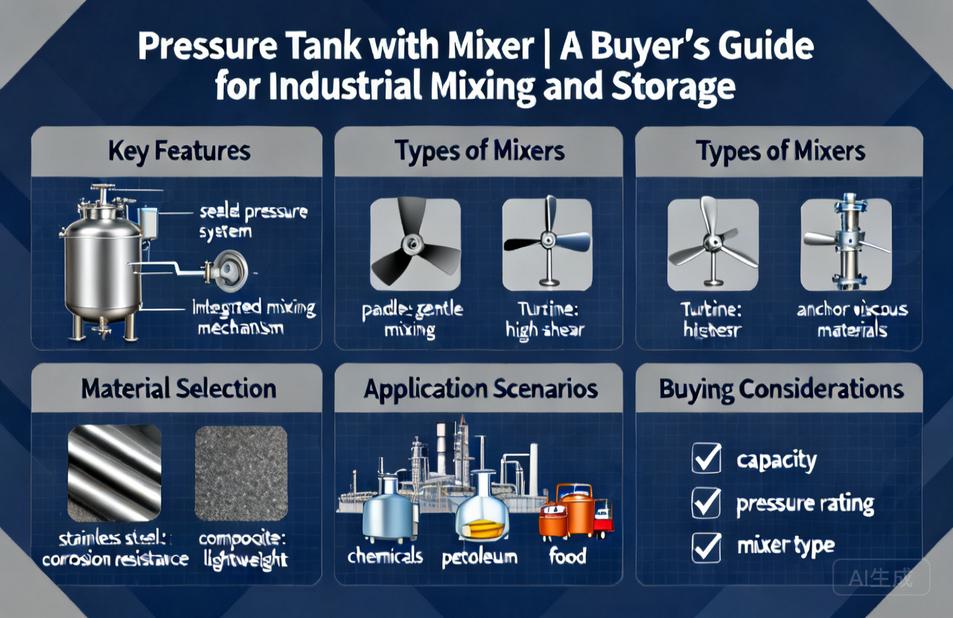
A pressure tank with mixer is a closed vessel that combines pressure containment with mechanical agitation. It is used to store, mix, and discharge liquids, slurries, or viscous materials under controlled pressure. In food processing, chemical blending, pharmaceutical production, and water treatment, this equipment allows a single unit to perform mixing, holding, and pressurized transfer. For overseas buyers, understanding how these tanks work, where they fit, and what to evaluate before requesting a quote helps avoid mismatched equipment and costly downtime.
What Is a Pressure Tank with Mixer?
A pressure tank with mixer is essentially a pressure vessel fitted with an agitator assembly. The tank body is designed to withstand internal pressure, while the mixer — typically a top-entry or side-entry shaft with impellers — keeps the product homogeneous. The combination is useful when a process requires blending that cannot be done in an open tank because of pressure, hygiene, or volatile ingredients. In practical terms, it is a mixing reactor, a pressurized holding tank, and a discharge vessel in one skid. Common configurations include vertical and horizontal orientations, single-wall or jacketed construction, and manual or automated control panels.
How the Mixing and Pressure System Works
Product enters through an inlet, often by pump or gravity. Once the tank is sealed, the mixer motor drives the shaft and impeller to create flow patterns inside the vessel. Pressure is maintained by compressed air or an inert gas blanket, or by the process itself. Discharge can be through a bottom outlet, a dip tube, or a spray ball system, depending on the application. Key elements include the pressure relief device, level indication, temperature sensing, and a mechanical seal that prevents leakage around the shaft. The mixer speed and impeller type are selected based on viscosity, solids content, and the desired mixing action — axial flow for blending, radial flow for dispersion, or a combination for high-solids slurries.
Key Features Buyers Should Look For
- Tank geometry: Cylindrical with dished or conical heads supports even mixing and easier cleaning. Cone-bottom designs help with solids discharge.
- Agitator design: The impeller, shaft, and seal must match the product viscosity and process goal. High-viscosity products often need anchor or helical ribbon agitators.
- Pressure rating: The vessel and fittings should be rated for the maximum working pressure of the application, with appropriate safety margins and relief valves.
- Surface finish: Internal finishes matter for hygiene, corrosion resistance, and cleanability. Buyers should specify the finish based on the product and cleaning method.
- Controls: Variable frequency drives, pressure transmitters, and batch control systems improve repeatability and reduce operator error.
Materials and Construction
Stainless steel is the most common material for pressure tanks with mixers, with grades selected according to the product and environment. For aggressive chemicals, higher-alloy stainless steels or lined tanks may be required. Carbon steel with internal coatings is sometimes used for non-hygienic industrial mixing. The construction method — welded, flanged, or clamped — affects maintenance and cleaning. Sanitary designs often use tri-clamp fittings and crevice-free welds. Buyers should discuss material certificates, weld maps, and post-weld treatment with the manufacturer to confirm the tank suits the intended service.
Industrial Applications
Pressure tanks with mixers appear in many process industries:
- Food and beverage: mixing sauces, syrups, and dairy blends under pressure for consistent texture and safe transfer.
- Chemical processing: blending resins, additives, and solvents where vapors or reactivity require a closed system.
- Pharmaceuticals and cosmetics: preparing emulsions, gels, and creams with controlled agitation and pressure.
- Water treatment: dosing and mixing chemicals before pressurized distribution.
- Adhesives and sealants: holding and dispensing high-viscosity materials through pressurized lines.
Each application influences the mixer type, seal arrangement, and discharge method. A supplier with experience in your industry can recommend a configuration that balances mixing performance with pressure integrity.
How to Choose the Right Pressure Tank with Mixer
Selection starts with the process requirements. Define the product characteristics: viscosity, density, solids size, temperature, and whether the material is shear-sensitive. Next, establish the required working pressure and the pressure source — compressed air, inert gas, or process pressure. Determine the batch size and the desired mixing time. From there, consider the tank orientation, outlet design, and cleaning method. The agitator should be sized for the most demanding condition, not just the average. Finally, review the control philosophy: manual valves, PLC-based automation, or a hybrid approach. A reputable manufacturer will ask these questions before quoting, and will provide a dimensional drawing and material list for review.
Customization and OEM Options
Many pressure tank manufacturers offer custom and OEM solutions. Customization can cover tank volume, pressure rating, agitator type, motor power, seal design, surface finish, nozzle layout, and control panel configuration. OEM production is common for equipment builders and distributors who need tanks branded or integrated into a larger system. When discussing customization, provide a detailed specification sheet and, if possible, a process description. This reduces the risk of rework and ensures the delivered tank matches the mixing and pressure requirements. Ask about engineering support, documentation, and spare parts availability during the quoting stage.
Buying Considerations and Supplier Selection
When comparing suppliers, look beyond the initial price. Evaluate the manufacturer’s engineering capability, fabrication quality, and experience with similar applications. Request references or examples of tanks built for comparable products, but avoid relying on unverified claims. Check how the supplier handles pressure testing, documentation, and after-sales support. A factory with in-house design and welding can often accommodate modifications more efficiently than a trading company. For international buyers, clarify shipping terms, packaging, and whether installation support is available. It is also wise to confirm the warranty scope and the availability of wear parts such as seals and impellers. A transparent supplier will welcome technical questions and provide clear answers without overpromising.
Frequently Asked Questions
What is the difference between a pressure tank with mixer and a standard mixing tank?
A standard mixing tank is usually open or vented and operates at atmospheric pressure. A pressure tank with mixer is sealed and designed to withstand internal pressure, allowing mixing under gas blankets, pressurized discharge, or closed-loop processing. The agitator, seals, and vessel thickness are adapted to these conditions.
Can the mixer be customized for high-viscosity products?
Yes. High-viscosity products often require anchor, helical ribbon, or planetary agitators with larger motors and reinforced shafts. The manufacturer should review the viscosity profile and solids content to recommend the right impeller and speed range.
How do I specify the right pressure rating?
Base the rating on the maximum pressure the tank will see during operation, including any surge or cleaning conditions. The relief valve and instrumentation must match that rating. Provide the process details to the supplier so they can confirm the vessel design.
What information should I provide for an OEM or custom request?
Share the product type, batch size, viscosity, temperature range, working pressure, cleaning method, and control requirements. A sketch or process flow diagram helps. The supplier can then propose a tank configuration and confirm feasibility.
Conclusion
Choosing a pressure tank with mixer is a matter of matching the vessel, agitator, and pressure system to the actual process. Buyers should focus on material compatibility, mixing performance, pressure integrity, and cleanability rather than headline specifications alone. Working with an experienced manufacturer or supplier who offers custom and OEM options can simplify the selection process and reduce integration risk. If you are evaluating options for an industrial application, contact the supplier with your product details and pressure requirements to request a configuration review and quotation.