

Pressure Supply Tank Selection Guide for Industrial Fluid Systems
A pressure supply tank is a vessel that stores liquid or gas under controlled pressure and delivers it to a downstream process at a steady, reliable flow. In industrial settings, it is often used to feed adhesives, solvents, inks, coatings, water, or compressed air into production equipment where consistent pressure is critical. For buyers sourcing this component, understanding how a pressure supply tank works, where it fits, and how to match it to an existing system is essential before requesting quotes from a manufacturer or supplier.
What a Pressure Supply Tank Does in a System
Unlike a simple storage tank, a pressure supply tank maintains internal pressure so that fluid can be pushed through lines, valves, and dispensing points without relying solely on gravity or a continuous pump. The tank typically receives pressurized air or gas on one side and liquid on the other, creating a balanced force that moves the product at a stable rate. This design is common in systems where pulsation from a pump would cause inconsistent application, such as spraying, dosing, or precision dispensing.
In many plants, the pressure supply tank also acts as a buffer. It absorbs demand spikes, reduces pump cycling, and helps maintain line pressure when multiple stations draw fluid at the same time. Because the tank separates the driving gas from the liquid, it can handle a range of viscosities and chemistries, provided the wetted materials are compatible.
Key Features Buyers Look For
When evaluating a pressure supply tank, purchasing teams often focus on features that affect safety, maintenance, and process control. Common considerations include:
- Pressure regulation: A reliable regulator and gauge allow operators to set and monitor the driving pressure.
- Level indication: Sight glasses or level sensors help track fluid volume without opening the vessel.
- Access and cleaning: Removable lids, sanitary fittings, or drain ports simplify refilling and cleaning between batches.
- Safety relief: A pressure relief valve protects the tank from over-pressurization and supports safe operation.
- Connection options: Inlet, outlet, vent, and drain ports should match existing hoses, pipes, or fittings.
These features vary by model and application, so it is important to define the process requirements before comparing offers from different suppliers.
Materials and Construction
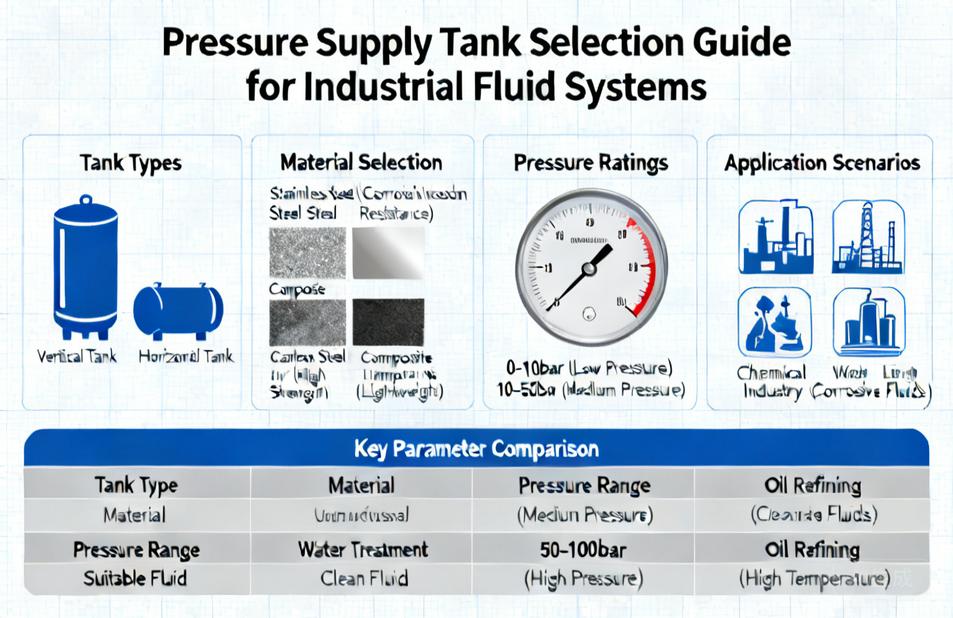
The construction material of a pressure supply tank must be compatible with the fluid being handled and the environment where it is installed. Stainless steel is a frequent choice for water-based, solvent-based, and food-related applications because it resists corrosion and is easy to clean. Carbon steel may be suitable for certain industrial oils and non-corrosive media, often with an internal coating. Some systems use plastic or composite vessels for lighter duty or highly corrosive chemicals.
Welding quality, surface finish, and port design also matter. A tank intended for sanitary use may require polished internal surfaces and crevice-free joints, while a general industrial unit may prioritize ruggedness and repairability. Buyers should confirm material certificates and pressure ratings with the manufacturer rather than assuming performance based on appearance alone.
Industrial Applications
Pressure supply tanks appear across many sectors because they solve a common problem: delivering fluid at a consistent pressure. Typical industrial applications include:
- Adhesive and sealant dispensing in assembly lines
- Ink supply for printing and marking systems
- Coating and painting equipment
- Chemical dosing and water treatment
- Lubrication systems for machinery
- Food and beverage ingredient transfer
In each case, the tank must match the fluid characteristics, required flow rate, and operating pressure of the downstream equipment. A tank that is too small may require frequent refilling, while an oversized unit can add unnecessary cost and footprint.
How to Choose the Right Pressure Supply Tank
Selecting a pressure supply tank starts with a clear process description. Buyers should gather the following information before contacting a supplier:
- Fluid type, viscosity, and temperature
- Required delivery pressure and flow rate
- Available space and mounting requirements
- Connection sizes and types
- Cleaning and maintenance expectations
- Environmental or regulatory considerations
With these details, a manufacturer can recommend a tank size, material, and port configuration that fits the application. It is also useful to ask about turndown capability, refill intervals, and how the tank integrates with existing pumps or control panels.
Customization and OEM Options
Many industrial buyers need more than a standard catalog item. Custom pressure supply tanks can be built with specific dimensions, port locations, materials, and mounting brackets to fit an existing machine or production line. OEM arrangements are common when the tank becomes part of a larger equipment package, allowing the original equipment manufacturer to specify branding, labeling, and interface details.
When discussing customization with a factory, provide drawings, schematics, or samples where possible. Clarify which parameters are fixed and which can be adjusted, and ask how changes affect lead time and tooling. A supplier experienced in custom fabrication will typically ask detailed questions about the process rather than offering a generic solution.
Buying Considerations and Supplier Selection
Price is only one factor in a successful purchase. Buyers should also evaluate the supplier’s technical support, production capability, and quality control process. A reliable manufacturer or supplier can provide material documentation, dimensional reports, and guidance on installation and maintenance. It is reasonable to request references or examples of similar applications, though specific customer names may be confidential.
Communication is another indicator of fit. A supplier that responds clearly to technical questions and offers practical suggestions is often easier to work with over the long term. For international orders, discuss packaging, marking, and documentation requirements early to avoid delays at customs or during installation.
Frequently Asked Questions
How do I know what size pressure supply tank I need?
Size depends on flow rate, refill frequency, and available space. Estimate how much fluid the process consumes per hour or per shift, then choose a tank that reduces refilling without being unnecessarily large. A supplier can help calculate the right volume based on your process data.
Can a pressure supply tank handle high-viscosity fluids?
Yes, but the design must account for flow characteristics. Higher viscosity may require larger ports, different valve types, or a tank configuration that supports easier movement of the fluid. Always share the fluid properties with the manufacturer before selection.
What is the difference between a pressure tank and a pressure supply tank?
The terms are often used interchangeably. In practice, a pressure supply tank emphasizes the delivery function, feeding fluid to a process, while a pressure tank may refer more broadly to any vessel that holds media under pressure. The specific features depend on the application.
Can pressure supply tanks be customized for OEM equipment?
Many manufacturers offer custom and OEM solutions. Typical customizations include dimensions, materials, port arrangements, mounting hardware, and labeling. Providing detailed specifications helps the factory deliver a tank that integrates smoothly with your equipment.
Conclusion
Choosing a pressure supply tank is a matter of matching the vessel to the fluid, the process, and the installation environment. Buyers should focus on pressure control, material compatibility, maintenance access, and the supplier’s ability to support custom or OEM requirements. Rather than comparing only price, evaluate technical responsiveness and production consistency. If you are sourcing for a specific application, contacting a manufacturer with your process details is the most practical next step to confirm the right configuration and customization options.
