

Pressure Feed Tank Selection Guide for Industrial Fluid and Dispensing Systems
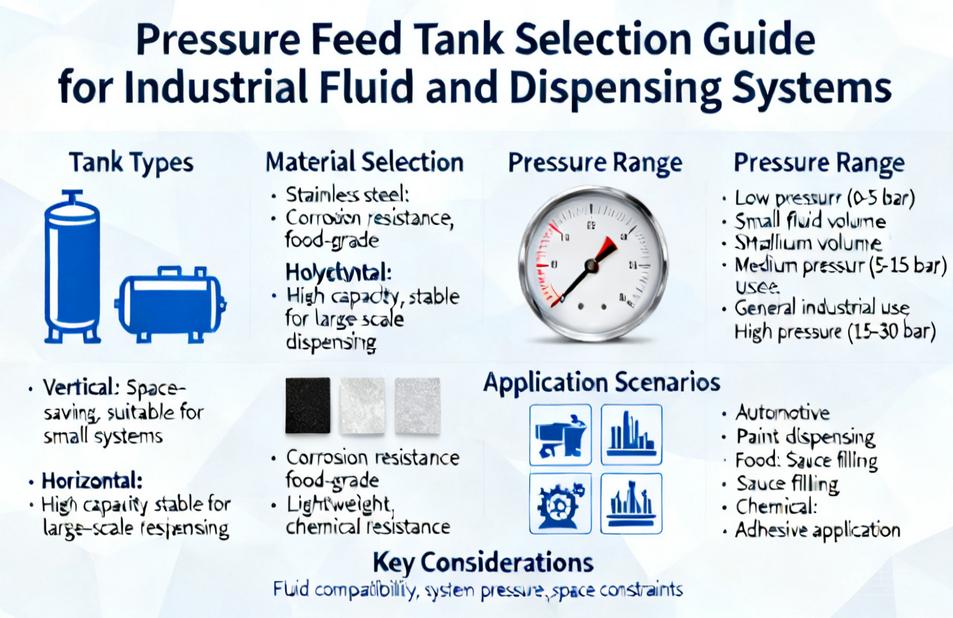
A pressure feed tank is a sealed vessel that stores and delivers liquid or semi-liquid materials under controlled air pressure to a downstream process, spray gun, dispenser, or production line. Instead of relying on a pump to move material, the tank uses compressed air to push the contents through an outlet, creating a steady and adjustable flow. This makes it a practical choice for adhesives, inks, coatings, sealants, lubricants, and other fluids that need consistent delivery in industrial operations. For overseas buyers, understanding how a pressure feed tank works, where it is used, and what to check before ordering helps avoid mismatches between the tank and the rest of the equipment.
What a Pressure Feed Tank Does in a Production Line
In many processes, the material source must stay separate from the point of application. A pressure feed tank acts as that buffer. The tank is filled with the material, sealed, and connected to a regulated compressed air supply. When air enters the tank, it pressurizes the headspace above the liquid and forces the material out through a dip tube or bottom outlet. The operator adjusts the air regulator to control flow rate, and the result is a smooth, pulseless supply that is often easier to manage than a pump-based system for low to medium viscosity fluids.
Because the tank is a closed system, it also limits exposure of the material to air, moisture, and contaminants. This is useful for moisture-sensitive adhesives, fast-drying solvents, and materials that should not be agitated excessively. In automated dispensing cells, a pressure feed tank can serve as a central supply unit feeding one or more dispensers, valves, or spray stations.
Typical Configurations and Key Features
Pressure feed tanks are available in several configurations to suit different materials and working environments. A standard unit usually includes a pressure vessel, a lid with a clamp or bolt closure, an air inlet regulator, a pressure gauge, a safety relief valve, a material outlet, and a fill port. Some models add a level sensor, agitator, or heating jacket when the material needs mixing or temperature control.
- Tank orientation: vertical or horizontal, depending on floor space and material flow requirements.
- Outlet type: bottom outlet for easy drainage, or dip tube for top-discharge arrangements.
- Pressure regulation: single-stage or two-stage air regulator with gauge for fine flow control.
- Closure style: quick-open clamp lid for frequent refilling, or bolted lid for higher security.
- Mobility: stationary skid, caster-mounted cart, or wall-mounted bracket.
These features determine how well the tank integrates with existing dispensers, spray guns, robots, or coating machines. Buyers should confirm the connection size and thread type before placing an order.
Materials and Construction
The wetted parts of a pressure feed tank must be compatible with the material being dispensed. Common construction materials include carbon steel with an internal coating, stainless steel such as 304 or 316, and in some cases plastic or PTFE-lined vessels for highly corrosive chemicals. Stainless steel is widely chosen for adhesives, food-related fluids, and solvents because it resists corrosion and is easier to clean.
Seals and gaskets also matter. Nitrile, EPDM, PTFE, and silicone are common options, and the choice depends on the chemical composition of the material and the operating temperature. A manufacturer or supplier should be able to recommend a seal material based on the buyer’s fluid. Welding quality, surface finish, and pressure test records are other indicators of build quality, though exact specifications vary by model and should be confirmed in the quotation.
Industrial Applications
Pressure feed tanks appear in a wide range of industrial applications. In automotive and transportation manufacturing, they supply adhesives, sealants, and lubricants to robotic dispensing systems. In electronics, they feed conformal coating and potting compounds to precision dispensers. In packaging and printing, they deliver inks, varnishes, and glues to rollers, nozzles, and spray heads. Other uses include woodworking adhesives, composite resin transfer, mold release agents, and general factory fluid handling.
Because the tank can be placed away from the point of use, it is also useful in workcells where space near the dispenser is limited or where operators should not handle the material container directly. In high-volume lines, multiple tanks may be connected to a manifold so that one can be refilled while another remains in service.
How to Choose the Right Pressure Feed Tank
Selecting a pressure feed tank starts with the material. Viscosity, chemical compatibility, and whether the material settles or cures over time will influence the tank design. Highly viscous materials may need a larger outlet, a follower plate, or an agitator, while low-viscosity solvents may require careful regulator selection to avoid surging. The required flow rate and the pressure drop across the downstream equipment determine the working pressure range, but the final setting should always stay within the tank’s rated limits.
Next, consider the working environment. Cleanroom production, washdown areas, and hazardous locations may call for specific surface finishes, enclosure types, or grounding provisions. Portability, floor space, and refill frequency affect whether a small cart-mounted unit or a larger stationary tank is more suitable. Buyers should also check the type of compressed air available, since oil-free or dried air may be required for certain coatings and adhesives.
Finally, match the tank outlet and fittings to the dispenser or spray equipment. Adapter kits are available, but specifying the correct thread and hose size from the start reduces installation time and leak risk.
Customization and OEM Options
Many pressure feed tank manufacturers and suppliers offer OEM and custom builds for specific production requirements. Customization can include tank volume, material of construction, outlet position, lid design, regulator type, gauge selection, mounting frame, and branding. For projects with unique fluids or space constraints, a custom pressure feed tank may be more cost-effective than modifying a standard unit.
When requesting a custom design, buyers should provide the material data sheet, required flow rate, available air pressure, connection details, and any environmental or safety requirements. A capable factory will review these inputs and propose a configuration, rather than simply quoting a catalog number.
Buying Considerations and Supplier Selection
Price is only one part of the total cost. Buyers should compare build quality, spare part availability, documentation, and after-sales support. Ask the supplier about lead time, packaging for export, and whether replacement seals, regulators, and dip tubes are available. For repeat orders, consistent quality and stable specifications are often more important than a low initial price.
When evaluating a pressure feed tank supplier, look for experience with similar applications, clear communication, and the ability to provide drawings or datasheets. A manufacturer that understands fluid handling and dispensing systems can help avoid compatibility problems. If the project involves a specific industry standard or internal specification, confirm that the supplier can meet it before committing to an order.
Frequently Asked Questions
What is the difference between a pressure feed tank and a pressure pot?
The terms are often used interchangeably in industrial fluid handling. Both refer to a sealed vessel that uses air pressure to push material to a dispenser or spray gun. Some suppliers use pressure pot for smaller portable units and pressure feed tank for larger or stationary systems, but the working principle is the same.
Can a pressure feed tank handle high-viscosity adhesives?
It can, but the design must match the material. High-viscosity adhesives may require a larger outlet, a follower plate, or an agitator to keep material moving toward the outlet. The air pressure needed also depends on the viscosity and the downstream restriction, so buyers should share the material specification with the supplier before selecting a model.
How do I know which tank size to choose?
Tank size depends on production rate, refill frequency, and available space. A larger tank reduces refill interruptions but takes more floor space and may be harder to move. A smaller tank is easier to handle but requires more frequent filling. Buyers should calculate material consumption per shift and consider future production changes.
Do suppliers offer OEM or custom pressure feed tanks?
Many do. OEM and custom options can include different tank volumes, materials, outlet configurations, pressure ratings, and mounting arrangements. Providing detailed application information helps the supplier propose a suitable design and confirm whether a standard or custom unit is the better fit.
Conclusion
Choosing a pressure feed tank is mainly a matter of matching the vessel to the material, the dispensing equipment, and the working environment. Buyers should focus on material compatibility, pressure control, outlet configuration, and the supplier’s ability to support customization and spare parts. Rather than comparing only purchase price, consider total cost of ownership, including maintenance and replacement parts. If you are planning a fluid handling or dispensing project, contact a pressure feed tank manufacturer or supplier with your material details, flow requirements, and connection specifications to discuss standard models, OEM options, or a custom build that fits your production line.
