

Small Volume Adhesive Dispensing Valve | A Buyer’s Guide to Precision Micro-Dispensing
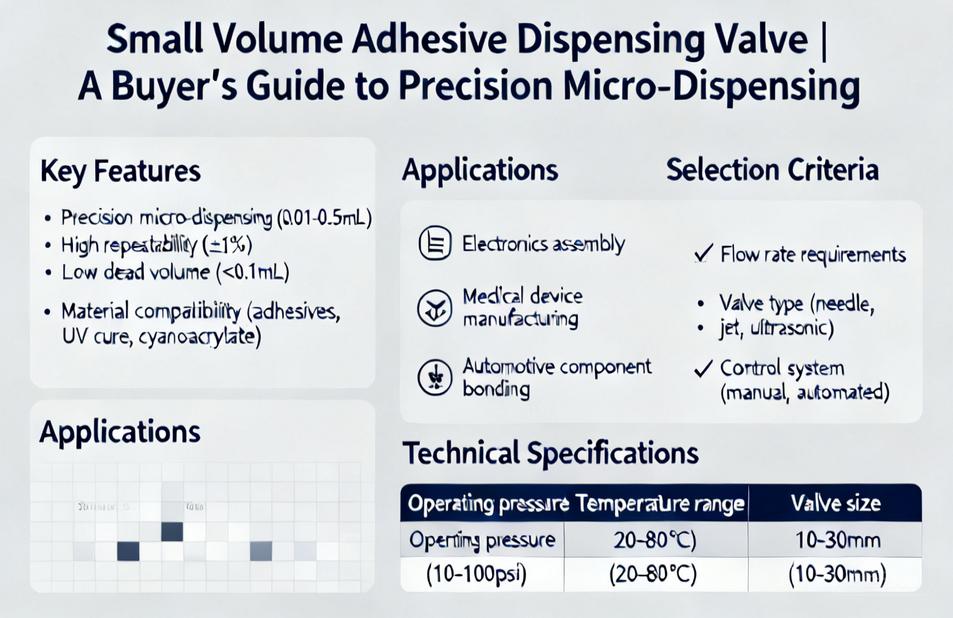
A small volume adhesive dispensing valve is a precision fluid control component designed to deliver tiny, repeatable amounts of adhesive, sealant, or other flowable media to a specific point on a workpiece. Unlike bulk dispensing equipment that lays down wide beads, these valves are built for micro-deposition, where the deposit size, position, and consistency directly affect product quality and material cost. They are commonly used in electronics assembly, medical device manufacturing, small parts bonding, and automated production lines where excess adhesive causes rework or functional problems. For overseas buyers sourcing dispensing components, understanding how these valves work, where they fit, and what to evaluate before ordering is essential for selecting the right model and supplier.
What a Small Volume Dispensing Valve Does
The core function of a small volume dispensing valve is to control the release of adhesive from a pressurized or syringe-fed supply. The valve opens for a defined interval, allowing a controlled amount of material to pass through a nozzle or needle, then closes cleanly to prevent dripping or stringing. The result is a small, consistent deposit that can be repeated across thousands of cycles. This is different from time-pressure dispensing alone, because a valve provides positive shut-off and better repeatability when adhesives have varying viscosity or when the dispensing cycle is very short.
These valves are often integrated into automated dispensing systems, robotic gantries, or benchtop workstations. They may be actuated pneumatically, electrically, or mechanically, and the choice depends on the adhesive type, the required deposit size, and the level of automation. In many projects, the valve is only one part of the fluid path; tubing, fittings, reservoirs, and nozzles must also match the adhesive and the production environment.
Key Features Buyers Should Look For
When reviewing small volume adhesive dispensing valve options, purchasers should focus on features that affect process stability and maintenance. Important characteristics include:
- Positive shut-off: A clean closing action reduces dripping, stringing, and clogging between cycles.
- Fine adjustment: Mechanical or electronic adjustment helps dial in the deposit size without changing nozzles constantly.
- Material compatibility: Wetted parts must suit the adhesive chemistry, whether it is cyanoacrylate, epoxy, UV adhesive, anaerobic adhesive, or a filled thermally conductive material.
- Compact footprint: Small valves fit into tight machine spaces and are easier to mount close to the dispense point.
- Serviceability: Replaceable seals, nozzles, and internal components reduce downtime and long-term cost.
It is also worth checking how the valve is controlled. Some models work with simple solenoid signals, while others require a valve controller or integrated timer. Matching the control method to the existing PLC or dispensing robot avoids extra integration work.
Materials and Construction
The construction of a small volume dispensing valve affects both durability and adhesive compatibility. Common body materials include anodized aluminum, stainless steel, and engineering plastics. Stainless steel is often chosen for corrosive adhesives or cleanroom environments, while aluminum bodies are common in general industrial automation. Seals may be made from materials such as PTFE, FFKM, or other elastomers selected for chemical resistance.
Buyers should ask the supplier for a wetted parts list and confirm that every material in contact with the adhesive is compatible. This is especially important with anaerobic adhesives, solvent-based products, and UV-curable materials. In some cases, a custom seal or housing material may be needed, which is why OEM and custom options are valuable for specialized applications.
Typical Industrial Applications
Small volume adhesive dispensing valves appear in many production processes where precision matters more than speed. Examples include:
- Surface mount and PCB assembly, where adhesives secure components or provide underfill.
- Medical device assembly, including bonding of small plastic and metal parts.
- Electronics encapsulation and potting of sensors and connectors.
- Automotive sensor and connector bonding.
- Optical component assembly and lens bonding.
- General small parts bonding in appliances, tools, and consumer products.
In each case, the valve must match the adhesive viscosity, the required deposit size, and the production cycle. A valve that performs well with a low-viscosity adhesive may not handle a filled, high-viscosity material without changes to the nozzle or valve design. Sharing full application details with a supplier is the most reliable way to narrow the selection.
How to Choose the Right Valve for Your Process
Selecting a small volume adhesive dispensing valve starts with the adhesive and the deposit. Buyers should define the adhesive type, viscosity range, fillers, cure method, and pot life. Next, define the deposit size and tolerance, the cycle time, and the number of dispense points per product. These details determine whether a simple pneumatic valve, a positive displacement valve, or a jet valve is appropriate.
Machine integration is another factor. Check the mounting options, air or electrical connections, and whether the valve needs a controller. If the valve will be used on an existing robot, confirm the payload and space available. For manual benchtop stations, ergonomics and easy adjustment may matter more than high-speed actuation.
Finally, consider maintenance. Ask how often seals and nozzles should be inspected, whether spare parts are available, and whether the valve can be cleaned without special tools. A valve that is easy to service and supported by a responsive manufacturer or supplier reduces long-term production risk.
OEM and Customization Options
Many dispensing valve manufacturers offer OEM and custom configurations for equipment builders and integrators. Customization may include nozzle geometry, mounting brackets, seal materials, inlet fittings, and actuation voltage. For project-specific requirements, a factory can often modify an existing valve body or develop a variant that fits a machine envelope. When discussing custom work, provide drawings, adhesive data, and expected cycle conditions so the supplier can evaluate feasibility. Clear communication about quantities, lead times, and validation requirements helps avoid misunderstandings during the project.
Buying Considerations and Supplier Selection
When comparing suppliers, look beyond the unit price. Ask about the manufacturer’s experience with your adhesive type, the availability of technical documentation, and the response time for application questions. A reliable supplier should be able to recommend a valve based on the fluid and deposit, not simply sell a standard model. If the project involves an automated line, confirm that the supplier can support integration questions and provide replacement parts consistently.
For buyers sourcing from overseas, it is also useful to confirm the factory’s production capability, quality control process, and packing method. Request a sample or a small trial order when possible, and test the valve with the actual adhesive under production conditions. This step helps verify deposit consistency, shut-off performance, and compatibility before committing to larger volumes.
Frequently Asked Questions
What adhesive types can a small volume dispensing valve handle?
These valves can handle many low-to-medium viscosity adhesives, including cyanoacrylate, epoxy, UV adhesive, anaerobic adhesive, and some filled materials. The exact compatibility depends on the valve’s wetted parts and internal design. Always confirm the adhesive chemistry and viscosity with the supplier before ordering.
Can the valve be integrated into an existing dispensing robot?
In most cases, yes. Integration depends on the valve’s mounting pattern, control signal, and size. Share the robot model, available mounting space, and control interface with the supplier so they can recommend a suitable configuration or adapter.
Is OEM or custom valve design available?
Many manufacturers and suppliers offer OEM and custom options, such as modified nozzles, brackets, seal materials, and inlet fittings. Custom work usually requires application details and may involve minimum order quantities. Discuss the project requirements directly with the factory.
How do I maintain consistent deposits over time?
Consistency depends on stable air pressure or actuation, clean nozzles, compatible seals, and regular maintenance. Establish a inspection schedule for seals and nozzles, and monitor deposit weight or visual appearance as part of quality control.
Conclusion
Choosing a small volume adhesive dispensing valve is primarily a matter of matching the valve to the adhesive, the deposit requirement, and the production equipment. Buyers should evaluate shut-off performance, material compatibility, adjustment range, and serviceability rather than focusing only on price. Working with an experienced manufacturer or supplier who understands micro-dispensing applications can shorten the selection process and reduce integration risk. If you have a specific adhesive, deposit size, or machine interface in mind, contact a qualified supplier to discuss standard models, OEM options, or custom configurations for your application.