

Micro-Volume Adhesive Dispensing Valve | A Buyer’s Guide for Precision Dispensing
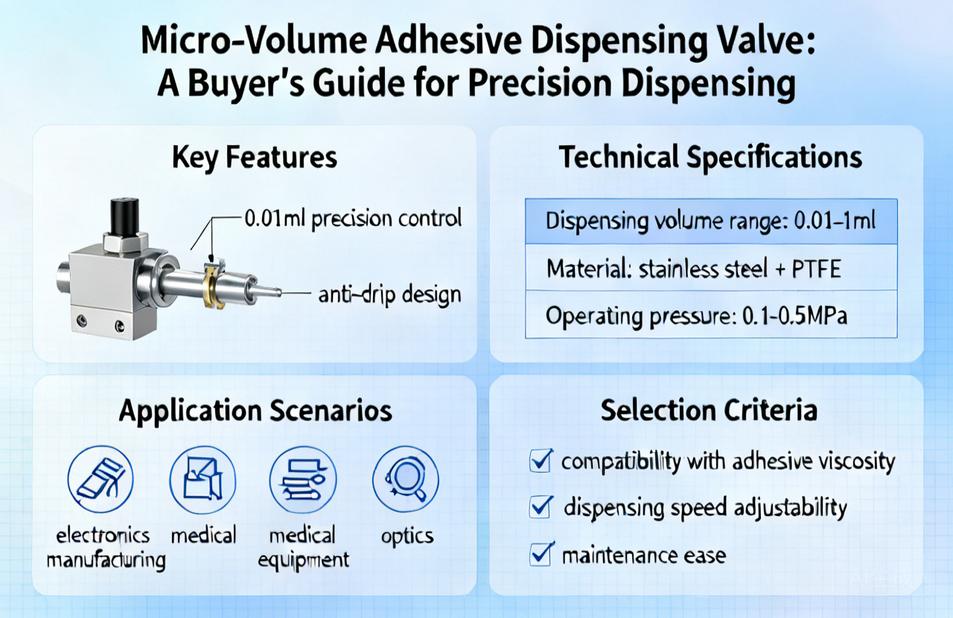
A micro-volume adhesive dispensing valve is a precision component designed to deliver very small, repeatable amounts of adhesive, sealant, or other fluids to a specific point. It is commonly used in electronics assembly, medical device manufacturing, small-part bonding, and automated dispensing systems where excess material can cause defects, waste, or rework. For overseas buyers sourcing dispensing components, understanding how these valves work, where they fit, and what to evaluate before ordering is essential for building a reliable production process.
What a Micro-Volume Dispensing Valve Does
Unlike a simple nozzle or syringe, a micro-volume valve controls the release of fluid through a mechanical or pneumatic action. The valve opens for a defined interval and closes to cut off the flow, which helps limit the deposit size and improve consistency from one cycle to the next. This makes the valve suitable for applications where the adhesive bead or dot must be small and placed accurately, such as bonding tiny components, potting small cavities, or applying conductive adhesive on a PCB.
Micro-volume dispensing is not only about the valve itself. The result depends on the fluid properties, the needle or nozzle size, the supply pressure, the control timer, and the stability of the mounting fixture. A valve that suits one adhesive may not perform the same way with a different viscosity or cure speed, so buyers should treat the valve as part of a complete dispensing setup rather than a standalone part.
Key Features Buyers Usually Evaluate
When comparing micro-volume adhesive dispensing valves from different manufacturers, purchasing teams and process engineers typically look at several practical points:
- Adjustability: The ability to fine-tune dispense time, stroke, or flow so the deposit size can be matched to the application.
- Fluid compatibility: Wetted parts and seal materials must suit the adhesive chemistry, whether it is epoxy, UV adhesive, anaerobic, silicone, or cyanoacrylate.
- Mounting flexibility: The valve should integrate with manual benches, semi-automatic stations, or robotic gantries without complex modifications.
- Maintenance access: Easy cleaning and replacement of seals or nozzles reduce downtime and help maintain repeatability.
- Repeatability: Consistent shot-to-shot performance is more important than a single high-speed result in most precision bonding tasks.
These features matter because micro-volume dispensing leaves little room for error. A small variation in deposit size can affect bond strength, electrical conductivity, or cosmetic appearance, especially on small parts.
Materials and Construction
The construction of a micro-volume valve affects both service life and fluid compatibility. Common designs use stainless steel or aluminum bodies with chemically resistant seals and precision-machined internal passages. The choice of seal material should be based on the adhesive and any cleaning solvents used in the process. Buyers should ask the supplier for a material list and confirm that the wetted components are suitable for the intended fluid, rather than assuming that a general-purpose valve will work with every adhesive.
Nozzle and needle selection is equally important. The internal diameter and tip shape influence the flow rate and the shape of the deposited dot or line. A supplier with dispensing experience can usually recommend a starting configuration based on the fluid viscosity and the target deposit size, but final validation should always be done with the actual adhesive and production conditions.
Industrial Applications
Micro-volume adhesive dispensing valves appear in many industrial applications where small, controlled deposits are required. Typical examples include:
- Electronics assembly, including PCB bonding, sensor attachment, and component fixing.
- Medical device and diagnostic consumable manufacturing, where small adhesive volumes are used in assembly.
- Automotive electronics and small sensor modules.
- Optical and camera module assembly.
- Precision mechanical assembly and small-part bonding.
In many of these applications, the valve is integrated into an automated dispensing system or a custom-built workstation. The dispensing valve supplier should be able to discuss how the valve matches different motion platforms, controllers, and fluid supply systems, not just the valve dimensions.
How to Choose the Right Valve for Your Process
Choosing a micro-volume dispensing valve starts with the fluid and the deposit requirement. Buyers should define the adhesive type, viscosity range, required deposit size, cycle time, and production environment. From there, the valve type, nozzle size, and control method can be narrowed down. It is also useful to consider whether the process needs a contact or non-contact dispensing method, because that choice affects part clearance and the risk of disturbing the deposited fluid.
Another factor is the level of automation. A valve intended for a manual workstation may have different mounting and control requirements from one used on a high-speed robotic line. Buyers should share the planned integration details with the supplier early, including available air supply, control signal type, and fixture space. This helps avoid a situation where the valve is technically suitable for the adhesive but difficult to fit into the existing equipment.
Customization and OEM Options
Many dispensing valve suppliers offer OEM and custom options for buyers with specific requirements. Customization may involve nozzle geometry, mounting brackets, seal material selection, or branding for OEM programs. The scope of customization depends on the supplier’s engineering capability and production setup. Buyers should clarify which parts are standard, which can be modified, and what information is needed for a custom quotation. It is also reasonable to request drawings or sample evaluations before committing to a production order.
Buying Considerations and Supplier Selection
For B2B buyers, supplier selection is as important as product selection. A reliable manufacturer or supplier should be able to explain the valve working principle, recommend suitable configurations, and provide consistent documentation. Buyers should ask about production capacity, quality control procedures, and after-sales support for replacement parts. It is also helpful to confirm whether the supplier has experience with the specific adhesive or industry application, because that experience often shortens the trial-and-error stage.
Price should be evaluated together with repeatability, maintenance needs, and spare-part availability. A low-cost valve that requires frequent adjustment or replacement may create higher long-term costs in a precision dispensing process. Buyers sourcing from a factory or trading company should also clarify lead times, packaging, and export documentation, while avoiding assumptions about certifications or performance claims that have not been verified.
Frequently Asked Questions
What fluids can a micro-volume adhesive dispensing valve handle?
The valve must be matched to the fluid chemistry and viscosity. Adhesives such as epoxy, UV-curable adhesive, silicone, and anaerobic products are common, but the seal and wetted materials should be confirmed with the supplier for each specific fluid.
Can the valve be integrated into an existing dispensing system?
In many cases, yes, but integration depends on mounting, control signals, and air supply. Buyers should provide system details to the supplier so the valve and controller can be matched correctly.
Is OEM or custom design available?
Many suppliers offer OEM and custom options, including nozzle changes, mounting adaptations, and private labeling. The available scope should be discussed directly with the manufacturer.
How do I validate repeatability before a bulk order?
Request a sample valve or a dispensing evaluation using your actual adhesive and target deposit size. Validation under production-like conditions is more meaningful than catalog specifications alone.
Conclusion
Selecting a micro-volume adhesive dispensing valve requires a clear understanding of the fluid, the deposit requirement, and the surrounding dispensing system. Buyers should focus on compatibility, adjustability, maintenance, and supplier support rather than comparing valves on price alone. Working with an experienced manufacturer or supplier that can advise on configuration, OEM options, and custom adaptations helps reduce integration risk and supports stable production. For specific specifications, application questions, or customization requirements, contacting the supplier directly with process details is the most practical next step.
