

Glue Storage Pressure Tank | A Buyer Guide for Industrial Adhesive Supply Systems
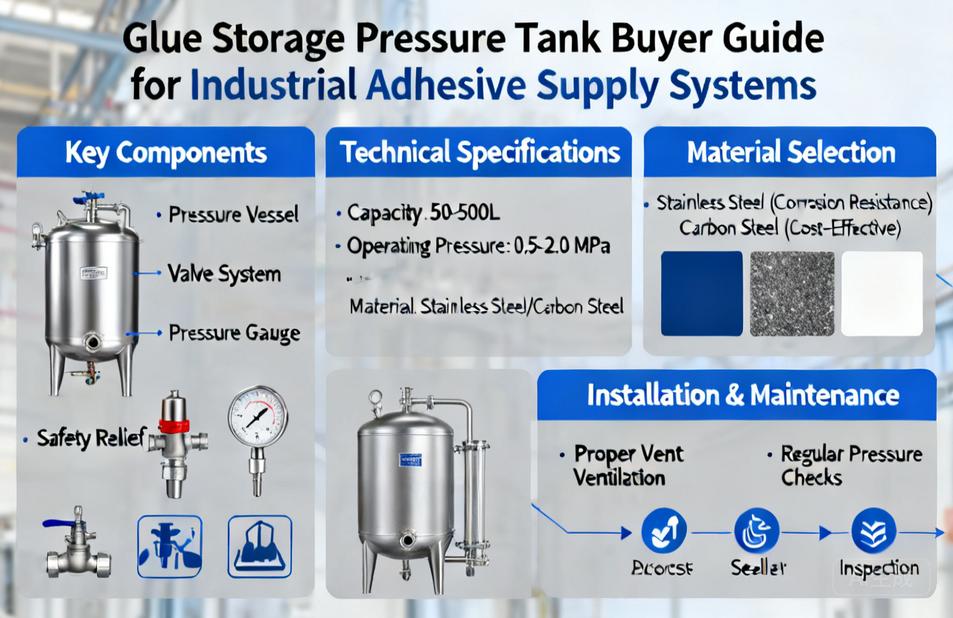
A glue storage pressure tank is a vessel that holds adhesive or other viscous media under controlled air pressure so it can be delivered steadily to dispensing valves, guns, rollers, or automated application heads. Instead of relying on gravity or manual refilling, the tank uses compressed air to push glue through a hose or pipe, keeping flow consistent during long production runs. For manufacturers that use hot melt, cold glue, silicone, polyurethane, epoxy, or similar materials, the tank becomes a central part of the adhesive supply system and directly affects dispense quality, material waste, and line uptime.
This guide is written for海外采购商, engineers, and maintenance teams who need to specify, source, or replace a glue storage pressure tank. It covers how the tank works, the construction details that matter, common industrial applications, selection criteria, customization options, and practical questions to ask a manufacturer or supplier before placing an order.
What a Glue Storage Pressure Tank Does in a Dispensing System
In a typical setup, the pressure tank is filled with adhesive through a top opening or a drum-following lid. The tank is then sealed, and regulated compressed air is introduced above the glue surface. That air pressure forces the adhesive out through a bottom outlet, along a heated or unheated hose, to the dispensing point. A pressure regulator, gauge, and safety relief valve control the internal atmosphere, while the tank level is monitored manually or with a low-level sensor. The result is a closed, pressurized supply that reduces pulsation, prevents contamination, and allows one tank to feed multiple dispensing stations.
Compared with pail pumps or gravity hoppers, a pressure tank is often chosen when the adhesive is too thick for simple gravity feed, when the material must be kept sealed from moisture or air, or when the application requires a steady, repeatable flow rate. The tank also allows bulk purchasing of adhesive, which can reduce packaging waste and changeover frequency on high-volume lines.
Key Features Buyers Look For
Not every glue storage pressure tank is built for the same duty. The following features are commonly reviewed during supplier evaluation:
- Pressure vessel design: the tank shell, dished ends, and welds should be suitable for the intended working pressure and cyclic operation.
- Sealing and gaskets: lid seals and outlet connections must be compatible with the adhesive chemistry to prevent leakage or curing at the joint.
- Level indication: sight glasses, float sensors, or load cells help operators know when to refill without opening the tank.
- Heating or insulation: for hot melt and temperature-sensitive adhesives, the tank may include a jacket, heating elements, or insulation to maintain viscosity.
- Agitation: some materials separate or settle, so a slow agitator can keep the glue uniform before dispensing.
- Safety accessories: relief valves, pressure gauges, and lockout provisions are standard on industrial units.
Materials and Construction
Stainless steel is a common choice for glue storage pressure tanks because it resists corrosion, cleans well, and works with many water-based and solvent-based adhesives. Carbon steel may be used for某些 non-corrosive materials when cost is a priority, often with an internal coating. The wetted path, including the outlet, dip tube, and valve seat, should be matched to the adhesive type. For example, moisture-curing polyurethane adhesives require a sealed tank and dry air supply, while solvent-based glues need compatible seals and grounding provisions. Buyers should ask the supplier for a material certificate or at least a clear description of the wetted materials so the tank can be checked against the adhesive manufacturer data sheet.
Industrial Applications
Glue storage pressure tanks appear in many production environments, including:
- Packaging lines that apply cold glue or hot melt for carton sealing, labeling, and case forming.
- Woodworking and furniture assembly, where adhesives are dispensed onto edges, dowels, and panels.
- Automotive and transportation component bonding, including interior trim, gaskets, and structural adhesives.
- Electronics and appliance manufacturing, for potting, sealing, and component fixing.
- Nonwoven and hygiene product lines, where adhesive is applied at high speed.
- Filter, footwear, and bookbinding operations that need a controlled adhesive supply.
In each case, the tank is selected to match the adhesive viscosity, required flow rate, number of dispensing points, and the working environment. A tank that is oversized may cause long residence times and material aging, while an undersized tank may require frequent refills and interrupt production.
How to Choose the Right Tank
Start with the adhesive. Confirm the chemistry, viscosity range, recommended application temperature, and any sensitivity to moisture, air, or shear. Then define the dispensing demand: how many valves or guns will run at the same time, what flow rate each needs, and what pressure range the valves require. The tank volume should be large enough to support a reasonable production interval but not so large that the adhesive sits for too long. Next, check the installation space, available air supply, and whether the tank will be stationary or mounted on a cart. Finally, review the control interface. Some tanks are simple manual units, while others include digital pressure regulators, level alarms, and communication outputs for line integration.
It is also wise to plan for maintenance. Easy access to the lid, outlet, and internal surfaces reduces cleaning time and helps prevent cured adhesive from blocking the system. Quick-release clamps, removable dip tubes, and smooth internal finishes are practical details that affect long-term reliability.
Customization and OEM Options
Many projects require more than a standard tank. A manufacturer or supplier may offer custom tank volumes, outlet positions, mounting brackets, cart frames, heating jackets, agitator assemblies, and control panels. OEM programs can include private labeling, custom paint or finish, and documentation packages for the buyer brand. When requesting a custom glue storage pressure tank, provide the adhesive specification, operating pressure range, temperature requirements, connection sizes, and any electrical or control standards that apply. A factory that asks detailed questions upfront is usually better prepared to deliver a tank that fits the line rather than forcing the line to adapt to a generic unit.
Buying Considerations and Supplier Selection
Price should be evaluated together with build quality, material traceability, and after-sales support. Ask for dimensional drawings, pressure and leak test procedures, and spare parts availability. If the tank will operate in a regulated environment, confirm that the supplier can provide the necessary documentation for the buyer to complete their own compliance review. For international orders, clarify packaging, shipping terms, and whether the tank will be shipped with or without fittings. A reliable supplier will be transparent about lead times, manufacturing location, and the scope of the warranty without making unverifiable claims.
When comparing suppliers, look for experience with similar adhesives and applications. A manufacturer that understands dispensing valves, hoses, and temperature control can often recommend a complete supply system rather than just a tank. If possible, request a reference from a similar industry or ask for a video walkthrough of the production and testing process.
Frequently Asked Questions
How do I know what size glue storage pressure tank I need?
Estimate the adhesive consumption per hour, then choose a tank volume that provides a practical refill interval without holding material too long. Consider the number of dispensing points and the maximum flow rate. A supplier can help calculate the right volume based on your production data.
Can a pressure tank handle hot melt adhesive?
Yes, but the tank must be designed for elevated temperature with appropriate heating, insulation, and seals. Cold glue and room-temperature adhesives use a different configuration. Always confirm temperature compatibility with the tank manufacturer and the adhesive supplier.
What is the difference between a pressure tank and a pail pump?
A pressure tank uses air pressure above the adhesive to push material out, while a pail pump uses a mechanical or pneumatic pump immersed in the container. Pressure tanks are often preferred for sealed, moisture-sensitive, or high-viscosity materials and for feeding multiple dispense points.
Can I order a custom tank with my own brand?
Many manufacturers offer OEM and custom options, including private labeling, custom dimensions, and specific fittings. Provide your adhesive details and system requirements so the factory can propose a suitable configuration.
Conclusion
Selecting a glue storage pressure tank is about matching the vessel to the adhesive, the dispensing system, and the production environment. Focus on wetted materials, pressure control, sealing, heating or agitation needs, and maintenance access. If you are comparing suppliers, ask for drawings, material details, and customization capability rather than relying on a single price figure. For projects that require a specific volume, connection layout, control interface, or OEM branding, contact a qualified manufacturer or supplier with your application details and they can recommend a configuration that fits your line.