

Automatic Dispensing Tank | A Complete Guide for Industrial Fluid Handling
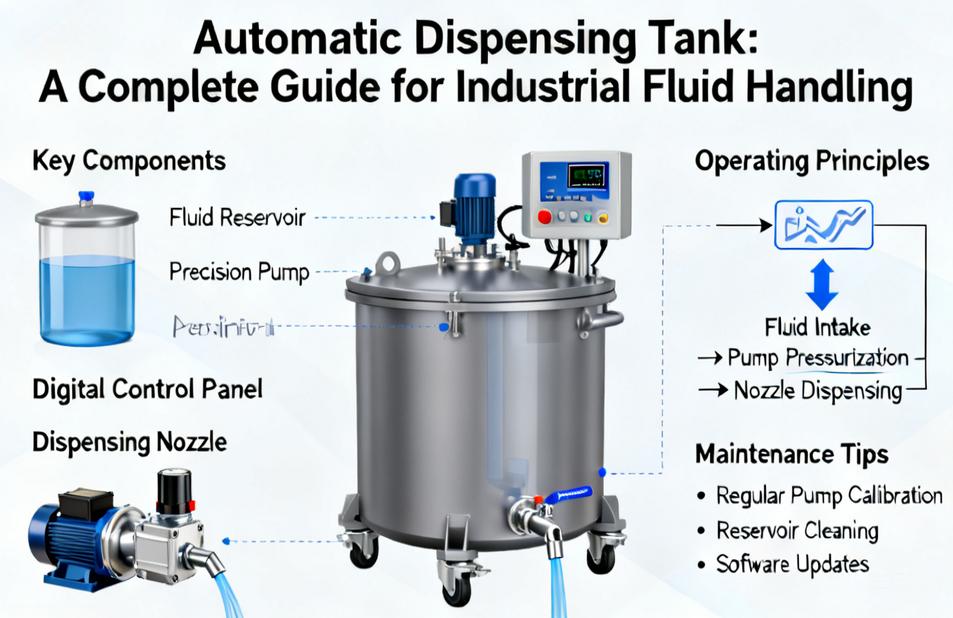
An automatic dispensing tank is a controlled fluid storage and delivery unit used to hold, condition, and dispense liquids or semi-liquids in industrial processes. It is commonly found in adhesive and sealant application, lubrication systems, chemical dosing, food processing, and automated production lines where consistent flow and repeatable shot sizes matter. Instead of relying on manual pouring or simple gravity feed, an automatic dispensing tank uses pumps, valves, level sensors, and control logic to deliver material on demand.
For overseas buyers, the automatic dispensing tank is not just a vessel. It is part of a fluid handling system that affects cycle time, material waste, operator safety, and product quality. Understanding how these tanks work, which configurations suit different fluids, and how to match them to existing equipment helps procurement teams avoid costly mismatches.
What Is an Automatic Dispensing Tank?
An automatic dispensing tank combines a storage reservoir with automated dispensing controls. The tank may be pressurized, gravity-fed, or pump-driven, depending on the material and the required flow rate. A control unit monitors level, pressure, or flow and signals the dispensing valve to open or close at the right moment. Some systems include agitation, heating, or recirculation to keep the fluid uniform before dispensing.
Typical configurations include pressure tanks that push material through a dispense valve, pump-fed tanks that use gear or diaphragm pumps, and metering tanks that dispense precise volumes. The tank itself can be a simple cylindrical vessel or a complex unit with multiple inlets, outlets, vent ports, and sensor ports. The automatic function may be initiated by a foot switch, PLC signal, robot trigger, or conveyor sensor.
Key Features Buyers Look For
When evaluating an automatic dispensing tank, buyers often focus on repeatability, material compatibility, and integration. Important features include:
- Level monitoring: Float switches, capacitive sensors, or load cells keep operators informed and prevent dry running.
- Pressure or flow control: Regulators, proportional valves, or variable-frequency drives maintain consistent output.
- Dispensing accuracy: Shot size repeatability is critical for adhesives, potting compounds, and sealants.
- Cleanability: Quick-release lids, smooth internal surfaces, and drain ports reduce changeover time.
- Safety: Pressure relief valves, guards, and lockout features protect operators.
- Control interface: PLC, HMI, or standalone controllers allow recipe storage and easy adjustment.
Materials and Construction
The wetted materials must match the fluid being dispensed. Common tank materials include stainless steel, carbon steel with internal coating, and engineered plastics. Stainless steel is often chosen for water-based fluids, solvents, and food-grade applications because it resists corrosion and is easy to clean. Carbon steel may be suitable for oils and certain chemicals when coated properly. Plastic tanks are lightweight and chemically resistant but may have lower pressure ratings.
Seals, gaskets, and diaphragms also matter. EPDM, FKM, PTFE, and silicone are common choices, each with different chemical compatibility and temperature limits. Buyers should provide a detailed fluid datasheet, including viscosity, solids content, temperature, and any aggressive ingredients, so the manufacturer can recommend suitable construction.
Industrial Applications
Automatic dispensing tanks serve many industries. In electronics manufacturing, they dispense encapsulants, underfill, and thermal interface materials. In automotive assembly, they handle adhesives, sealants, and lubricants. In food and beverage, they dose flavorings, sauces, and coatings. In pharmaceutical and cosmetic production, they transfer gels, creams, and liquid additives. Other applications include 3D printing material supply, battery slurry dispensing, and general factory automation.
Each application has its own requirements. High-viscosity pastes may need a pressure tank with a follower plate. Low-viscosity liquids may suit a pump-fed system with a flow meter. Abrasive slurries require wear-resistant components. The more the supplier knows about the application, the better the tank can be configured.
How to Choose the Right Automatic Dispensing Tank
Choosing the correct tank involves several practical steps. First, define the fluid properties: viscosity, density, temperature range, chemical composition, and whether the material separates or cures. Second, determine the required dispense volume, cycle time, and accuracy. Third, review the available utilities, such as compressed air, electricity, and floor space. Fourth, consider how the tank will connect to existing valves, hoses, robots, or conveyors. Fifth, evaluate the control requirements, including I/O signals, recipe management, and data logging.
It is also wise to discuss maintenance and spare parts. A tank that is difficult to clean or requires frequent seal replacement can increase downtime. Buyers should ask about recommended maintenance intervals and the availability of wear parts.
Customization and OEM Options
Many automatic dispensing tank suppliers offer custom and OEM solutions. Customization can include tank size, port layout, material selection, control voltage, mounting configuration, and branding. OEM arrangements may involve private-label branding, custom control software, or unique mechanical interfaces. When requesting a custom tank, provide drawings, fluid details, and any applicable standards. A reliable factory will review the requirements and propose a workable design rather than simply quoting a standard unit.
Buying Considerations and Supplier Selection
When comparing automatic dispensing tank manufacturers and suppliers, look beyond the initial price. Evaluate technical support, documentation, and responsiveness. A good supplier will ask detailed questions about your process and may request a sample of the fluid for compatibility testing. They should provide clear specifications, material certificates, and a bill of materials. If the tank is part of a larger system, confirm that the supplier can coordinate with your equipment integrator.
Factory audits, references, and sample testing can reduce risk. For custom projects, request a prototype or a detailed design review before full production. Also clarify warranty terms, shipping methods, and spare parts availability. These factors often matter more than a small difference in unit cost.
Frequently Asked Questions
What fluids can an automatic dispensing tank handle?
Automatic dispensing tanks can handle many liquids and semi-liquids, including adhesives, sealants, lubricants, inks, coatings, food additives, and chemical reagents. The key is selecting wetted materials and a dispensing method compatible with the fluid viscosity, temperature, and chemical properties.
How do I know what tank size I need?
Tank size depends on production rate, refill frequency, and material shelf life. Calculate the maximum consumption per shift and allow a reasonable buffer. For materials that cure or settle, a smaller tank with more frequent refills may be better than a large tank that sits unused.
Can the tank be integrated with my existing dispensing valve?
In most cases, yes. Suppliers can provide the correct outlet fittings, pressure ratings, and control signals to match your valve or robot. Share the valve model and operating parameters during the inquiry stage.
Do you offer OEM or private-label automatic dispensing tanks?
Many manufacturers offer OEM and custom branding options. This can include nameplates, control panel labels, and customized packaging. Discuss your requirements with the supplier early so they can plan production accordingly.
Conclusion
An automatic dispensing tank is a practical investment for manufacturers who need consistent fluid delivery and reduced manual handling. The right choice depends on fluid characteristics, production requirements, and integration needs. Buyers should work closely with a qualified supplier or factory that can provide technical guidance, custom options, and reliable after-sales support. If you are evaluating automatic dispensing tank solutions for your application, contact a supplier to discuss your specifications, OEM needs, or customization requirements.
