

Glue Pressure Vessel Selection Guide for Industrial Adhesive Supply Systems
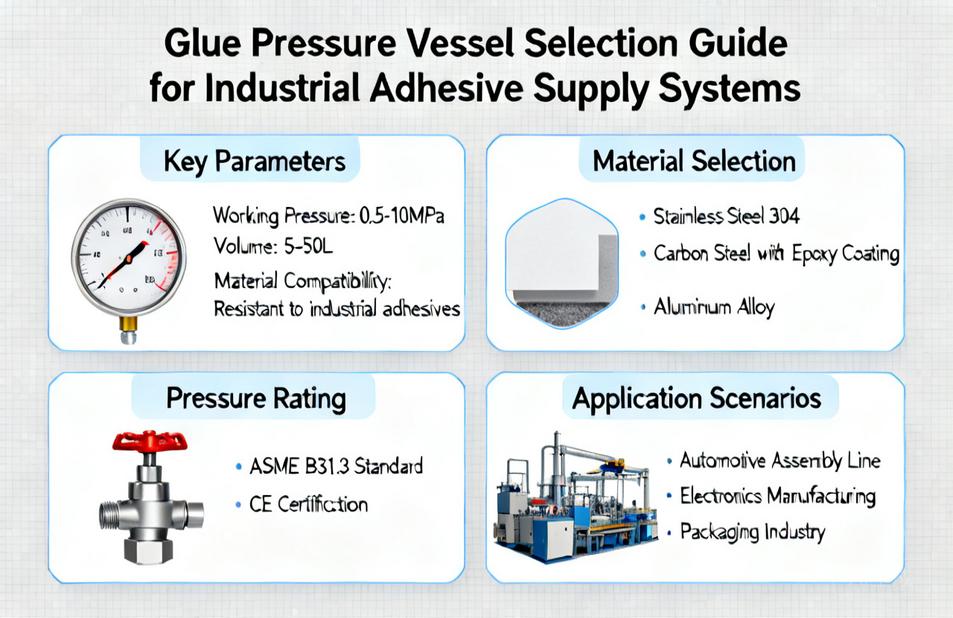
A glue pressure vessel is a closed tank that stores and delivers adhesive or sealant under controlled air or gas pressure to dispensing equipment. It is commonly used in packaging, woodworking, automotive assembly, electronics, and general industrial bonding processes where consistent flow and steady pressure matter. Unlike simple gravity-fed containers, a glue pressure vessel helps maintain uniform material supply to valves, nozzles, and robots, reducing pulsation and improving bead quality. For buyers sourcing adhesive delivery systems, understanding the vessel’s role, construction, and customization options is the first step toward reliable production.
What Is a Glue Pressure Vessel and How Does It Work?
A glue pressure vessel, sometimes called an adhesive pressure tank or glue pressure pot, holds liquid adhesive, hot melt, or sealant and uses compressed air or inert gas to push the material toward a dispenser. The tank is sealed, so the pressure inside remains stable while the material is consumed. A regulator controls the incoming air pressure, and a hose or pipe carries the adhesive to the application point.
Because the vessel is pressurized, the adhesive can be delivered over distance and at a consistent rate. This is especially valuable when the dispensing valve is mounted on a robot arm or gantry and the material source must stay stationary. Some systems include agitators or heating elements to keep the adhesive at a workable viscosity, but the exact configuration depends on the adhesive chemistry and the production environment.
Key Features Buyers Look For in an Adhesive Pressure Tank
Industrial buyers often evaluate a glue pressure vessel on pressure stability, material compatibility, ease of cleaning, and integration with existing dispensers. A well-designed vessel should maintain steady pressure as the adhesive level drops, because pressure fluctuations can cause inconsistent beads or drips.
- Pressure regulation: A reliable regulator and gauge help operators set and repeat the delivery pressure.
- Sealing: Tight seals prevent air leaks and material curing around the lid or fittings.
- Material contact: Wetted parts must resist the adhesive, solvent, or sealant being used.
- Cleaning access: Removable lids, liners, or quick-release clamps reduce changeover time.
- Mounting: Floor stands, wall brackets, or cart-mounted frames help match the vessel to the production layout.
These features are not about marketing claims. They are practical points that affect uptime, maintenance, and adhesive waste. When comparing suppliers, ask how the vessel handles pressure decay, what materials contact the adhesive, and how the tank is cleaned between batches.
Materials and Construction of Glue Pressure Vessels
The body of a glue pressure vessel is typically made from carbon steel, stainless steel, or aluminum, depending on the adhesive and the working environment. Stainless steel is often chosen for water-based adhesives, solvent-based materials, or applications where corrosion resistance and easy cleaning are important. Carbon steel may be suitable for certain non-corrosive adhesives when properly coated.
Internal surfaces should be smooth and compatible with the adhesive. Fittings, gaskets, and seals must also resist the material being dispensed. For example, solvent-based adhesives may require specific seal compounds, while hot melt systems may need heated hoses and insulated tanks. A responsible manufacturer will ask about the adhesive type, operating temperature, and required flow rate before recommending a construction.
Pressure ratings, capacity, and port sizes vary by model and application. Buyers should request a specification sheet that clearly states the working pressure range, tank volume, inlet and outlet connections, and any optional features. Do not assume that a standard vessel will fit every adhesive or dispenser. Matching the vessel to the material and the dispensing valve is essential for stable production.
Industrial Applications of Glue Pressure Vessels
Glue pressure vessels appear in many manufacturing processes where adhesive must be supplied reliably. Common applications include:
- Packaging and carton sealing, where consistent adhesive flow affects bond strength and line speed.
- Woodworking and furniture assembly, including edge banding and panel bonding.
- Automotive and transportation, for structural bonding, gasketing, and interior assembly.
- Electronics and small parts assembly, where precise adhesive dots or lines are required.
- General industrial bonding, including filter assembly, appliance manufacturing, and product assembly.
In each case, the vessel acts as a buffer between bulk adhesive supply and the dispensing point. It helps isolate the dispenser from pump pulsation and provides a steady reservoir for high-duty cycles. For automated cells, a pressure vessel can be integrated with robots, gantries, and reciprocating applicators, provided the pressure and flow are properly matched.
How to Choose the Right Glue Pressure Vessel
Choosing a glue pressure vessel starts with the adhesive. Is it water-based, solvent-based, hot melt, epoxy, silicone, or polyurethane? Each chemistry has different requirements for wetted materials, sealing, and temperature control. Next, consider the dispensing method. A manual gun, an automated valve, or a robot-mounted nozzle may need different pressure and flow characteristics.
Production volume also matters. Higher duty cycles may require a larger tank to reduce refill frequency, or a smaller tank for faster changeovers. Available plant air pressure, floor space, and operator access should be reviewed as well. If the vessel will be used in a cleanroom or washdown area, the surface finish and mounting design may need special attention.
Finally, think about maintenance. A vessel that is difficult to clean or inspect can lead to downtime and adhesive waste. Quick-release clamps, smooth internal surfaces, and accessible fittings can make a meaningful difference in daily operation. A supplier that understands these trade-offs can help narrow the options without overselling unnecessary features.
Customization and OEM Options
Many industrial buyers need more than a standard tank. Customization may include specific tank volumes, port configurations, mounting frames, agitators, heating jackets, level sensors, or pressure control packages. OEM and custom manufacturing are common in this category because adhesive systems are often designed around a specific production line or dispenser brand.
When discussing customization with a factory, provide the adhesive type, required working pressure, flow rate, temperature range, connection sizes, and available space. If the vessel will interface with an existing controller or robot, share the signal and communication requirements. A capable supplier can review these details and propose a configuration that fits the application. Avoid vague requests; specific technical inputs lead to better quotations and shorter engineering cycles.
Supplier Selection and Buying Considerations
When evaluating a glue pressure vessel manufacturer or supplier, look for experience with adhesive delivery systems, not just general pressure tanks. Ask how they verify pressure integrity, how they handle material compatibility, and what documentation they provide. A factory that serves dispensing equipment integrators will understand the importance of stable pressure and clean material paths.
Request dimensional drawings, material certificates where applicable, and a clear scope of supply. Confirm whether the vessel is delivered as a standalone unit or as part of a complete adhesive supply system. If spare parts, seals, or regulators are needed, check availability and lead times. These details reduce the risk of production interruptions after installation.
For international buyers, communication is part of the evaluation. A supplier who responds with technical questions rather than a generic price list is often a better long-term partner. If the application involves hazardous or fast-curing adhesives, discuss safety measures and cleaning procedures before placing an order.
Frequently Asked Questions
What is the difference between a glue pressure vessel and a glue pump?
A glue pressure vessel uses air or gas pressure to push adhesive from a sealed tank to the dispenser. A glue pump uses a mechanical pump to move the material. Pressure vessels are often used for lower to medium viscosity adhesives and can provide smooth, pulse-free flow. Pumps may be better for high-viscosity materials or long-distance delivery. The right choice depends on the adhesive, flow rate, and dispensing equipment.
Can a glue pressure vessel be used with hot melt adhesive?
It can, but the vessel and delivery components must be designed for elevated temperatures. Heated tanks, heated hoses, and temperature controls are typically required to keep hot melt adhesive at the correct viscosity. Buyers should confirm temperature ranges and material compatibility with the supplier before selecting a vessel.
How do I determine the right tank size for my application?
Tank size depends on adhesive consumption rate, refill intervals, available space, and changeover frequency. A larger tank reduces refill labor but may increase material waste during cleanup. A smaller tank offers faster changeovers but requires more frequent filling. Review your production schedule and adhesive usage to find the right balance.
Is OEM or custom manufacturing available for glue pressure vessels?
Many suppliers offer OEM and custom options, including tank volume, port layout, mounting, agitation, heating, and level sensing. To get an accurate quote, provide the adhesive type, working pressure, flow rate, temperature, connection sizes, and any integration requirements. A factory with dispensing system experience can usually adapt a standard design or build a new configuration.
Conclusion
Selecting a glue pressure vessel is a matter of matching the vessel to the adhesive, the dispenser, and the production environment. Focus on pressure stability, material compatibility, cleaning access, and integration with your existing equipment. If you need a specific tank size, connection layout, heating option, or OEM design, contact a qualified supplier with your application details. A clear technical discussion will help you get a vessel that supports consistent adhesive delivery and reliable production.
